

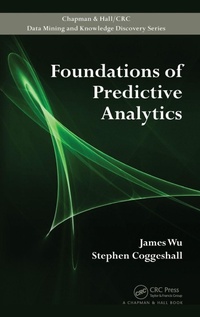
Foundations of Predictive Analytics
1st Edition
Published on 15. February 2012
Book
Hardback
338 pages
978-1-4398-6946-8 (ISBN)
Description
Drawing on the authors' two decades of experience in applied modeling and data mining, Foundations of Predictive Analytics presents the fundamental background required for analyzing data and building models for many practical applications, such as consumer behavior modeling, risk and marketing analytics, and other areas. It also discusses a variety of practical topics that are frequently missing from similar texts.
The book begins with the statistical and linear algebra/matrix foundation of modeling methods, from distributions to cumulant and copula functions to Cornish-Fisher expansion and other useful but hard-to-find statistical techniques. It then describes common and unusual linear methods as well as popular nonlinear modeling approaches, including additive models, trees, support vector machine, fuzzy systems, clustering, naive Bayes, and neural nets. The authors go on to cover methodologies used in time series and forecasting, such as ARIMA, GARCH, and survival analysis. They also present a range of optimization techniques and explore several special topics, such as Dempster-Shafer theory.
An in-depth collection of the most important fundamental material on predictive analytics, this self-contained book provides the necessary information for understanding various techniques for exploratory data analysis and modeling. It explains the algorithmic details behind each technique (including underlying assumptions and mathematical formulations) and shows how to prepare and encode data, select variables, use model goodness measures, normalize odds, and perform reject inference.
Web ResourceThe book's website at www.DataMinerXL.com offers the DataMinerXL software for building predictive models. The site also includes more examples and information on modeling.
The book begins with the statistical and linear algebra/matrix foundation of modeling methods, from distributions to cumulant and copula functions to Cornish-Fisher expansion and other useful but hard-to-find statistical techniques. It then describes common and unusual linear methods as well as popular nonlinear modeling approaches, including additive models, trees, support vector machine, fuzzy systems, clustering, naive Bayes, and neural nets. The authors go on to cover methodologies used in time series and forecasting, such as ARIMA, GARCH, and survival analysis. They also present a range of optimization techniques and explore several special topics, such as Dempster-Shafer theory.
An in-depth collection of the most important fundamental material on predictive analytics, this self-contained book provides the necessary information for understanding various techniques for exploratory data analysis and modeling. It explains the algorithmic details behind each technique (including underlying assumptions and mathematical formulations) and shows how to prepare and encode data, select variables, use model goodness measures, normalize odds, and perform reject inference.
Web ResourceThe book's website at www.DataMinerXL.com offers the DataMinerXL software for building predictive models. The site also includes more examples and information on modeling.
Reviews / Votes
"The book deals with the necessary knowledge for understanding the theoretical and practical aspects regarding the common techniques of exploratory data analysis and modeling. For a better understanding, the underlying assumptions, mathematical formulations, and the algorithms involved by these techniques are presented. The authors made the text self-contained, the book being designed as a supplemental and referential resource for the practitioners dealing with this domain. The book also discusses a variety of practical topics more or less present in the literature." -Book Review by Florin Gorunescu, appearing in Zentralblatt MATH, 1306 | 1More details
Language
English
Place of publication
Oxford
United States
Publishing group
Taylor & Francis Inc
Target group
Professional and scholarly
Academic and Professional Practice & Development
Illustrations
14 b/w images and 43 tables
Dimensions
Height: 240 mm
Width: 161 mm
Thickness: 23 mm
Weight
672 gr
ISBN-13
978-1-4398-6946-8 (9781439869468)
Copyright in bibliographic data and cover images is held by Nielsen Book Services Limited or by the publishers or by their respective licensors: all rights reserved.
Schweitzer Classification
Other editions
Additional editions
James Wu | Stephen Coggeshall
Foundations of Predictive Analytics
Book
09/2019
1st Edition
Chapman & Hall/CRC
€94.30
Shipment within 15-20 days
James Wu | Stephen Coggeshall
Foundations of Predictive Analytics
E-Book
02/2012
1st Edition
Chapman & Hall/CRC
€86.99
Available for download
James Wu | Stephen Coggeshall
Foundations of Predictive Analytics
E-Book
02/2012
Chapman and Hall
€86.99
Available for download
Persons
James Wu is a Fixed Income Quant with extensive expertise in a wide variety of applied analytical solutions in consumer behavior modeling and financial engineering. He previously worked at ID Analytics, Morgan Stanley, JPMorgan Chase, Los Alamos Computational Group, and CASA. He earned a PhD from the University of Idaho.
Stephen Coggeshall is the Chief Technology Officer of ID Analytics. He previously worked at Los Alamos Computational Group, Morgan Stanley, HNC Software, CASA, and Los Alamos National Laboratory. During his over 20 year career, Dr. Coggeshall has helped teams of scientists develop practical solutions to difficult business problems using advanced analytics. He earned a PhD from the University of Illinois and was named 2008 Technology Executive of the Year by the San Diego Business Journal.
Stephen Coggeshall is the Chief Technology Officer of ID Analytics. He previously worked at Los Alamos Computational Group, Morgan Stanley, HNC Software, CASA, and Los Alamos National Laboratory. During his over 20 year career, Dr. Coggeshall has helped teams of scientists develop practical solutions to difficult business problems using advanced analytics. He earned a PhD from the University of Illinois and was named 2008 Technology Executive of the Year by the San Diego Business Journal.
Content
Introduction. Properties of Statistical Distributions. Important Matrix Relationships. Linear Modeling and Regression. Nonlinear Modeling. Time Series Analysis. Data Preparation and Variable Selection. Model Goodness Measures. Optimization Methods. Miscellaneous Topics. Appendices. Bibliography. Index.