

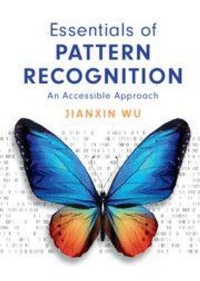
Essentials of Pattern Recognition
An Accessible Approach
Published on 19. November 2020
Book
Hardback
398 pages
978-1-108-48346-9 (ISBN)
Description
This textbook introduces fundamental concepts, major models, and popular applications of pattern recognition for a one-semester undergraduate course. To ensure student understanding, the text focuses on a relatively small number of core concepts with an abundance of illustrations and examples. Concepts are reinforced with hands-on exercises to nurture the student's skill in problem solving. New concepts and algorithms are framed by real-world context and established as part of the big picture introduced in an early chapter. A problem-solving strategy is employed in several chapters to equip students with an approach for new problems in pattern recognition. This text also points out common errors that a new player in pattern recognition may encounter, and fosters the ability for readers to find useful resources and independently solve a new pattern recognition task through various working examples. Students with an undergraduate understanding of mathematical analysis, linear algebra, and probability will be well prepared to master the concepts and mathematical analysis presented here.
Reviews / Votes
'I highly recommend this book to all those computer-science students who mainly focus on deep learning: this is the book they should read, where they can learn the fundamentals and the big picture of pattern recognition, which will benefit them in the long run.' Jianfei Cai, Monash University 'Dr. Wu has written a valuable book that could not be more timely: the commoditization of machine learning is putting increasingly powerful tools for working with data in the hands of an increasingly broad population of users and practitioners. However, using these tools correctly and interpreting their outputs properly still require significant expertise. This book fills the gap between the classic pattern-recognition texts that assume a substantial amount of background knowledge and preparation and the innumerable internet blog posts which are highly accessible but often superficial. I am sure this self-contained and useful book will enjoy widespread adoption, and I recommend it highly.' James M. Rehg, Georgia Institute of Technology 'This well-designed book is both accessible and substantial in content. I highly recommend it as a textbook as well as for self-study.' Zhi-Hua Zhou, Nanjing UniversityMore details
Language
English
Place of publication
Cambridge
United Kingdom
Target group
College/higher education
Professional and scholarly
Product notice
sewn/stitched
Cloth over boards
Illustrations
Worked examples or Exercises
Dimensions
Height: 248 mm
Width: 172 mm
Thickness: 25 mm
Weight
950 gr
ISBN-13
978-1-108-48346-9 (9781108483469)
Copyright in bibliographic data and cover images is held by Nielsen Book Services Limited or by the publishers or by their respective licensors: all rights reserved.
Schweitzer Classification
Other editions
Additional editions
E-Book
11/2020
Cambridge University Press
€52.49
Available for download
Person
Jianxin Wu is a professor in the Department of Computer Science and Technology and the School of Artificial Intelligence at Nanjing University, China. He received his B.S. and M.S. degrees in computer science from Nanjing University and his Ph.D. degree in computer science from the Georgia Institute of Technology. Professor Wu has served as an area chair for the conference on Computer Vision and Pattern Recognition (CVPR), the International Conference on Computer Vision (ICCV), and the AAAI Conference on Artificial Intelligence, and he is an associate editor for the Pattern Recognition journal. His research interests are computer vision and machine learning.
Content
Preface; Notation; Part I. Introduction and Overview: 1. Introduction; 2. Mathematical background; 3. Overview of a pattern recognition system; 4. Evaluation; Part II. Domain-Independent Feature Extraction: 5. Principal component analysis; 6. Fisher's linear discriminant; Part III. Classifiers and Tools: 7. Support vector machines; 8. Probabilistic methods; 9. Distance metrics and data transformations; 10. Information theory and decision trees; Part IV. Handling Diverse Data Formats: 11. Sparse and misaligned data; 12. Hidden Markov model; Part V. Advanced Topics: 13. The normal distribution; 14. The basic idea behind expectation-maximization; 15. Convolutional neural networks; References; Index.