

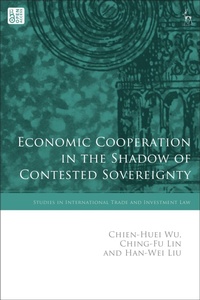
Economic Cooperation in the Shadow of Contested Sovereignty
Will be published approx. on 23. July 2026
Book
Paperback/Softback
248 pages
978-1-5099-7019-3 (ISBN)
Description
This open access book is the first of its kind to address a question of both theoretical and practical significance: how do countries or entities approach economic cooperation in the face of vexing political concerns and overlapping sovereignty claims?
Built upon three contemporary case studies on North-South Korea, China-Taiwan, and North-South Cyprus - representative pairs of 'divided nations', broadly defined - the book explores from both an empirical and a conceptual perspective the underlying factors, approaches and patterns that influence the economic relationship between the two sides.
The book examines complex dynamics and identifies critical factors across the case studies, making a timely contribution to debates surrounding sovereignty, democracy and legitimacy in the context of international economic laws given the shifting geopolitical landscape. It further informs countries that do not share the same features of divided nations but nonetheless experience diplomatic crises or military conflicts, which render their economic cooperation sensitive and strenuous.
This book is a must-read for researchers, trade lawyers, and students in international law and international relations. It also serves as a valuable asset for negotiators, diplomats and policymakers, providing crucial insights for making decisions that can either escalate or de-escalate geopolitical conflicts.
The ebook editions of this book are available open access under a CC BY-NC-ND 4.0 licence on bloomsburycollections.com. Open access was funded by the Academia Sinica Thematic Program.
Built upon three contemporary case studies on North-South Korea, China-Taiwan, and North-South Cyprus - representative pairs of 'divided nations', broadly defined - the book explores from both an empirical and a conceptual perspective the underlying factors, approaches and patterns that influence the economic relationship between the two sides.
The book examines complex dynamics and identifies critical factors across the case studies, making a timely contribution to debates surrounding sovereignty, democracy and legitimacy in the context of international economic laws given the shifting geopolitical landscape. It further informs countries that do not share the same features of divided nations but nonetheless experience diplomatic crises or military conflicts, which render their economic cooperation sensitive and strenuous.
This book is a must-read for researchers, trade lawyers, and students in international law and international relations. It also serves as a valuable asset for negotiators, diplomats and policymakers, providing crucial insights for making decisions that can either escalate or de-escalate geopolitical conflicts.
The ebook editions of this book are available open access under a CC BY-NC-ND 4.0 licence on bloomsburycollections.com. Open access was funded by the Academia Sinica Thematic Program.
More details
Series
Language
English
Place of publication
Oxford
United Kingdom
Publishing group
Bloomsbury Publishing PLC
Target group
Professional and scholarly
College/higher education
Product notice
Paperback (trade)
Unsewn / adhesive bound
Dimensions
Height: 234 mm
Width: 156 mm
Thickness: 25 mm
Weight
454 gr
ISBN-13
978-1-5099-7019-3 (9781509970193)
Copyright in bibliographic data and cover images is held by Nielsen Book Services Limited or by the publishers or by their respective licensors: all rights reserved.
Schweitzer Classification
Persons
Chien-Huei Wu is Research Professor and Fellow of the Institute of European and American Studies, Academia Sinica, Taipei, Taiwan.
Ching-Fu Lin is Professor at the Institute of Law for Science and Technology, and Director of Interdisciplinary Program of Management and Technology, National Tsing Hua University, Taiwan.
Han-Wei Liu is Associate Professor of Law at Singapore Management University and Senior Research Fellow (Adjunct) at Monash University, Australia.
Ching-Fu Lin is Professor at the Institute of Law for Science and Technology, and Director of Interdisciplinary Program of Management and Technology, National Tsing Hua University, Taiwan.
Han-Wei Liu is Associate Professor of Law at Singapore Management University and Senior Research Fellow (Adjunct) at Monash University, Australia.
Content
1. Introduction
2. Cross-Strait Economic Relations
3. Inter-Korean Economic Relations
4. Northern and Southern Cyprus
5. Navigating the Labyrinth: The Complex Interplay of Identity, Democratic Legitimacy, and Changing Geo-Politics
6. Conclusion
2. Cross-Strait Economic Relations
3. Inter-Korean Economic Relations
4. Northern and Southern Cyprus
5. Navigating the Labyrinth: The Complex Interplay of Identity, Democratic Legitimacy, and Changing Geo-Politics
6. Conclusion