

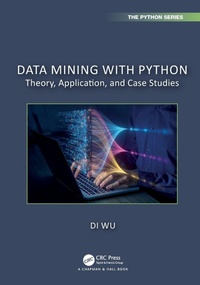
Data Mining with Python
Theory, Application, and Case Studies
1st Edition
Published on 10. April 2024
Book
Paperback/Softback
390 pages
978-1-032-59890-1 (ISBN)
Description
Named an Outstanding Academic Title of 2025 by Choice.
Data is everywhere and it's growing at an unprecedented rate. But making sense of all that data is a challenge. Data Mining is the process of discovering patterns and knowledge from large data sets, and Data Mining with Python focuses on the hands-on approach to learning Data Mining. It showcases how to use Python Packages to fulfill the Data Mining pipeline, which is to collect, integrate, manipulate, clean, process, organize, and analyze data for knowledge.
The contents are organized based on the Data Mining pipeline, so readers can naturally progress step by step through the process. Topics, methods, and tools are explained in three aspects: "What it is" as a theoretical background, "why we need it" as an application orientation, and "how we do it" as a case study.
This book is designed to give students, data scientists, and business analysts an understanding of Data Mining concepts in an applicable way. Through interactive tutorials that can be run, modified, and used for a more comprehensive learning experience, this book will help its readers to gain practical skills to implement Data Mining techniques in their work.
Data is everywhere and it's growing at an unprecedented rate. But making sense of all that data is a challenge. Data Mining is the process of discovering patterns and knowledge from large data sets, and Data Mining with Python focuses on the hands-on approach to learning Data Mining. It showcases how to use Python Packages to fulfill the Data Mining pipeline, which is to collect, integrate, manipulate, clean, process, organize, and analyze data for knowledge.
The contents are organized based on the Data Mining pipeline, so readers can naturally progress step by step through the process. Topics, methods, and tools are explained in three aspects: "What it is" as a theoretical background, "why we need it" as an application orientation, and "how we do it" as a case study.
This book is designed to give students, data scientists, and business analysts an understanding of Data Mining concepts in an applicable way. Through interactive tutorials that can be run, modified, and used for a more comprehensive learning experience, this book will help its readers to gain practical skills to implement Data Mining techniques in their work.
More details
Series
Language
English
Place of publication
United Kingdom
Publishing group
Taylor & Francis Ltd
Target group
Professional and scholarly
College/higher education
Professional Practice & Development
Illustrations
222 farbige Abbildungen, 222 Farbfotos bzw. farbige Rasterbilder
222 Halftones, color; 222 Illustrations, color
Dimensions
Height: 254 mm
Width: 178 mm
Thickness: 22 mm
Weight
779 gr
ISBN-13
978-1-032-59890-1 (9781032598901)
Copyright in bibliographic data and cover images is held by Nielsen Book Services Limited or by the publishers or by their respective licensors: all rights reserved.
Schweitzer Classification
Other editions
Additional editions
Book
04/2024
1st Edition
Chapman & Hall/CRC
€184.30
Shipment within 10-20 days
E-Book
04/2024
1st Edition
Chapman and Hall
€67.49
Available for download
E-Book
04/2024
1st Edition
Chapman and Hall
€67.49
Available for download
Person
Di Wu is an Assistant Professor of Finance, Information Systems, and Economics department of Business School, Lehman College. He obtained a Ph.D. in Computer Science from the Graduate Center, CUNY. Dr. Wu's research interests are 1) Temporal extensions to RDF and semantic web, 2) Applied Data Science, and 3) Experiential Learning and Pedagogy in business education. Dr. Wu developed and taught courses including Strategic Management, Databases, Business Statistics, Management Decision Making, Programming Languages (C++, Java, and Python), Data Structures and Algorithms, Data Mining, Big Data, and Machine Learning.
Content
Section I. Data Wrangling 1. Data Collection. 2. Data Integration 3. Data Statistics 4. Data Visualization 5. Data Preprocessing Section II. Data Analysis 6. Classification 7. Regression 8. Clustering 9. Frequent Patterns 10. Outlier Detection