

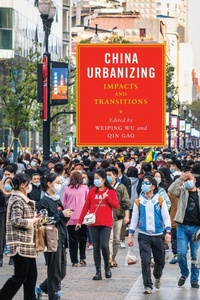
China Urbanizing
Impacts and Transitions
Published on 20. September 2022
Book
Hardback
248 pages
978-1-5128-2301-1 (ISBN)
Description
China turned majority urban only in the recent decade, a dramatic leap given that less than 20 percent of its population lived in cities before 1980. This book situates China's urbanization in the interconnected forces of historical legacies, contemporary state interventions, and human and ecological conditions. It captures the complexity of the phenomenon of urbanization in its historical and regional variations, and explores its impact on the country's socioeconomic welfare, environment and resources, urban form and lifestyle, and population and health. It is also a book about China, in which the contributors provide new perspectives to understand the transitions underway and the gravity of the progress, particularly in the context of demographic shifts and climate change.
The chapters in China Urbanizing, written by American and Chinese scholars, achieve three interconnected aims. The first is to explore how the process of urbanization has shaped and been influenced by the social, economic, and physical interactions that take place in and beyond cities, and the state interventions intended to regulate such interactions. The second is to examine the shifts and evolutions emerging in urban China, such as the economic slowdown, population aging and low fertility rates, and how cities interact with the environment and planet given China's rising role in the global discourse on climate change. The third is to explore new sources of information for conducting research on urban China, such as satellite and street-level imagery data and online listings, to account for the complexity and heterogeneity that characterize contemporary Chinese urbanization.
Contributors: Juan Chen, Dean Curran, Deborah Davis, Peilei Fan, Qin Gao, Pierre F. Landry, Shi Li, Shiqi Ma, Justin Remais, Alan Smart, Shin Bin Tan, Jeremy Wallace, Sarah Williams, Binbin Wu, Weiping Wu, Guibin Xiong, Wenfei Xu.
The chapters in China Urbanizing, written by American and Chinese scholars, achieve three interconnected aims. The first is to explore how the process of urbanization has shaped and been influenced by the social, economic, and physical interactions that take place in and beyond cities, and the state interventions intended to regulate such interactions. The second is to examine the shifts and evolutions emerging in urban China, such as the economic slowdown, population aging and low fertility rates, and how cities interact with the environment and planet given China's rising role in the global discourse on climate change. The third is to explore new sources of information for conducting research on urban China, such as satellite and street-level imagery data and online listings, to account for the complexity and heterogeneity that characterize contemporary Chinese urbanization.
Contributors: Juan Chen, Dean Curran, Deborah Davis, Peilei Fan, Qin Gao, Pierre F. Landry, Shi Li, Shiqi Ma, Justin Remais, Alan Smart, Shin Bin Tan, Jeremy Wallace, Sarah Williams, Binbin Wu, Weiping Wu, Guibin Xiong, Wenfei Xu.
Reviews / Votes
"Readers can gain a rich and in-depth understanding of China's recent urbanization through this book. It covers a wide range of urbanization issues including not only well-studied themes such as rural migrant workers, land, urban housing, and segregation but also novel yet important themes such as environment, health, and digital governance....China Urbanizing can inspire readers to explore a variety of additional issues salient to Chineseurbanization: migrants' children, talent workers, household registration (hukou) and land reforms, urban regeneration, CO2 reduction, COVID-19 impacts, and post-pandemic urbanization. After reading this book, you can understand why China's urbanization remains an important driver of world development.
" (Journal of Urban Affairs)
More details
Series
Language
English
Place of publication
Pennsylvania
United States
Target group
Professional and scholarly
Product notice
Paper over boards
Illustrations
5 bw, 4 maps, 24 tables, 12 charts/graphs
Dimensions
Height: 232 mm
Width: 154 mm
Thickness: 20 mm
Weight
499 gr
ISBN-13
978-1-5128-2301-1 (9781512823011)
Copyright in bibliographic data and cover images is held by Nielsen Book Services Limited or by the publishers or by their respective licensors: all rights reserved.
Schweitzer Classification
Other editions
Additional editions
E-Book
09/2022
1st Edition
University of Pennsylvania Press
from
€173.99
Available for download
Persons
Weiping Wu is Professor and Director of Urban Planning Program in the Graduate School of Architecture, Planning and Preservation at Columbia University.
Qin Gao is Professor of Social Policy and Social Work in the School of Social Work at Columbia University and the founding director of the University's China Center for Social Policy.
Qin Gao is Professor of Social Policy and Social Work in the School of Social Work at Columbia University and the founding director of the University's China Center for Social Policy.
Content
Introduction
Weiping Wu and Qin Gao
1. Paying for Urbanization: Land Finance and Impacts
Weiping Wu
2. Cities for Whom? The 2017 Beijing Demolitions in Context
Shiqi Ma and Jeremy Wallace
3. Housing Markets, Residential Sorting, and Spatial Segregation
Shin Bin Tan, Wenfei Xu, and Sarah Williams
Appendix A. Filtering Criteria
Appendix B. Descriptive Statistics for Fang.com Listings
Appendix C. Calculating Spatial Exposure/Isolation and Spatial Entropy
4. Has the Economic Situation of Rural Migrant Workers in Urban China Been Improving? An Updated Assessment
Shi Li and Binbin Wu
5. Urban Poverty in China: Has Dibao Been an Effective Policy Response?
Qin Gao
6. Implementing the National New-Type Urbanization Plan: Regional Variations
Juan Chen, Pierre F. Landry, and Deborah Davis
7. Dementia or Anomie: What Explains the Missing Older Adults Phenomenon in China?
Guibin Xiong
8. Environmental Impact of Urbanization in Post-Reform China
Peilei Fan
9. Shifting Exposures in China's Urbanization Experience: Implications for Health
Justin Remais
10. Prospects and Social Impact of Big Data-Driven Urban Governance in China: Provincializing Smart City Research
Alan Smart and Dean Curran
List of Contributors
Index
Weiping Wu and Qin Gao
1. Paying for Urbanization: Land Finance and Impacts
Weiping Wu
2. Cities for Whom? The 2017 Beijing Demolitions in Context
Shiqi Ma and Jeremy Wallace
3. Housing Markets, Residential Sorting, and Spatial Segregation
Shin Bin Tan, Wenfei Xu, and Sarah Williams
Appendix A. Filtering Criteria
Appendix B. Descriptive Statistics for Fang.com Listings
Appendix C. Calculating Spatial Exposure/Isolation and Spatial Entropy
4. Has the Economic Situation of Rural Migrant Workers in Urban China Been Improving? An Updated Assessment
Shi Li and Binbin Wu
5. Urban Poverty in China: Has Dibao Been an Effective Policy Response?
Qin Gao
6. Implementing the National New-Type Urbanization Plan: Regional Variations
Juan Chen, Pierre F. Landry, and Deborah Davis
7. Dementia or Anomie: What Explains the Missing Older Adults Phenomenon in China?
Guibin Xiong
8. Environmental Impact of Urbanization in Post-Reform China
Peilei Fan
9. Shifting Exposures in China's Urbanization Experience: Implications for Health
Justin Remais
10. Prospects and Social Impact of Big Data-Driven Urban Governance in China: Provincializing Smart City Research
Alan Smart and Dean Curran
List of Contributors
Index