

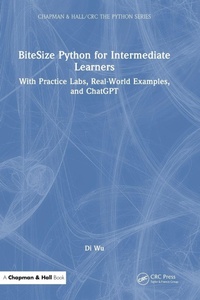
BiteSize Python for Intermediate Learners
With Practice Labs, Real-World Examples, and ChatGPT
1st Edition
Will be published approx. on 16. March 2026
Book
Hardback
352 pages
978-1-041-03684-5 (ISBN)
Description
This book is an introduction to Python for intermediate learners. It allows readers to take a slow and steady approach to building upon their understanding of Python code. While there are many books, websites, and online courses about the topic, Python programming is broken down here into easily digestible lessons of less than 5 minutes each, following a tried and tested BiteSize approach.
Each lesson begins with a clear and concise introduction to the topic, giving the reader a strong base to start from and gets them ready for deeper learning. This is followed by coding demonstrations that further explore the ideas discussed. The book offers practice tasks in different difficulty levels, so readers can test their knowledge and grow their confidence. The reader will also play with case studies to solve real-world problems. Tips on how to incorporate Generative AI into a learning toolkit are provided, for purposes like feedback, practice exercises, code reviews, and exploring advanced topics. Recommended AI prompts can help readers identify areas for improvement, review key concepts, and track progress.
This book is designed for intermediate learners with a basic understanding of Python. It is ideal for individuals with busy schedules or limited time for studying.
Each lesson begins with a clear and concise introduction to the topic, giving the reader a strong base to start from and gets them ready for deeper learning. This is followed by coding demonstrations that further explore the ideas discussed. The book offers practice tasks in different difficulty levels, so readers can test their knowledge and grow their confidence. The reader will also play with case studies to solve real-world problems. Tips on how to incorporate Generative AI into a learning toolkit are provided, for purposes like feedback, practice exercises, code reviews, and exploring advanced topics. Recommended AI prompts can help readers identify areas for improvement, review key concepts, and track progress.
This book is designed for intermediate learners with a basic understanding of Python. It is ideal for individuals with busy schedules or limited time for studying.
More details
Series
Language
English
Place of publication
London
United Kingdom
Publishing group
Taylor & Francis Ltd
Target group
College/higher education
Professional and scholarly
Professional Practice & Development, Professional Reference, and Undergraduate Advanced
Illustrations
9 s/w Tabellen, 165 s/w Zeichnungen, 165 s/w Abbildungen
9 Tables, black and white; 165 Line drawings, black and white; 165 Illustrations, black and white
Dimensions
Height: 260 mm
Width: 183 mm
Thickness: 24 mm
Weight
868 gr
ISBN-13
978-1-041-03684-5 (9781041036845)
Copyright in bibliographic data and cover images is held by Nielsen Book Services Limited or by the publishers or by their respective licensors: all rights reserved.
Schweitzer Classification
Other editions
Additional editions
Book
approx. 03/2026
1st Edition
CRC Press
€74.60
Not yet published
E-Book
03/2026
1st Edition
Chapman and Hall
€68.49
Available for download
E-Book
03/2026
1st Edition
Chapman and Hall
€68.49
Available for download
Person
Dr. Di Wu is an Assistant Professor of Finance, Information Systems, and Economics department of Business School, Lehman College. He obtained a Ph.D. in Computer Science from the Graduate Center, CUNY. Dr. Wu's research interests are 1) Temporal extensions to RDF and semantic web, 2) Applied Data Science, and 3) Experiential Learning and Pedagogy in business education. Dr. Wu developed and taught courses including Strategic Management, Databases, Business Statistics, Management Decision Making, Programming Languages (C++, Java, and Python), Data Structures and Algorithms, Data Mining, Big Data, and Machine Learning.
Content
Section I: Object-Oriented Programming 1. Introduction to OOP 2. Inheritance 3. Polymorphism 4. Encapsulation 5. Abstraction 6. Documentation 7. Case Studies Section II. Data Manipulation 8. N-dimensional Arrays 9. NumPy 10. Series 11. DataFrame 12. Pandas Section III. Data Visualization 13. Matplotlib (Basic) 14. Matplotlib (Advanced) 15. Seaborn 16. Plotly. What is Next? Index