

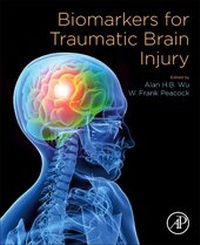
Biomarkers for Traumatic Brain Injury
Published on 11. July 2020
Book
Paperback/Softback
486 pages
978-0-12-816346-7 (ISBN)
Description
Biomarkers for Traumatic Brain Injury provides a comprehensive overview on the selection and implementation of serum-based and saliva-based biomarkers for traumatic brain injury. The book presents an economic analysis for implementing TBI biomarkers into clinical practice. In addition, it discusses the analytical tools needed to implement TBI biomarkers, including specifications for testing instruments and interpretative software. Neurologists, emergency department physicians, intensivists, and clinical laboratorians will find this book a great resource from which to familiarize themselves with the issues and processes regarding TBI biomarkers.
Approximately 2 million people in the U.S. sustain a traumatic brain injury (TBI) each year with over 250,000 hospitalizations and 50,000 deaths. There has been a significant rise in interest in diagnosing mild concussions, particularly in the sports world. While imaging has been the gold standard, these procedures are costly and not always available. There is great potential in using serum-based biomarkers, hence the book seeks to enlighten readers on new possibilities.
Approximately 2 million people in the U.S. sustain a traumatic brain injury (TBI) each year with over 250,000 hospitalizations and 50,000 deaths. There has been a significant rise in interest in diagnosing mild concussions, particularly in the sports world. While imaging has been the gold standard, these procedures are costly and not always available. There is great potential in using serum-based biomarkers, hence the book seeks to enlighten readers on new possibilities.
Reviews / Votes
"This book does a satisfactory job of serving as an introductory reference on traumatic brain injury and associated biomarkers available or in the works. My preferred reference is Textbook of Traumatic Brain Injury, 3rd edition, Silver et al. (American Psychiatric Association Publishing, 2019,) both for its breadth and detailed information. Brain Injury Medicine: Principles and Practice, 2nd edition, Zasler et al. (Springer Publishing Company, 2013) is also a good alternative. Although these two do not strictly cover TBI, they have better organization, more comprehensive information, and better readability." --DoodyMore details
Language
English
Place of publication
San Diego
United States
Publishing group
Elsevier Science Publishing Co Inc
Target group
Professional and scholarly
researchers in neurologic diseases, neurologists, emergency department physicians, intensivists, and clinical laboratorians
Dimensions
Height: 235 mm
Width: 191 mm
Weight
950 gr
ISBN-13
978-0-12-816346-7 (9780128163467)
Copyright in bibliographic data and cover images is held by Nielsen Book Services Limited or by the publishers or by their respective licensors: all rights reserved.
Schweitzer Classification
Other editions
Additional editions
Alan H. B. Wu | W. Frank Peacock MD
Biomarkers for Traumatic Brain Injury
E-Book
07/2020
Academic Press
€131.00
Available for download
Persons
Dr. Alan Wu is a Professor of Laboratory Medicine at the University of California at San Francisco. He is the Co-Director of the Core Laboratory at the Zuckerberg San Francisco General Hospital. His research is focused on biomarkers of cardiovascular disease, clinical toxicology, and pharmacogenomics. In this capacity, his clinical and research laboratory conducts testing for routine analytes in blood, urine and cerebral spinal fluid for electrolytes, metabolites, hormones, proteins, and biomarkers. His particular area of interest is in cardiac biomarkers for acute cardiac diseases. He received a B.S. in both Chemistry and Biology at Purdue University and a Ph.D. in Analytical Chemistry at the University of Illinois. He was a professor at the University of Texas and the University of Connecticut prior to his current position at UCSF. W. Frank Peacock IV, MD, FACEP, FACC is a Professor of Emergency Medicine and Vice Chair for Research in the department of Emergency Medicine at Baylor College of Medicine, in Houston, Texas. He has >500 publications, is a two-time winner of the Best Research Paper of the Year Award from the American College of Emergency Physicians, and the 2019 Ray Bahr Award for Excellence from the American College of Cardiology. Finally, he is the founder of Comprehensive Research Associates, LLC, and Emergencies in Medicine, LLC.
Content
Section I. INTRODUCTION
1. Introduction-scope of the problem
2. The need for traumatic brain injury markers
3. Regulatory considerations for diagnostics and biomarkers of traumatic brain injury
Section II. PATHOPHYSIOLOGY OF TBI
4. Peripheral markers of TBI and blood-brain barrier disruption
5. The role of autoimmunity after traumatic brain injury
6. Traumatic brain injury: glial fibrillary acidic protein posttranslational
modification
SECTION III. TBI BIOMARKERS IN MEDICAL PRACTICE
7. Economics of traumatic brain injury biomarkers
8. Electrophysiology monitoring
9. Traumatic brain injury therapeutics
SECTION IV. CLASSICAL TBI BIOMARKERS
10. S100 biomarkers in patients with traumatic brain injury
11. Pathophysiology and clinical implementation of traumatic brain injury biomarkers: neuron-specific enolase
12. Traumatic brain injury biomarkers glial fibrillary acidic protein/ubiquitin C-terminal hydrolase L1
13. Neurofilaments light chain/Neurofilaments heavy chain
14. Tau protein, biomarker for traumatic brain injury
SECTION V. NOVEL TBI BIOMARKERS
15. Neurogranin
16. Myelin basic protein in traumatic brain injury
SECTION VI. ANALYTICAL TESTING CONSIDERATION
17. Antibody selection, evaluation, and validation for analysis of traumatic brain injury biomarkers
18. Sensitive immunoassay testing platforms
19. Clinical mass spectrometry and its applications in traumatic brain injuries
20. Surface plasmon resonance
21. Point-of-care testing for concussion and traumatic brain injury
SECTION VII. NON-BLOOD TBI BIOMARKER STRATEGY
22. Clinical risk factors of traumatic brain injury
23. Saliva biomarkers of traumatic brain injury
24. Digital neurocognitive testing
25. Electroencephalographic as a biomarker of concussion
26. Neuropsychological testing
27. Outpatient risk stratification for traumatic brain injury
28. Peptidomics and traumatic brain injury: biomarker utilities for a theragnostic approach
29. Autoantibodies in central nervous system trauma: new frontiers for diagnosis and prognosis biomarkers
1. Introduction-scope of the problem
2. The need for traumatic brain injury markers
3. Regulatory considerations for diagnostics and biomarkers of traumatic brain injury
Section II. PATHOPHYSIOLOGY OF TBI
4. Peripheral markers of TBI and blood-brain barrier disruption
5. The role of autoimmunity after traumatic brain injury
6. Traumatic brain injury: glial fibrillary acidic protein posttranslational
modification
SECTION III. TBI BIOMARKERS IN MEDICAL PRACTICE
7. Economics of traumatic brain injury biomarkers
8. Electrophysiology monitoring
9. Traumatic brain injury therapeutics
SECTION IV. CLASSICAL TBI BIOMARKERS
10. S100 biomarkers in patients with traumatic brain injury
11. Pathophysiology and clinical implementation of traumatic brain injury biomarkers: neuron-specific enolase
12. Traumatic brain injury biomarkers glial fibrillary acidic protein/ubiquitin C-terminal hydrolase L1
13. Neurofilaments light chain/Neurofilaments heavy chain
14. Tau protein, biomarker for traumatic brain injury
SECTION V. NOVEL TBI BIOMARKERS
15. Neurogranin
16. Myelin basic protein in traumatic brain injury
SECTION VI. ANALYTICAL TESTING CONSIDERATION
17. Antibody selection, evaluation, and validation for analysis of traumatic brain injury biomarkers
18. Sensitive immunoassay testing platforms
19. Clinical mass spectrometry and its applications in traumatic brain injuries
20. Surface plasmon resonance
21. Point-of-care testing for concussion and traumatic brain injury
SECTION VII. NON-BLOOD TBI BIOMARKER STRATEGY
22. Clinical risk factors of traumatic brain injury
23. Saliva biomarkers of traumatic brain injury
24. Digital neurocognitive testing
25. Electroencephalographic as a biomarker of concussion
26. Neuropsychological testing
27. Outpatient risk stratification for traumatic brain injury
28. Peptidomics and traumatic brain injury: biomarker utilities for a theragnostic approach
29. Autoantibodies in central nervous system trauma: new frontiers for diagnosis and prognosis biomarkers