

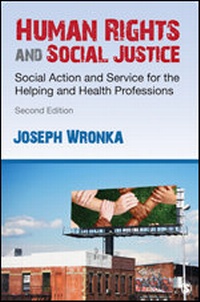
Human Rights and Social Justice
Social Action and Service for the Helping and Health Professions
2nd Edition
Published on 29. September 2017
Book
Paperback/Softback
472 pages
978-1-4833-8717-8 (ISBN)
Description
Offering a unique perspective that views human rights as the foundation of social justice, Joseph Wronka's groundbreaking text outlines human rights and social justice concerns as a powerful conceptual framework for policy and practice interventions for the helping and health professions. This highly accessible, interdisciplinary text urges the creation of a human rights culture as a "lived awareness" of human rights principles, including human dignity, nondiscrimination, civil and political rights, economic, social, and cultural rights, and solidarity rights. The Second Edition includes numerous social action activities and questions for discussion to help scholars, activists, and practitioners promote a human rights culture and the overall well-being of populations across the globe.
Intended Audience
This text is applicable for courses in social work, psychology, sociology, public health, law, medicine, philosophy, political science, as well as "newer" disciplines like peace studies, world citizenship, and environmental sustainability. Scholars, activists, and practitioners will find it a valuable reference for years to come.
Intended Audience
This text is applicable for courses in social work, psychology, sociology, public health, law, medicine, philosophy, political science, as well as "newer" disciplines like peace studies, world citizenship, and environmental sustainability. Scholars, activists, and practitioners will find it a valuable reference for years to come.
Reviews / Votes
"Many UN experts and human rights activists worldwide warmly welcome the publication of the Second Edition of Dr. Wronka's Human Rights and Social Justice, an inspiring if not brilliant work . . . Written for the educated layperson, it builds on the momentum it began in the original edition, excellently integrating both theory and practice, in this case, for the helping and health professions, but in ways that could also have implications for other traditional academic disciplines and 'newer' ones like peace and environmental studies, world citizenship, and global distributive justice." -- Alfred de Zayas "Human Rights and Social Justice is a compendium of ideas, reflections, strategies, and insights-a great resource for learners and enjoyable read for the curious." -- Ana M. Sobocan "Joseph Wronka is truly a social work scholar and visionary of integrating human rights in the helping and health professions. His transdisciplinary approach offers a tangible model to realizing rights for all people in all places." -- Tina Maschi "A must-read for anyone in the helping professions who is interested in human rights and social justice." -- Margaret Lombe "The background and history of human rights is superior to other textbooks that I have seen in this area." -- Jessica Jablonski This book is a must for those who are working to make human rights an overarching way of life around the world. -- Shulamith KoenigMore details
Edition
2nd Revised edition
Language
English
Place of publication
Thousand Oaks
United States
Target group
College/higher education
Edition type
Revised edition
Dimensions
Height: 229 mm
Width: 152 mm
Weight
643 gr
ISBN-13
978-1-4833-8717-8 (9781483387178)
Copyright in bibliographic data and cover images is held by Nielsen Book Services Limited or by the publishers or by their respective licensors: all rights reserved.
Schweitzer Classification
Other editions
Previous edition
Joseph M. Wronka
Human Rights and Social Justice
Social Action and Service for the Helping and Health Professions
Book
02/2008
1st Edition
SAGE Publications Inc
€86.85
Article exhausted; check for reprint
Person
Dr. Joseph Wronka is Professor of Social Work, Springfield College, Springfield, MA, Representative to the United Nations in Geneva for the International Association of Schools of Social Work (IASSW) and part-time representative for the People's Movement for Human Rights Learning to the UN in New York. He is also President of Human Rights Action International (HRAI). Dr. Wronka received a Fulbright Senior Specialist award, in the discipline of social work with specialities in social justice and poverty and sub specialities in human rights, psychology, and existential-phenomenology. In 2015 he went to Pakistan and Austria as a Fulbright Scholar. Select academic appointments included: West Georgia College, St. Francis College, New York University, Caldwell College, Ramapo College, Chukchi Community College, the University of Alaska, Fairbanks, Kotzebue Technical Center, College of the Holy Cross, Simmons, Boston College, and in Europe, Fachhochschule at Berne and Zurich, Switzerland; Vienna, Sankt-Poelton, and Innsbruck, Austria; and Hanover, Germany. He was also Visiting Scholar at Brandeis University and Visiting Fellow at the University of Delhi, India. He was also a counselor at alcoholism and methadone maintenance treatment centers; clinician in community mental health centers and in private practice; director of a mental health/substance abuse center; human rights commissioner; Vice President of the World Citizen Foundation; board member to the Coalition for a Strong United Nations and Amherst Media, where he is presently producer of "Creating a Human Rights Culture". His website is: www.humanrightsculture.org
Published widely in scholarly and popular fora, he has presented his work in roughly eighteen countries. His interest is primarily the development of social change strategies to implement human rights principles, in other words, the creation of a human rights culture which he views as the pillars of social justice. Such principles mirror substantively millennia of teaching in various spiritual and ethical belief systems, which assert ultimately that every person, everywhere ought to be guaranteed their human rights, and live with human dignity and to their potential, without discrimination. At times, he refers to himself as an "adventure junkie." He also likes to travel, swim laps; kayak; fish; ride his bike; and play classical music on the piano and concert and ethnic pieces on the accordion.
Published widely in scholarly and popular fora, he has presented his work in roughly eighteen countries. His interest is primarily the development of social change strategies to implement human rights principles, in other words, the creation of a human rights culture which he views as the pillars of social justice. Such principles mirror substantively millennia of teaching in various spiritual and ethical belief systems, which assert ultimately that every person, everywhere ought to be guaranteed their human rights, and live with human dignity and to their potential, without discrimination. At times, he refers to himself as an "adventure junkie." He also likes to travel, swim laps; kayak; fish; ride his bike; and play classical music on the piano and concert and ethnic pieces on the accordion.
Content
Part I: Human Rights as the Bedrock of Social Justice
Chapter 1: Introduction
Rationale for This Work
Toward the Creation of a Human Rights Culture
Five Core Notions of Human Rights
Social Justice as Struggle
Some Initial Provisos for the Human Rights Defender
Political Argument--Don't Be Fooled
Summary
Questions for Discussion
Activities/Actions
Notes
Chapter 2: Before and Beyond the Universal Declaration of Human Rights
Toward a History of the Idea of Human Rights
Antiquity
The Middle Ages
The Renaissance
The Age of Enlightenment
The Age of Industrialization
Select Input Prior to the Endorsement of the Universal Declaration
Select Core Principles of Some Major Human Rights Documents
Other Human Rights Regimes
Implementation
Universal Periodic Review (UPR)
Summary
Questions for Discussion
Activities/Actions
Notes
Part II: Building from the Foundation
Chapter 3: An Advanced Generalist/Public Health Model and Whole Population Approaches to Human Rights and Social Justice
A Helping and Health Profession Model of Intervention
Levels of Intervention
The Struggle to Implement Levels of Intervention
Education Toward the Creation of a Human Rights Culture
Commemorating Major International Days
Proclamations, Resolutions, Declarations, and Bills
Providing NGO Input
The Arts, Human Rights, and Social Justice
Other Select Direct Nonviolent Strategies
Summary
Questions for Discussion
Activities/Actions
Notes
Chapter 4: At-Risk and Clinical Social Action and Service Strategies Toward the Creation of a Human Rights Culture
The Helping and Health Professions as an At-Risk Group
Business and Human Rights
Humanistic Administration
Social Entrepreneurship
Grant Writing
Principles for the Protection of Persons With Mental Illness
Toward a Socially Just Human Rights-Based Approach to Clinical Practice
Human Rights Principles That Have Implications for the Therapeutic Relationship
Some Words on the Meta-Micro Level
Summary
Questions for Discussion
Activites/Actions
Notes
Chapter 5: A Human Rights/Social Justice Approach to Research-Action Projects for the Helping and Health Professions
Human Rights Documents as a Means of Defining the Problem
The Universal Declaration of Human Rights Project
Toward a Culture of Informed Consent
Quantitative Research
Qualitative Research
Research Leading to Social Action
Summary
Questions for Discussion
Activities/Actions
Notes
Chapter 6: Ground Rules
Toward the Paradoxical Commandments
Some Ground Rules for Social Action and Service
Conclusion
Questions for Discussion
Activity/Action
Note
Chapter 7: Redux: A Human Rights/Social Justice Approach to Policy Assessment and Direct Non-Violent Social Action
The World Drug Problem
Chapter as a Synopsis
Steps Actually a Misnomer
A Human Rights/Social Justice Approach to Policy Assessment and Direct Non-Violent Action as Pertaining to Illicit Drug Abuse
Chapter 1: Introduction
Rationale for This Work
Toward the Creation of a Human Rights Culture
Five Core Notions of Human Rights
Social Justice as Struggle
Some Initial Provisos for the Human Rights Defender
Political Argument--Don't Be Fooled
Summary
Questions for Discussion
Activities/Actions
Notes
Chapter 2: Before and Beyond the Universal Declaration of Human Rights
Toward a History of the Idea of Human Rights
Antiquity
The Middle Ages
The Renaissance
The Age of Enlightenment
The Age of Industrialization
Select Input Prior to the Endorsement of the Universal Declaration
Select Core Principles of Some Major Human Rights Documents
Other Human Rights Regimes
Implementation
Universal Periodic Review (UPR)
Summary
Questions for Discussion
Activities/Actions
Notes
Part II: Building from the Foundation
Chapter 3: An Advanced Generalist/Public Health Model and Whole Population Approaches to Human Rights and Social Justice
A Helping and Health Profession Model of Intervention
Levels of Intervention
The Struggle to Implement Levels of Intervention
Education Toward the Creation of a Human Rights Culture
Commemorating Major International Days
Proclamations, Resolutions, Declarations, and Bills
Providing NGO Input
The Arts, Human Rights, and Social Justice
Other Select Direct Nonviolent Strategies
Summary
Questions for Discussion
Activities/Actions
Notes
Chapter 4: At-Risk and Clinical Social Action and Service Strategies Toward the Creation of a Human Rights Culture
The Helping and Health Professions as an At-Risk Group
Business and Human Rights
Humanistic Administration
Social Entrepreneurship
Grant Writing
Principles for the Protection of Persons With Mental Illness
Toward a Socially Just Human Rights-Based Approach to Clinical Practice
Human Rights Principles That Have Implications for the Therapeutic Relationship
Some Words on the Meta-Micro Level
Summary
Questions for Discussion
Activites/Actions
Notes
Chapter 5: A Human Rights/Social Justice Approach to Research-Action Projects for the Helping and Health Professions
Human Rights Documents as a Means of Defining the Problem
The Universal Declaration of Human Rights Project
Toward a Culture of Informed Consent
Quantitative Research
Qualitative Research
Research Leading to Social Action
Summary
Questions for Discussion
Activities/Actions
Notes
Chapter 6: Ground Rules
Toward the Paradoxical Commandments
Some Ground Rules for Social Action and Service
Conclusion
Questions for Discussion
Activity/Action
Note
Chapter 7: Redux: A Human Rights/Social Justice Approach to Policy Assessment and Direct Non-Violent Social Action
The World Drug Problem
Chapter as a Synopsis
Steps Actually a Misnomer
A Human Rights/Social Justice Approach to Policy Assessment and Direct Non-Violent Action as Pertaining to Illicit Drug Abuse