

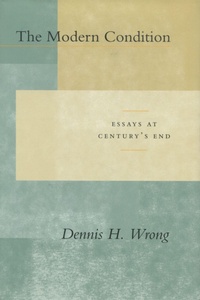
The Modern Condition
Essays at Century's End
Published on 1. April 1998
Book
Hardback
264 pages
978-0-8047-3239-0 (ISBN)
Description
In this collection, a leading sociologist brings his distinctive method of social criticism to bear on some of the most significant ideas, political and social events, and thinkers of the late twentieth century. Of the seventeen essays, two are published for the first time, and several of the previously published essays have been expanded and updated for this volume.
In the first section, the author critiques several concepts that have figured prominently in political-ideological controversies-capitalism, rationality, totalitarianism, power, alienation, left and right, and cultural relativism/multiculturalism. He considers their origins, historical shifts in their meaning and the myths surrounding them, and their subtle resonance beyond their formal definitions.
The second section highlights the author's lifelong interest in the relation of intellectuals to social classes and institutions. The author critically assesses the notion of a "New Class" in which intellectuals have been alleged to play a prominent role, considers the implications for class structure of the increasing centering of intellectual life in the university, and assesses the relation of sociology to professional jargon. The final essays in this section discuss four influential thinkers: David Riesman, Daniel Bell, Christopher Lasch, and Allan Bloom. The book closes with an autobiographical statement centered on the author's intellectual-political life.
In the first section, the author critiques several concepts that have figured prominently in political-ideological controversies-capitalism, rationality, totalitarianism, power, alienation, left and right, and cultural relativism/multiculturalism. He considers their origins, historical shifts in their meaning and the myths surrounding them, and their subtle resonance beyond their formal definitions.
The second section highlights the author's lifelong interest in the relation of intellectuals to social classes and institutions. The author critically assesses the notion of a "New Class" in which intellectuals have been alleged to play a prominent role, considers the implications for class structure of the increasing centering of intellectual life in the university, and assesses the relation of sociology to professional jargon. The final essays in this section discuss four influential thinkers: David Riesman, Daniel Bell, Christopher Lasch, and Allan Bloom. The book closes with an autobiographical statement centered on the author's intellectual-political life.
Reviews / Votes
"For almost fifty years, Wrong may well have been the single most consistent voice for good sense and moderation in both the fevered circles of the New York intelligentsia and the discipline of sociology. He brings to his analyses a unique combination of historical perspective and a temperamental inclination to cut through the hype. As a result, whether he is reconsidering past events or arguments (McCarthyism, Hannah Arendt's characterization of totalitarianism, David Riesman's The Lonely Crowd) or assessing current events and fads (rational choice theory, postmodernism, Allan Bloom's lament about the state of the 'American Mind'), Wrong invariably ends up providing a new, balanced perspective where none existed before." -Axel van den Berg,McGill UniversityMore details
Language
English
Place of publication
Palo Alto
United States
Target group
College/higher education
Professional and scholarly
Product notice
sewn/stitched
Cloth over boards
Dimensions
Height: 225 mm
Width: 147 mm
Thickness: 21 mm
Weight
481 gr
ISBN-13
978-0-8047-3239-0 (9780804732390)
Copyright in bibliographic data and cover images is held by Nielsen Book Services Limited or by the publishers or by their respective licensors: all rights reserved.
Schweitzer Classification
Content
Part I. Concepts and Realities: 1. Disaggregating the idea of capitalism; 2. Is rational choice humanity's most distinctive trait?; 3. Hannah Adrendt on totalitarianism; 4. The concept of power: boundless or delimited?; 5. Myths of alienation; 6. The politics of left and right; 7. Cultural relativism as ideology; Part II. Intellectuals and Middle Classes: 8. The new class: does it exist? 9. Knowledge and power: intellectuals, Universities, and the class structure; 10. The influence of sociological ideas on American culture; 11. Professional jargon: is sociology the culprit? 12. The New York intellectuals and McCarthyism; 13. David Riesman: The Lonely Crowd revisited; 14. Daniel Bell: a specialist in generalizations; 15. Christopher Lasch: is progress a delusion? 16. Allan Bloom: the paperbacking of the American mind; Autobiographical coda; 17. 'As we grow older the world becomes stranger'; Notes; Bibliography; Sources.