

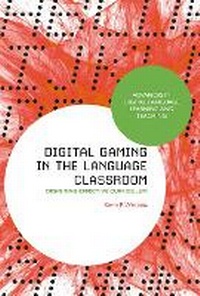
Digital Gaming in the Language Classroom
Designing Effective Curricula
Will be published approx. on 19. February 2026
Book
Hardback
240 pages
978-1-350-41592-8 (ISBN)
Description
This book examines how single-player role-playing digital games can promote foreign language acquisition and looks at how they can be integrated into the curricula of foreign language classrooms.
As the commercialization of digital games continues to expand and accelerate, some research in digital game-based learning has shifted from creating digital games with pedagogical applications to adopting commercial off-the-shelf digital games for pedagogical purposes. Relevant literature has continually identified massively multi-player online role-playing games (MMORPGs) as a specific genre which may benefit second language acquisition (SLA), primarily through a sociocultural perspective whereby language learners interact with linguistically more capable peers within the context of the game. However, there is a gap in research regarding whether these benefits to SLA are limited to social gameplay mechanics.
Wrobetz addresses this gap in research by using the smartphone edition of the single-player role-playing game (RGP) Life Is Strange in a mixed-methods study, measuring vocabulary acquisition and long-term retention from gameplay relative to controls. The author also examines how the perception of both smartphone gaming as a language-learning tool and the target language culture shifted throughout the study.
This volume helps guide future research in digital games-based language learning to broaden the scope of games identified as being conducive to SLA. It also outlines how to structure formal foreign language curricula around the use of a single-player RPG to achieve the most desirable pedagogical outcomes.
As the commercialization of digital games continues to expand and accelerate, some research in digital game-based learning has shifted from creating digital games with pedagogical applications to adopting commercial off-the-shelf digital games for pedagogical purposes. Relevant literature has continually identified massively multi-player online role-playing games (MMORPGs) as a specific genre which may benefit second language acquisition (SLA), primarily through a sociocultural perspective whereby language learners interact with linguistically more capable peers within the context of the game. However, there is a gap in research regarding whether these benefits to SLA are limited to social gameplay mechanics.
Wrobetz addresses this gap in research by using the smartphone edition of the single-player role-playing game (RGP) Life Is Strange in a mixed-methods study, measuring vocabulary acquisition and long-term retention from gameplay relative to controls. The author also examines how the perception of both smartphone gaming as a language-learning tool and the target language culture shifted throughout the study.
This volume helps guide future research in digital games-based language learning to broaden the scope of games identified as being conducive to SLA. It also outlines how to structure formal foreign language curricula around the use of a single-player RPG to achieve the most desirable pedagogical outcomes.
More details
Series
Language
English
Place of publication
London
United Kingdom
Publishing group
Bloomsbury Publishing PLC
Target group
Professional and scholarly
Illustrations
10 bw illus
Dimensions
Height: 234 mm
Width: 156 mm
ISBN-13
978-1-350-41592-8 (9781350415928)
Copyright in bibliographic data and cover images is held by Nielsen Book Services Limited or by the publishers or by their respective licensors: all rights reserved.
Schweitzer Classification
Person
Kevin R. Wrobetz is Associate Professor in the Department of Business Administration at Kobe Gakuin University, Hyogo, Japan. His primary area of research is digital game-based language learning with a focus on the psycholinguistic effects of gameplay mechanics on target language vocabulary acquisition.
Content
List of Figures
List of Tables
List of Terminology
1. Introduction to Using Digital Games in Education
2. Game and Platform Selection for the Foreign Language Classroom
3. Life Is Strange as a Language Learning Tool
4. Life Is Strange as an Instructional Medium
5. Effects of the Life Is Strange Curriculum
6. Considerations of the Life Is Strange Curriculum
References
Appendices
List of Tables
List of Terminology
1. Introduction to Using Digital Games in Education
2. Game and Platform Selection for the Foreign Language Classroom
3. Life Is Strange as a Language Learning Tool
4. Life Is Strange as an Instructional Medium
5. Effects of the Life Is Strange Curriculum
6. Considerations of the Life Is Strange Curriculum
References
Appendices