

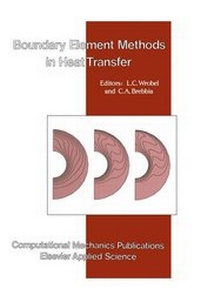
Boundary Element Methods in Heat Transfer
Published in April 1992
Book
Hardback
XII, 294 pages
978-1-85166-726-0 (ISBN)
Description
Heat transfer problems in industry are usually of a very complex nature, simultaneously involving different transfer modes such as conduction, convection, radiation and others. Because of this, very few problems can be solved analytically and one generally has to resort to numerical analysis. The boundary element method is a numerical technique which has been receiving growing attention for solving heat transfer problems because of its unique ability to confine the discretization process to the boundaries of the problem region. This allows major reductions in the data preparation and computer effort necessary to solve complex industrial problems. The purpose of this book is to present efficient algorithms used in conjunction with the boundary element method for the solution of steady and transient, linear and non-linear heat transfer problems. It represents the state-of-the-art of boundary element applications in the field of heat transfer, and constitutes essential reading for researchers and practising engineers involved with this important topic.
More details
Series
Language
English
Place of publication
Dordrecht
Netherlands
Publishing group
Kluwer Academic Publishers Group
Target group
College/higher education
Professional and scholarly
Illustrations
biography
Dimensions
Height: 24.4 cm
Width: 17 cm
Weight
640 gr
ISBN-13
978-1-85166-726-0 (9781851667260)
DOI
10.1007/978-94-011-2902-2
Schweitzer Classification
Other editions
Additional editions
Wrobel | C.A. Brebbia
Boundary Element Methods in Heat Transfer
E-Book
12/2012
Springer
€82.38
Available for download
Content
Preface. Solving heat transfer problems by the dual reciprocity BEM. Transient problems using time-dependent fundamental solutions. Solving linear heat conduction problems by the multiple reciprocity method. Solving nonlinear heat transfer problems using the boundary element method. Coupled conduction-convection problems. Solving coupled problems involving conduction, convection and thermal radiation. Advanced thermoelastic analysis. Integral equation analyses of natural convection problems in fluid flow. Improperly posed problems in heat transfer. Acknowledgments. References.