

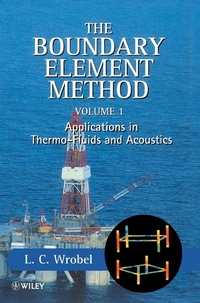
The Boundary Element Method, Volume 1
Applications in Thermo-Fluids and Acoustics
Published on 12. March 2002
Book
Hardback
472 pages
978-0-471-72039-3 (ISBN)
Description
The boundary element method (BEM) is a modern numerical techniquewhich has enjoyed increasing popularity over the last two decades,and is now an established alternative to traditional computationalmethods of engineering analysis. The main advantage of the BEM isits unique ability to provide a complete solution in terms ofboundary values only, with substantial savings in modelling effort.
This two-volume book set is designed to provide the readers with acomprehensive and up-to-date account of the boundary element methodand its application to solving engineering problems. Each volume isa self-contained book including a substantial amount of materialnot previously covered by other text books on the subject. Volume 1covers applications to heat transfer, acoustics, electrochemistryand fluid mechanics problems, while volume 2 concentrates on solidsand structures, describing applications to elasticity, plasticity,elastodynamics, fracture mechanics and contact analysis. The earlychapters are designed as a teaching text for final yearundergraduate courses. Both volumes reflect the experience of theauthors over a period of more than twenty years of boundary element research.
This volume, Applications in Thermo-Fluids and Acoustics, provides acomprehensive presentation of the BEM from fundamentals to advancedengineering applications and encompasses:
Steady and transient heat transfer
Potential and viscous fluid flows
Frequency and time-domain acoustics
Corrosion and other electrochemical problems.
A unique feature of this book is an in-depth presentation of BEMformulations in all the above fields, including detaileddiscussions of the basic theory, numerical algorithms and practicalengineering applications of the method.
Written by an internationally recognised authority in the field,this is essential reading for postgraduates, researchers andpractitioners in civil, mechanical and chemical engineering andapplied mathematics.
This two-volume book set is designed to provide the readers with acomprehensive and up-to-date account of the boundary element methodand its application to solving engineering problems. Each volume isa self-contained book including a substantial amount of materialnot previously covered by other text books on the subject. Volume 1covers applications to heat transfer, acoustics, electrochemistryand fluid mechanics problems, while volume 2 concentrates on solidsand structures, describing applications to elasticity, plasticity,elastodynamics, fracture mechanics and contact analysis. The earlychapters are designed as a teaching text for final yearundergraduate courses. Both volumes reflect the experience of theauthors over a period of more than twenty years of boundary element research.
This volume, Applications in Thermo-Fluids and Acoustics, provides acomprehensive presentation of the BEM from fundamentals to advancedengineering applications and encompasses:
Steady and transient heat transfer
Potential and viscous fluid flows
Frequency and time-domain acoustics
Corrosion and other electrochemical problems.
A unique feature of this book is an in-depth presentation of BEMformulations in all the above fields, including detaileddiscussions of the basic theory, numerical algorithms and practicalengineering applications of the method.
Written by an internationally recognised authority in the field,this is essential reading for postgraduates, researchers andpractitioners in civil, mechanical and chemical engineering andapplied mathematics.
More details
Edition
Volume 1 edition
Language
English
Place of publication
New York
United States
Target group
College/higher education
Professional and scholarly
Product notice
sewn/stitched
Cloth over boards
Dimensions
Height: 250 mm
Width: 175 mm
Thickness: 30 mm
Weight
982 gr
ISBN-13
978-0-471-72039-3 (9780471720393)
Copyright in bibliographic data and cover images is held by Nielsen Book Services Limited or by the publishers or by their respective licensors: all rights reserved.
Schweitzer Classification
Person
Luiz Carlos Wrobel, Brazilian civil engineer. Certified civil engineer. Fellow Institute of Mathematics and Applications; member Brazilian Society Engineers and Architects, Brazilian Society Mechanical Sciences, Brazilian Society Water Resources. Wrobel, Luiz Carlos was born on July 28, 1953 in Niteroi, Brazil. Arrived in England, 1989. Bachelor of Science, University Federal Fluminense, 1974. Master of Science, University Federal do Rio de Janeiro, 1977. Doctor of Philosophy, University Southampton, 1981. Engineer Construction Wrobel Hilf, Rio de Janeiro, 1973-1976, Engenheiros Associates, Rio de Janeiro, 1976-1977. Lecturer University Federal do Rio de Janeiro, 1981-1996. Professor department mechanical engineering Brunel University, Uxbridge, England, since 1996. Reader computational mechanics Wessex Institute of Technology, Southampton, England, 1989-1996. Environmental consultant Rio de Janeiro City Council, 1988-1989. Fellow Institute of Mathematics and Applications. Member Brazilian Society Engineers and Architects, Brazilian Society Mechanical Sciences, Brazilian Society Water Resources.
Content
Preface
Preface to Volume 1
Acknowledgements
Introduction
Potential Problems
Steady Heat Transfer
Transient Heat Transfer
Acoustics
Electrochemical Problems
Flow of Ideal Fluids
Slow Viscous Flow
General Viscous Flow
Inverse Problems
Numerical Integration
Index
Preface to Volume 1
Acknowledgements
Introduction
Potential Problems
Steady Heat Transfer
Transient Heat Transfer
Acoustics
Electrochemical Problems
Flow of Ideal Fluids
Slow Viscous Flow
General Viscous Flow
Inverse Problems
Numerical Integration
Index