

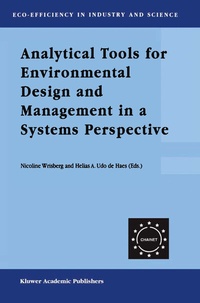
Analytical Tools for Environmental Design and Management in a Systems Perspective
The Combined Use of Analytical Tools
Published on 2. November 2012
Book
Paperback/Softback
XII, 275 pages
978-94-010-3902-4 (ISBN)
Description
The aim of this book is to link demand and supply of environmental information in the field of Life Cycle Management. The book is based on the results of the CHAINET concerted action financed by EU-DGXII for the work period 1998-2000, and is intended to build bridges between the different scientific communities in the field of Life Cycle Management. A structured approach is followed, meaning that both demand and supply of environmental information are characterised, after which the two are linked.
More details
Series
Edition
Softcover reprint of the original 1st ed. 2002
Language
English
Place of publication
Dordrecht
Netherlands
Target group
Professional and scholarly
Research
Illustrations
XII, 275 p.
Dimensions
Height: 235 mm
Width: 155 mm
Thickness: 16 mm
Weight
446 gr
ISBN-13
978-94-010-3902-4 (9789401039024)
DOI
10.1007/978-94-010-0456-5
Schweitzer Classification
Other editions
Additional editions
Nicoline Wrisberg | Helias A. Udo de Haes | Ursula Triebswetter
Analytical Tools for Environmental Design and Management in a Systems Perspective
The Combined Use of Analytical Tools
Book
05/2002
Kluwer Academic Publishers
€106.99
Shipment within 15-20 days
Content
I: Demand and supply of environmental information.- 1. Introduction.- 2. Demands for environmental information.- 3. Supply of environmental information for decision support.- 4. Analytical tools.- 5. Linking supply and demand concerning environmental information.- 6. Concluding remarks.- Al Aims of the electronic consumer goods case study.- A2 Description of the subject: electronic consumer goods.- A3 Demand side.- A4 Supply side.- A5 Linking demand and supply.- A6 Recommendations.- References.- Bl Aims of the automobile case study.- B2 Description of the subject: the automobile sector.- B3 Demand side.- B4 Supply side.- B5 Linking demand and supply.- B6 Recommendations.- B7 Additional information.- References.- CI Aims of the domestic clothes washing case study.- C2 Description of the subject: provision of clean garments.- C3 Demand side.- C4 Supply side.- C5 Linking demand and supply.- C6 Recommendations.- References.- Dl Life Cycle Assessment (LCA).- D2 Material Input Per unit of Service (MIPS).- D3 Environmental Risk Assessment (ERA).- D4 Material Flow Accounting (MFA).- D5 Cumulative Energy Requirement Analysis (CERA).- D6 Environmental Input-Output Analysis (env. IOA).- D7 Analytical tools for eco-design (matrices and checklists).- D8 Life Cycle Costing (LCC).- D9 Total Cost Accounting (TCA).- D10 Cost-Benefit Analysis (CBA).- Dll Cost-effectiveness analysis (CEA).- D12 Multi-Criteria Analysis (MCA).- El Introduction.- E2 Response.- E3 Characteristics of the overall response population.- E4 Preferences of the overall response population.- E5 Relationships between type of decision situation (question type) and preferences for certain tool characteristics.- E6 Relationship between occupational position and question type.- E7 Relationship between occupational position and preferences for certain tool characteristics.- E8 Some more findings.