

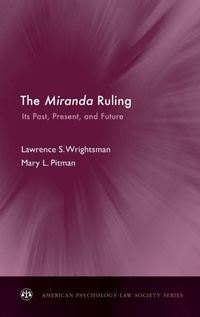
The Miranda Ruling
Its Past, Present, and Future
Published on 29. July 2010
Book
Hardback
208 pages
978-0-19-973090-2 (ISBN)
Description
Where did Miranda go wrong? The purpose of this book is to identify and describe four problems with the implementation of the Miranda decision and to suggest remedies in order to have it achieve its original purpose. The four problems identified in the book are:
1. The justices, in placing restrictions of the questioning of suspects, limited these rights only to those suspects who were "in custody." The term "in custody" is legally vague as well as vague to the layperson. It permits the police to question suspects without giving them their Miranda rights in those settings where it is unclear whether custody is present.
2. The Miranda warnings may not be fully understood by many suspects. There is no country-wide standardization of what is said; there are literally thousands of different versions of "the" Miranda warnings in use by different police departments in the United States.
3. Police training manuals, while recognizing the right to a "Miranda warning," have developed many ways to circumvent giving the warnings or ignoring a response in which a suspect does decide to remain silent or ask for an attorney.
4. In the 40 years since the Miranda law was established, the Supreme Court and lower courts have made decisions eroding their application.
Can the original goal of the authors of the Miranda law be salvaged? This book examines the state of interrogations and the state of the law before the Miranda decision was made, the purposes and nature of the decision, and proposes recommendations for reinstituting the original goals.
1. The justices, in placing restrictions of the questioning of suspects, limited these rights only to those suspects who were "in custody." The term "in custody" is legally vague as well as vague to the layperson. It permits the police to question suspects without giving them their Miranda rights in those settings where it is unclear whether custody is present.
2. The Miranda warnings may not be fully understood by many suspects. There is no country-wide standardization of what is said; there are literally thousands of different versions of "the" Miranda warnings in use by different police departments in the United States.
3. Police training manuals, while recognizing the right to a "Miranda warning," have developed many ways to circumvent giving the warnings or ignoring a response in which a suspect does decide to remain silent or ask for an attorney.
4. In the 40 years since the Miranda law was established, the Supreme Court and lower courts have made decisions eroding their application.
Can the original goal of the authors of the Miranda law be salvaged? This book examines the state of interrogations and the state of the law before the Miranda decision was made, the purposes and nature of the decision, and proposes recommendations for reinstituting the original goals.
Reviews / Votes
"The Miranda Ruling: Its Past, Present, and Future is not only a useful primer forpeople unfamiliar with Miranda's antecedents and progeny, but it also makes a significant
contribution to the literature by explicitly applying psychological expertise to understanding
how Miranda came to be and how this decision has shaped interrogation practices...Lawyers wishing to
augment their legal understanding of voluntariness with an introduction to the psychological
literature pertinent to whether a confessor was coerced will, therefore, also find this work
helpful. Graduate students interested in interrogation specifically or the accommodation of
competing considerations within our justice system will also find it informative." --PsycCRITIQUES
More details
Series
Language
English
Place of publication
New York
United States
Target group
College/higher education
Professional and scholarly
Dimensions
Height: 240 mm
Width: 161 mm
Thickness: 16 mm
Weight
479 gr
ISBN-13
978-0-19-973090-2 (9780199730902)
Copyright in bibliographic data and cover images is held by Nielsen Book Services Limited or by the publishers or by their respective licensors: all rights reserved.
Schweitzer Classification
Other editions
Additional editions
E-Book
05/2010
1st Edition
OUP eBook
€45.99
Available for download
Persons
Lawrence S. Wrightsman is Professor Emeritus in the Department of Psychology at the University of Kansas
Mary L. Pitman is Research Assistant to Lawrence Wrightsman in the Department of Psychology at the University of Kansas
Mary L. Pitman is Research Assistant to Lawrence Wrightsman in the Department of Psychology at the University of Kansas
Content
Series Foreword ; Preface ; Acknowledgments ; Chapter 1: The Public Image of Miranda and Why It is Incomplete ; Chapter 2: What Led Up to the Miranda Decision ; Chapter 3: The Decision in Miranda v. Arizona ; Chapter 4: Limitations of the Original Decision ; Chapter 5: Problems in the Comprehension of the Miranda Rights ; Chapter 6: More Recent Supreme Court Decisions that Erode Miranda Rights ; Chapter 7: Police Reactions to the Miranda Requirements ; Chapter 8: The Future of the Miranda Ruling ; References