

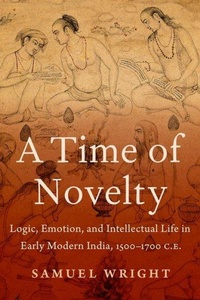
A Time of Novelty
Logic, Emotion, and Intellectual Life in Early Modern India, 1500-1700 C.E
Published on 7. September 2021
Book
Hardback
304 pages
978-0-19-756816-3 (ISBN)
Description
In A Time of Novelty, Samuel Wright re-envisions the relationship between philosophy and history in premodern India. This relationship is studied through the tradition of Sanskrit logic between 1500 and 1700 CE -- the period in Indian history that witnessed the ascendency of the Mughal Empire. During this period, Sanskrit logicians would refer to themselves and their arguments as 'new,' indicating that the concept of novelty was at the center of their philosophical project. By retaining space for emotion when studying intellectual thought,this book recovers both what it means to "think" novelty and to "feel" novelty for these thinkers.
Focusing on a number of little-known essays by early modern Sanskrit logicians, Wright argues that the concept of novelty is used to forge a new philosophical community in this period where novelty is both an intellectual and affective category. This perspective allows the book to raise questions that have never been asked when studying Sanskrit logic -- questions concerning critical thought, mood, imagination, and manuscript culture. Wright expands the ways in which we study philosophical thought by considering philosophy as deeply immersed in the felt experiences of one's life, at the confluence of thinking and feeling.
Focusing on a number of little-known essays by early modern Sanskrit logicians, Wright argues that the concept of novelty is used to forge a new philosophical community in this period where novelty is both an intellectual and affective category. This perspective allows the book to raise questions that have never been asked when studying Sanskrit logic -- questions concerning critical thought, mood, imagination, and manuscript culture. Wright expands the ways in which we study philosophical thought by considering philosophy as deeply immersed in the felt experiences of one's life, at the confluence of thinking and feeling.
Reviews / Votes
A Time of Novelty is a significant contribution to the study of the history of Nyaya and Indian philosophy. It also demonstrates a new approach to this study through a sensitive and careful reading of how and why novelty becomes important in early modernity. * Anusha Rao, Philosophy East & West *More details
Language
English
Place of publication
New York
United States
Target group
Professional and scholarly
Product notice
sewn/stitched
Cloth over boards
Dimensions
Height: 241 mm
Width: 163 mm
Thickness: 23 mm
Weight
567 gr
ISBN-13
978-0-19-756816-3 (9780197568163)
Copyright in bibliographic data and cover images is held by Nielsen Book Services Limited or by the publishers or by their respective licensors: all rights reserved.
Schweitzer Classification
Other editions
Additional editions
Samuel Wright
A Time of Novelty
Logic, Emotion, and Intellectual Life in Early Modern India, 1500-1700 C.E.
E-Book
05/2021
OUP eBook
€56.99
Available for download
Samuel Wright
A Time of Novelty
Logic, Emotion, and Intellectual Life in Early Modern India, 1500-1700 C.E.
E-Book
05/2021
OUP eBook
€56.99
Available for download
Person
Samuel Wright is Assistant Professor at Ahmedabad University. His research area is the history and philosophy of premodern South Asia.
Content
Preface and Acknowledgments
List of Maps
List of Tables
English Translations of Sanskrit Titles
Map 1. Early Modern South Asia: select towns and cities
Note on Transliteration
Introduction
Part I. Newness and Emotion
Chapter 1 - Doubt
Chapter 2 - Objectivity
Part II. Feeling and Reasoning
Chapter 3 - Happiness
Chapter 4 - Dying
Part III. Space and Time
Chapter 5 - Space
Chapter 6 - Time
Conclusion: A Time of Novelty
Appendix
Bibliography
Index
List of Maps
List of Tables
English Translations of Sanskrit Titles
Map 1. Early Modern South Asia: select towns and cities
Note on Transliteration
Introduction
Part I. Newness and Emotion
Chapter 1 - Doubt
Chapter 2 - Objectivity
Part II. Feeling and Reasoning
Chapter 3 - Happiness
Chapter 4 - Dying
Part III. Space and Time
Chapter 5 - Space
Chapter 6 - Time
Conclusion: A Time of Novelty
Appendix
Bibliography
Index