

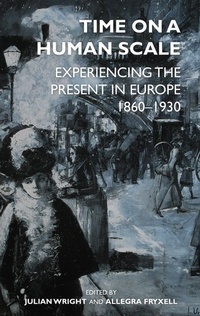
Time on a Human Scale
Experiencing the Present in Europe, 1860-1930
Published on 7. October 2021
Book
Hardback
344 pages
978-0-19-726697-7 (ISBN)
Description
How have modern Europeans understood the times in which they live? Many accounts of late nineteenth and early twentieth century Europe tend to emphasize degeneration or acceleration - a return to the past, or the rush to the future. This volume, however, shows how writers, artists, politicians and sociologists brought the present into focus by re-casting time in terms of human experience. With fresh contributions from history, politics, literary studies, musicology, cultural studies and art history, it shows how the search for the human present defined the culture, politics and ideas of Western Europe from the 1860s to the 1930s. The pressing search for the human present uncovered in these essays is, if anything, of even greater relevance today.
More details
Series
Language
English
Place of publication
Oxford
United Kingdom
Target group
Professional and scholarly
Illustrations
39
Dimensions
Height: 240 mm
Width: 160 mm
Thickness: 24 mm
Weight
908 gr
ISBN-13
978-0-19-726697-7 (9780197266977)
Copyright in bibliographic data and cover images is held by Nielsen Book Services Limited or by the publishers or by their respective licensors: all rights reserved.
Schweitzer Classification
Persons
Julian Wright is a modern historian concerned with time, individual life-writing, culture and politics. Wright has published two monographs on ideas, political culture, and time in France and edits the journal French History. Wright was a Junior Research Fellow at Christ Church, Oxford and taught history at Durham University until 2017, when he moved to Northumbria University.
Allegra Fryxell is a cultural historian of modern Europe interested in the interactions between the arts and sciences in the late nineteenth and early twentieth centuries. Fryxell is currently completing two monographs on time in the fin de siecle and the biography of a mid-century oil industrialist. Following her Research Fellowship at Pembroke College, Cambridge from 2017 to 2021, Fryxell will be a member of the Chair for Science Studies at ETH Zuerich.
Allegra Fryxell is a cultural historian of modern Europe interested in the interactions between the arts and sciences in the late nineteenth and early twentieth centuries. Fryxell is currently completing two monographs on time in the fin de siecle and the biography of a mid-century oil industrialist. Following her Research Fellowship at Pembroke College, Cambridge from 2017 to 2021, Fryxell will be a member of the Chair for Science Studies at ETH Zuerich.
Content
List of Illustrations
Note on Contributors
Introduction: Time on a human scale, 1860-1940
Conflicting Presents in Political Culture
Revolution, restoration, regeneration: historical cycles and the politics of time in Spain, 1870-1931
Fighting time in Ireland: temporality, time reform and the Irish present
Irregular rhythm: empire and ideas of the present in interwar France
The everyday and the eternal: English interwar Conservatism and the political present
Creating the Cultural Present
Collecting and the contemporary antiquarian: documenting the present in fin-de-siecle Paris
H. G. Wells's The Time Machine: tales of time and space
Music and the aesthetics of appearing
Embodied time: synchronizing 'somatic time' in modern dance and psychodrama, 1900-1930
Painting the present after impressionism: Pierre Bonnard and time's continuous duration
Being Present Through the Time of the First World War
Jean Jaures and the democratic present
'Time and the soldier': experiences of time in the Great War
Dates and days: the Printemps agenda, temporality and gender in the First World War
Eschatological presentism in Protestant German theology of the late 19th and early 20th centuries
Afterword: The human scale of time and the influenza pandemic of 1918
Index
Note on Contributors
Introduction: Time on a human scale, 1860-1940
Conflicting Presents in Political Culture
Revolution, restoration, regeneration: historical cycles and the politics of time in Spain, 1870-1931
Fighting time in Ireland: temporality, time reform and the Irish present
Irregular rhythm: empire and ideas of the present in interwar France
The everyday and the eternal: English interwar Conservatism and the political present
Creating the Cultural Present
Collecting and the contemporary antiquarian: documenting the present in fin-de-siecle Paris
H. G. Wells's The Time Machine: tales of time and space
Music and the aesthetics of appearing
Embodied time: synchronizing 'somatic time' in modern dance and psychodrama, 1900-1930
Painting the present after impressionism: Pierre Bonnard and time's continuous duration
Being Present Through the Time of the First World War
Jean Jaures and the democratic present
'Time and the soldier': experiences of time in the Great War
Dates and days: the Printemps agenda, temporality and gender in the First World War
Eschatological presentism in Protestant German theology of the late 19th and early 20th centuries
Afterword: The human scale of time and the influenza pandemic of 1918
Index