

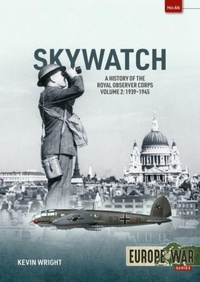
Skywatch Volume 2
The History of the Royal Observer Corps, 1939-1945
Published on 30. May 2026
Book
Paperback/Softback
100 pages
978-1-80672-288-4 (ISBN)
Description
The second volume of Skywatch continues the story of Britain's Observer Corps (later Royal Observer Corps) through its defining era; the Second World War of 1939-1945, during which the Observer Corps came to fulfil the role it was designed for in providing early warning of enemy air attack against Britain's cities and industry.
After the 1938 Munich crisis, war was almost inevitable. The RAF and Observer Corps stepped up their air defence exercises. So severe were the concerns of a pre-emptive German air attack on the country that the Observer Corps was mobilised on 24 August 1939, 10 days before war was declared.
Posts and Centres were constantly manned; the 'Phoney War' allowed many long-overdue readiness measures to be addressed as their eyes scanned the skies for Luftwaffe reconnaissance aircraft. In May 1940, exhausting action came with the defeat of France and the Battle of Britain. The Observer Corps quickly moved from being a peacetime organisation to one forged in battle.
As the summer of 1940 slipped away and the Blitz came, the Corps had to adapt to changing enemy tactics. In 1941, having received 'royal' recognition, it embarked on a significant reorganisation and professionalisation. Chapters cover enemy attacks, women joining the Corps, the Post at Windsor Castle, the assistance to lost and damaged aircraft, and the Allied air offensive which brought further change.
It discusses the build-up to D-Day in June 1944 with the need for 'Seaborne' Observers, and the immediate threat posed by the vast number of V-1 'Flying Bombs' launched against Britain. Volume two draws to a close with the end of the War and the temporary stand down of the Royal Observer Corps.
Skywatch, A History of The Royal Observer Corps Volume 2: 1939-1945 uses a combination of new research, official fi les, and firsthand accounts to critically assess the wartime activities of the Royal Observer Corps and its relationship with the RAF, from high-level policy to life at Posts and Group Centres. This volume is illustrated throughout with original photographs and specially commissioned colour artworks.
After the 1938 Munich crisis, war was almost inevitable. The RAF and Observer Corps stepped up their air defence exercises. So severe were the concerns of a pre-emptive German air attack on the country that the Observer Corps was mobilised on 24 August 1939, 10 days before war was declared.
Posts and Centres were constantly manned; the 'Phoney War' allowed many long-overdue readiness measures to be addressed as their eyes scanned the skies for Luftwaffe reconnaissance aircraft. In May 1940, exhausting action came with the defeat of France and the Battle of Britain. The Observer Corps quickly moved from being a peacetime organisation to one forged in battle.
As the summer of 1940 slipped away and the Blitz came, the Corps had to adapt to changing enemy tactics. In 1941, having received 'royal' recognition, it embarked on a significant reorganisation and professionalisation. Chapters cover enemy attacks, women joining the Corps, the Post at Windsor Castle, the assistance to lost and damaged aircraft, and the Allied air offensive which brought further change.
It discusses the build-up to D-Day in June 1944 with the need for 'Seaborne' Observers, and the immediate threat posed by the vast number of V-1 'Flying Bombs' launched against Britain. Volume two draws to a close with the end of the War and the temporary stand down of the Royal Observer Corps.
Skywatch, A History of The Royal Observer Corps Volume 2: 1939-1945 uses a combination of new research, official fi les, and firsthand accounts to critically assess the wartime activities of the Royal Observer Corps and its relationship with the RAF, from high-level policy to life at Posts and Group Centres. This volume is illustrated throughout with original photographs and specially commissioned colour artworks.
More details
Series
Language
English
Place of publication
Solihull
United Kingdom
Target group
Adult education
Illustrations
18 colour profiles, 16 colour photos, 109 b/w photos, 3 colour maps, 1 b/w map, 2 diagrams, 7 tables
Dimensions
Height: 297 mm
Width: 210 mm
ISBN-13
978-1-80672-288-4 (9781806722884)
Copyright in bibliographic data and cover images is held by Nielsen Book Services Limited or by the publishers or by their respective licensors: all rights reserved.
Schweitzer Classification
Person
Kevin Wright is a regular contributor to aviation magazines (including 'Aviation News' and 'Aeroplane') and is an accomplished air-to-air photographer. He has a lifelong special interest in Cold War intelligence collection and produced numerous articles on related topics. Other recent publications include co-authoring a book, with Peter Jefferies, on allied intelligence collection along the Berlin Corridors. He taught international security and politics for over 15 years at universities in the UK and overseas. His PhD was on the role of expert communities in arms control policy making which became the topic of his first book. He currently lives in the Republic of IE - Ireland.