

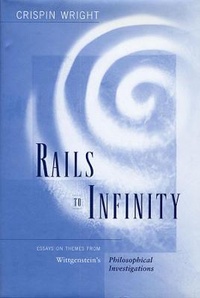
Rails to Infinity
Essays on Themes from Wittgenstein's Philosophical Investigations
Published on 30. October 2001
Book
Hardback
494 pages
978-0-674-00504-4 (ISBN)
Description
This volume, published on the fiftieth anniversary of Wittgenstein's death, brings together thirteen of Crispin Wright's most influential essays on Wittgenstein's later philosophies of language and mind, many hard to obtain, including the first publication of his Whitehead Lectures given at Harvard in 1996.
Organized into four groups, the essays focus on issues about following a rule and the objectivity of meaning; on Saul Kripke's contribution to the interpretation of Wittgenstein; on privacy and self-knowledge; and on aspects of Wittgenstein's philosophy of mathematics. Wright uses the cutting edge of Wittgenstein's thought to expose and undermine the common assumptions in platonistic views of mathematical and logical objectivity and Cartesian ideas about self-knowledge. The great question remains: How to react to the demise of these assumptions? In response, the essays develop a concerted, evolving approach to the possibilities--and limitations--of constructive philosophies of mathematics and mind. Their collection constitutes a major statement by one of Britain's most important philosophers--and will provide an indispensable tool both for students of Wittgenstein and for scholars working more generally in the metaphysics of mind and language.
Organized into four groups, the essays focus on issues about following a rule and the objectivity of meaning; on Saul Kripke's contribution to the interpretation of Wittgenstein; on privacy and self-knowledge; and on aspects of Wittgenstein's philosophy of mathematics. Wright uses the cutting edge of Wittgenstein's thought to expose and undermine the common assumptions in platonistic views of mathematical and logical objectivity and Cartesian ideas about self-knowledge. The great question remains: How to react to the demise of these assumptions? In response, the essays develop a concerted, evolving approach to the possibilities--and limitations--of constructive philosophies of mathematics and mind. Their collection constitutes a major statement by one of Britain's most important philosophers--and will provide an indispensable tool both for students of Wittgenstein and for scholars working more generally in the metaphysics of mind and language.
More details
Language
English
Place of publication
Cambridge, Mass
United States
Target group
College/higher education
Professional and scholarly
Illustrations
none
Dimensions
Height: 235 mm
Width: 156 mm
Thickness: 44 mm
Weight
925 gr
ISBN-13
978-0-674-00504-4 (9780674005044)
Copyright in bibliographic data and cover images is held by Nielsen Book Services Limited or by the publishers or by their respective licensors: all rights reserved.
Schweitzer Classification
Person
Crispin Wright is Global Professor of Philosophy at New York University, Professor of Philosophical Research at the University of Stirling, and Regius Professor of Logic Emeritus at the University of Aberdeen.
Content
Preface PART 1: WITTGENSTEIN AND RULES 1. Following a Rule 2. Rule-Following, Objectivity and the Theory of Meaning 3. Rule-Following, Meaning and Constructivism PART 2: WITTGENSTEIN'S ARGUMENT AS IT STRUCK KRIPKE 4. Kripke's Account of the Argument against Private Language 5. On Making Up One's Mind: Wittgenstein on Intention 6. Excerpts from a Critical Study of Cohn McGinn's Wittgenstein on Meaning 7. Wittgenstein's Rule-Following Considerations and the Central Project of Theoretical Linguistics PART 3: PRIVACY AND SELF- KNOWLEDGE 8. Does Philosophical Investigations 258-60 Suggest a Cogent Argument against Private Language? 9. Wittgenstein's Later Philosophy of Mind: Sensation, Privacy and Intention 10. The Problem of Self-Knowledge (I) 11. The Problem of Self-Knowledge (II) PART 4: RULE-FOLLOWING AND MATHEMATICS 12. Skolem and the Sceptic 13. Wittgenstein on Mathematical Proof POSTSCRIPTS Study Note on Wittgenstein on the Nature of Philosophy and Its Proper Method On Mind and World"br /> References and Additional Readings Credits Index