

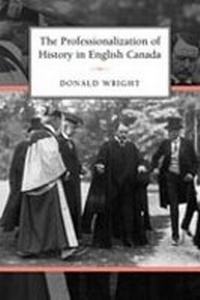
The Professionalization of History in English Canada
Will be published approx. on 20. August 2005
Book
Hardback
280 pages
978-0-8020-3928-6 (ISBN)
Description
The study of history in Canada has a history of its own, and its development as an academic discipline is a multifaceted one. The Professionalization of History in English Canada charts the transition of the study of history from a leisurely pastime to that of a full-blown academic career for university-trained scholars - from the mid-nineteenth to the late twentieth century.
Donald Wright argues that professionalization was not, in fact, a benign process, nor was it inevitable. It was deliberate. Within two generations, historians saw the creation of a professional association - the Canadian Historical Association - and rise of an academic journal - the Canadian Historical Review. Professionalization was also gendered. In an effort to raise the status of the profession and protect the academic labour market for men, male historians made a concerted effort to exclude women from the academy.
History's professionalization is best understood as a transition from one way of organizing intellectual life to another. What came before professionalization was not necessarily inferior, but rather, a different perspective of history. As well, Wright argues convincingly that professionalization inadvertently led to a popular inverse: the amateur historian, whose work is often more widely received and appreciated by the general public.
Donald Wright argues that professionalization was not, in fact, a benign process, nor was it inevitable. It was deliberate. Within two generations, historians saw the creation of a professional association - the Canadian Historical Association - and rise of an academic journal - the Canadian Historical Review. Professionalization was also gendered. In an effort to raise the status of the profession and protect the academic labour market for men, male historians made a concerted effort to exclude women from the academy.
History's professionalization is best understood as a transition from one way of organizing intellectual life to another. What came before professionalization was not necessarily inferior, but rather, a different perspective of history. As well, Wright argues convincingly that professionalization inadvertently led to a popular inverse: the amateur historian, whose work is often more widely received and appreciated by the general public.
Reviews / Votes
'[Wright presents] thoughtful comparative analyses and intriguing paradoxes that bring us closer to understanding what was at stake in the making of the historical profession in Canada ... A compelling history.'- Jarrett Rudy (Labour/Le Travail) 'A contribution to the considerable literature on the professionalization of history ... Wright employs significant archival research and interviews with a small but significant group of individuals to describe a process characterized by change rather than progress.'
- Ronald Rudin (Canadian Historical Review) 'A thoughtful history of the historical profession.'
- Catherine Gidney (Urban History Review)
More details
Language
English
Place of publication
Toronto
Canada
Target group
Professional and scholarly
Product notice
With dust jacket
Dimensions
Height: 236 mm
Width: 160 mm
Thickness: 27 mm
Weight
560 gr
ISBN-13
978-0-8020-3928-6 (9780802039286)
Copyright in bibliographic data and cover images is held by Nielsen Book Services Limited or by the publishers or by their respective licensors: all rights reserved.
Schweitzer Classification
Other editions
Additional editions
Donald Wright
The Professionalization of History in English Canada
Professionalization of History in English Canada
E-Book
07/2005
1st Edition
University of Toronto Press
€58.95
Available for download
Person
Donald Wright is a professor in the Department of Political Science at the University of New Brunswick.
Content
acknowledgments
Introduction
1 History as avocation
2 From avocation to vocation: the beginnings
3 'The post-1918 generation': professionalization continued
4 'Mr. Newman, manifestly, is not a historian': the amateurization of history
5 The importance of being sexist: the masculinization of history
6 Protecting scholarly independence: a professional imperative
7 'History cannot be too much professionalized':professionalization reconsidered
Conclusion
notes
bibliography
index
Introduction
1 History as avocation
2 From avocation to vocation: the beginnings
3 'The post-1918 generation': professionalization continued
4 'Mr. Newman, manifestly, is not a historian': the amateurization of history
5 The importance of being sexist: the masculinization of history
6 Protecting scholarly independence: a professional imperative
7 'History cannot be too much professionalized':professionalization reconsidered
Conclusion
notes
bibliography
index