

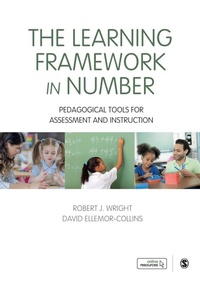
The Learning Framework in Number
Pedagogical Tools for Assessment and Instruction
1st Edition
Published on 28. March 2018
Book
Paperback/Softback
184 pages
978-1-5264-0276-9 (ISBN)
Description
This latest book in the bestselling Mathematics Recovery (R) series gives mathematics educators a complete research-based framework for assessment, instruction and intervention in whole number arithmetic across grades K to 5. The integrated set of classroom tools includes:
Nine carefully designed schedules of assessment tasks
Nine models of learning progressions
Ten teaching maps that guide the instructional progressions across key topics
The book offers guidance on innovative video-based assessment, and an overview of principles of intervention instruction, giving you an integrated resource for supporting the children you teach.
The Learning Framework in Number will be a useful guide for all primary and elementary school classroom teachers and assistants, and specialist teachers, including experienced Mathematics Recovery (R) instructors. The book will also be of significant interest to teacher educators and researchers.
Nine carefully designed schedules of assessment tasks
Nine models of learning progressions
Ten teaching maps that guide the instructional progressions across key topics
The book offers guidance on innovative video-based assessment, and an overview of principles of intervention instruction, giving you an integrated resource for supporting the children you teach.
The Learning Framework in Number will be a useful guide for all primary and elementary school classroom teachers and assistants, and specialist teachers, including experienced Mathematics Recovery (R) instructors. The book will also be of significant interest to teacher educators and researchers.
Reviews / Votes
Math Recovery (R) assessment and instruction come together in this comprehensive and accessible resource. Individuals new to the Math Recovery (R) series and those well versed in using existing resources will find the expanded models and pedagogical tools an empowering resource for teaching number concepts from kindergarten through grade 5. Notably, the inclusion of teaching charts support educators in providing targeted and responsive instruction to all students. -- Christina MillerMore details
Series
Language
English
Place of publication
London
United Kingdom
Target group
Professional and scholarly
Dimensions
Height: 297 mm
Width: 210 mm
Thickness: 12 mm
Weight
731 gr
ISBN-13
978-1-5264-0276-9 (9781526402769)
Copyright in bibliographic data and cover images is held by Nielsen Book Services Limited or by the publishers or by their respective licensors: all rights reserved.
Schweitzer Classification
Other editions
Additional editions
Robert J. Wright | David Ellemor-Collins
The Learning Framework in Number
Pedagogical Tools for Assessment and Instruction
Book
04/2018
1st Edition
SAGE Publications Ltd
€191.64
Shipment within 15-20 days
Persons
Dr Robert J. (Bob) Wright holds Bachelor's and Master's degrees in mathematics from the University of Queensland (Australia) and a doctoral degree in mathematics education from the University of Georgia. He is an adjunct professor in mathematics education at Southern Cross University in New South Wales. Bob is an inter-nationally recognized leader in assessment and instruction relating to children's early arithmetical knowledge and strategies, publishing six books, and many articles and papers in this field. His work over the last 25 years has included the development of the Mathematics Recovery Program, which focuses on providing specialist training for teachers to advance the numeracy levels of young children assessed as low-attainers. In Australia and New Zealand, Ireland, the UK, the USA, Canada, Mexico, South Africa and elsewhere, this programme has been implemented widely, and applied extensively to classroom teaching and to average and able learners as well as low-attainers. Bob has conducted several research projects funded by the Australian Research Council including the most recent project focusing on assessment and intervention in the early arithmetical learning of low-attaining 8- to 10-year-olds.
David Ellemor-Collins is the senior mathematics teacher at Living School Academy, a progressive independent school in Lismore, Australia. David holds a Bachelor's degree with honours in mathematics and philosophy from Harvard University, a Graduate Diploma in Education from the University of Melbourne, and a doctoral degree in mathematics education from Southern Cross University. He has been a mathematics teacher for over 25 years across primary schools, high schools and universities. Alongside teaching, David has been a researcher in mathematics education, collaborating with Dr. Bob Wright in a long-term program of research developing pedagogical tools for teaching number. As a specialist in arithmetic instruction, David publishes articles for both researchers and practitioners, designs curriculum materials, and provides professional development to teachers. He has co-authored three books in the Math Recovery series with Sage Publishing.
David Ellemor-Collins is the senior mathematics teacher at Living School Academy, a progressive independent school in Lismore, Australia. David holds a Bachelor's degree with honours in mathematics and philosophy from Harvard University, a Graduate Diploma in Education from the University of Melbourne, and a doctoral degree in mathematics education from Southern Cross University. He has been a mathematics teacher for over 25 years across primary schools, high schools and universities. Alongside teaching, David has been a researcher in mathematics education, collaborating with Dr. Bob Wright in a long-term program of research developing pedagogical tools for teaching number. As a specialist in arithmetic instruction, David publishes articles for both researchers and practitioners, designs curriculum materials, and provides professional development to teachers. He has co-authored three books in the Math Recovery series with Sage Publishing.
Content
Chapter 1: The Learning Framework in Number
Chapter 2: Approach to Assessment
Chapter 3: Assessment Schedules
Chapter 4: Models of Learning Progressions
Chapter 5: Approach to Intervention Instruction
Chapter 6: Teaching Charts
Chapter 2: Approach to Assessment
Chapter 3: Assessment Schedules
Chapter 4: Models of Learning Progressions
Chapter 5: Approach to Intervention Instruction
Chapter 6: Teaching Charts