

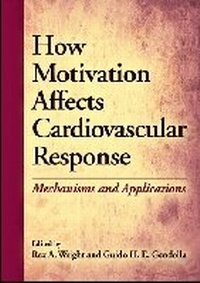
How Motivation Affects Cardiovascular Response
Mechanisms and Applications
Will be published approx. on 15. September 2011
Book
Hardback
424 pages
978-1-4338-1026-8 (ISBN)
Description
Cardiovascular response refers to changes in parameters such as heart rate, blood pressure, and heart contraction in reaction to an event or set of events. The chapters in this book, authored by an international group of distinguished scientists, show that applied motivational research has considerable predictability, informing us about cardiovascular responses and highlighting conditions under which those responses might pose a health risk.
The volume will appeal to scholars and practitioners in numerous specialty areas, including motivation, emotion, psychophysiology, medical/health psychology, social/personality psychology and human factors/ergonomics. It will be a vital research source and could serve as a text or supplement in classes that address motivational, psychophysiological and health issues.
The volume will appeal to scholars and practitioners in numerous specialty areas, including motivation, emotion, psychophysiology, medical/health psychology, social/personality psychology and human factors/ergonomics. It will be a vital research source and could serve as a text or supplement in classes that address motivational, psychophysiological and health issues.
More details
Language
English
Place of publication
Washington DC
United States
Target group
Professional and scholarly
Dimensions
Height: 254 mm
Width: 178 mm
ISBN-13
978-1-4338-1026-8 (9781433810268)
Copyright in bibliographic data and cover images is held by Nielsen Book Services Limited or by the publishers or by their respective licensors: all rights reserved.
Schweitzer Classification
Persons
Rex A. Wright, PhD, is a professor of psychology at the University of Alabama at Birmingham. He received his BA at the University of Texas in Austin and his PhD at the University of Kansas, and he did his postdoctoral training at the State University of New York at Stony Brook.
Dr. Wright's research is concerned chiefly with determinants and cardiovascular consequences of effort. He has authored numerous publications, including research articles, book chapters, and books. He also has held numerous visiting academic appointments, including ones at the Max Planck Institute (Germany), the University of Bielefeld (Germany), the University of Erlangen amp ndash Nuremberg (Germany), the University of Geneva (Switzerland), the University of Maryland at College Park, the University of Missouri at Columbia, and the University of Texas at Austin.
Dr. Wright's visits have been supported in part by the Fulbright Program, the German Academic Exchange Service, and the Swiss National Science Foundation. His research has been supported by various granting agencies, most notably the National Science Foundation.
Dr. Wright currently serves as an associate editor for the journal Motivation and Emotion.
Guido H. E. Gendolla, PhD, is a professor of psychology at the University of Geneva (Switzerland), where he holds the chair for motivation psychology and directs the Geneva Motivation Lab. He earned his diploma (corresponding to the MA) and his PhD in psychology at the University of Bielefeld (Germany). He earned his habilitation in psychology at the University of Erlangen amp ndash Nuremberg (Germany).
Dr. Gendolla's research focuses on human motivation and affective states and is mainly concerned with psychophysiological processes. He has authored numerous publications, and his research has been supported by various grants from the Deutsche Forschungsgemeinschaft (DFG, German Research Foundation) and the Swiss National Funds.
Dr. Wright's research is concerned chiefly with determinants and cardiovascular consequences of effort. He has authored numerous publications, including research articles, book chapters, and books. He also has held numerous visiting academic appointments, including ones at the Max Planck Institute (Germany), the University of Bielefeld (Germany), the University of Erlangen amp ndash Nuremberg (Germany), the University of Geneva (Switzerland), the University of Maryland at College Park, the University of Missouri at Columbia, and the University of Texas at Austin.
Dr. Wright's visits have been supported in part by the Fulbright Program, the German Academic Exchange Service, and the Swiss National Science Foundation. His research has been supported by various granting agencies, most notably the National Science Foundation.
Dr. Wright currently serves as an associate editor for the journal Motivation and Emotion.
Guido H. E. Gendolla, PhD, is a professor of psychology at the University of Geneva (Switzerland), where he holds the chair for motivation psychology and directs the Geneva Motivation Lab. He earned his diploma (corresponding to the MA) and his PhD in psychology at the University of Bielefeld (Germany). He earned his habilitation in psychology at the University of Erlangen amp ndash Nuremberg (Germany).
Dr. Gendolla's research focuses on human motivation and affective states and is mainly concerned with psychophysiological processes. He has authored numerous publications, and his research has been supported by various grants from the Deutsche Forschungsgemeinschaft (DFG, German Research Foundation) and the Swiss National Funds.
Content
Contributors
Preface
Introduction
Rex A. Wright and Guido H. E. Gendolla
I. Mechanisms
A. Neural Integration and Direct Effects of Effort
. Integration of Cardiac Function With Cognitive, Motivational, and Emotional Processing: Evidence From Neuroimaging
Marcus A. Gray and Hugo D. Critchley
2. Beta-Adrenergic Cardiovascular Reactivity and Adaptation to Stress: The Cardiac Pre-Ejection Period as an Index of Effort
Robert M. Kelsey
3. Psychophysiological Processes of Mental Effort Investment
Stephen H. Fairclough and L. J. M. Mulder
Reward Influence and Response Specificity
4. Cardiovascular Response to Reward
Michael Richter
5. Emotion, Motivation, and Cardiovascular Response
Sylvia D. Kreibig
Affect and Stressful Conflict
. Emotional Intensity Theory and Its Cardiovascular Implications for Emotional States
Anca M. Miron and Jack W. Brehm
7. Gloomy and Lazy? On the Impact of Mood and Depressive Symptoms on Effort-Related Cardiovascular Response
Guido H. E. Gendolla, Kerstin Brinkmann, and Nicolas Silvestrini
8. Cardiovascular Reactivity to Stress: The Role of Motivational Conflict
Justin E. Stanley and Richard J. Contrada
Fatigue
9. Pause and Plan: Self-Regulation and the Heart
Suzanne C. Segerstrom, Jaime K. Hardy, Daniel R. Evans, and Natalie F. Winters
. Multifaceted Effects of Fatigue on Effort and Associated Cardiovascular Responses
Rex A. Wright and Christopher C. Stewart
II. Applications
A. Health and Cardiovascular Response
. Cardiovascular Reactivity and Health
Stephan Bongard, Mustafa al'Absi, and William R. Lovallo
2. The Behavioral and Health Corollaries of Blunted Physiological Reactions to Acute Psychological Stress: Revising the Reactivity Hypothesis
Douglas Carroll, Anna C. Phillips, and William R. Lovallo
Social Striving and Sex (Gender) Influence
3. Agonistic Striving, Emotion Regulation, and Hypertension Risk
Craig K. Ewart
4. Interpersonal Motives and Cardiovascular Response: Mechanisms Linking Dominance and Social Status With Cardiovascular Disease
Timothy W. Smith, Jenny M. Cundiff, and Bert N. Uchino
5. Social Influences on Cardiovascular Processes: A Focus on Health
Greg J. Norman, A. Courtney DeVries, Louise Hawkley, John T. Cacioppo, and Gary G. Berntson
. Indeterminate Motivations: Cardiovascular Health Costs of Living in a Social World
Britta A. Larsen and Nicholas J. S. Christenfeld
7. Effort Mechanisms Linking Sex to Cardiovascular Response: Toward a Comprehensive Analysis With Relevance for Health
Rex A. Wright and Patricia Barreto
Work and Achievement
8. Cardiovascular Measures in Human Factors/Ergonomics Research
Richard W. Backs, John Lenneman, and Nicholas Cassavaugh
9. Clarifying Achievement Motives and Effort: Studies of Cardiovascular Response
R amp eacute mi L. Capa
Index
About the Editors
Preface
Introduction
Rex A. Wright and Guido H. E. Gendolla
I. Mechanisms
A. Neural Integration and Direct Effects of Effort
. Integration of Cardiac Function With Cognitive, Motivational, and Emotional Processing: Evidence From Neuroimaging
Marcus A. Gray and Hugo D. Critchley
2. Beta-Adrenergic Cardiovascular Reactivity and Adaptation to Stress: The Cardiac Pre-Ejection Period as an Index of Effort
Robert M. Kelsey
3. Psychophysiological Processes of Mental Effort Investment
Stephen H. Fairclough and L. J. M. Mulder
Reward Influence and Response Specificity
4. Cardiovascular Response to Reward
Michael Richter
5. Emotion, Motivation, and Cardiovascular Response
Sylvia D. Kreibig
Affect and Stressful Conflict
. Emotional Intensity Theory and Its Cardiovascular Implications for Emotional States
Anca M. Miron and Jack W. Brehm
7. Gloomy and Lazy? On the Impact of Mood and Depressive Symptoms on Effort-Related Cardiovascular Response
Guido H. E. Gendolla, Kerstin Brinkmann, and Nicolas Silvestrini
8. Cardiovascular Reactivity to Stress: The Role of Motivational Conflict
Justin E. Stanley and Richard J. Contrada
Fatigue
9. Pause and Plan: Self-Regulation and the Heart
Suzanne C. Segerstrom, Jaime K. Hardy, Daniel R. Evans, and Natalie F. Winters
. Multifaceted Effects of Fatigue on Effort and Associated Cardiovascular Responses
Rex A. Wright and Christopher C. Stewart
II. Applications
A. Health and Cardiovascular Response
. Cardiovascular Reactivity and Health
Stephan Bongard, Mustafa al'Absi, and William R. Lovallo
2. The Behavioral and Health Corollaries of Blunted Physiological Reactions to Acute Psychological Stress: Revising the Reactivity Hypothesis
Douglas Carroll, Anna C. Phillips, and William R. Lovallo
Social Striving and Sex (Gender) Influence
3. Agonistic Striving, Emotion Regulation, and Hypertension Risk
Craig K. Ewart
4. Interpersonal Motives and Cardiovascular Response: Mechanisms Linking Dominance and Social Status With Cardiovascular Disease
Timothy W. Smith, Jenny M. Cundiff, and Bert N. Uchino
5. Social Influences on Cardiovascular Processes: A Focus on Health
Greg J. Norman, A. Courtney DeVries, Louise Hawkley, John T. Cacioppo, and Gary G. Berntson
. Indeterminate Motivations: Cardiovascular Health Costs of Living in a Social World
Britta A. Larsen and Nicholas J. S. Christenfeld
7. Effort Mechanisms Linking Sex to Cardiovascular Response: Toward a Comprehensive Analysis With Relevance for Health
Rex A. Wright and Patricia Barreto
Work and Achievement
8. Cardiovascular Measures in Human Factors/Ergonomics Research
Richard W. Backs, John Lenneman, and Nicholas Cassavaugh
9. Clarifying Achievement Motives and Effort: Studies of Cardiovascular Response
R amp eacute mi L. Capa
Index
About the Editors