

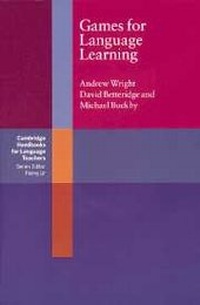
Games for Language Learning
2nd Edition
Published on 17. May 1984
Book
Paperback/Softback
224 pages
978-0-521-27737-2 (ISBN)
Description
Games provide meaningful and enjoyable language practice at all levels and for all age groups. They can be used to practise any of the skills - speaking, listening, reading and writing - at any stage of the learning process, from controlled repetition through guided practice to free expression. To enable teachers to select the activities most suitable for their needs, precise information is provided, both at the beginning of each game and in the summary chart, about the language content, the skills to be practised, the level, the degree of teacher-control, and the time and materials required. Clear advice is given on preparation and classroom procedure, with many illustrations and examples. There is a comprehensive index.
Reviews / Votes
'Games for Language Learning is an excellent aid to the teacher who wants to make language learning more meaningful and more fun.' Elizabeth Rowell, Journal of ReadingMore details
Series
Edition
2nd Revised edition
Language
English
Place of publication
Cambridge
United Kingdom
Target group
ELT/ESL
Edition type
Revised edition
Product notice
Paperback (trade)
Dimensions
Height: 227 mm
Width: 152 mm
Thickness: 16 mm
Weight
340 gr
ISBN-13
978-0-521-27737-2 (9780521277372)
Copyright in bibliographic data and cover images is held by Nielsen Book Services Limited or by the publishers or by their respective licensors: all rights reserved.
Schweitzer Classification
Other editions
New editions
Andrew Wright | David Betteridge | Michael Buckby
Games for Language Learning
Book
02/2006
3rd Edition
Cambridge University Press
€61.40
Shipment within 15-20 days
Previous edition

Andrew Wright
Games for Language Learning
Book
09/1979
Cambridge University Press
€4.95
Article exhausted; check for reprint
Content
Acknowledgements; Preface; Introduction; 1. Language for the organisation of games; 2. Picture games; 3. Psychology games; 4. Magic tricks; 5. Caring and sharing games; 6. Card and board games; 7. Sound games; 8. Story games; 9. Word games; 10. True/false games; 11. Memory games; 12. Question and answer games; 13. Guessing and speculating games; 14. Miscellaneous games; Summary of the games (skills, level, time, etc.); Index to structures and types of communication; Alphabetical list of games.