

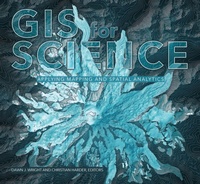
GIS for Science
Applying Mapping and Spatial Analytics
Published on 12. September 2019
Book
Paperback/Softback
252 pages
978-1-58948-530-3 (ISBN)
Description
GIS for Science presents a collection of real-world stories about modern science and a cadre of scientists who use mapping and spatial analytics to expand their understanding of the world.
The accounts in this book are written for a broad audience including professional scientists, the swelling ranks of citizen scientists, and people generally interested in science and geography. Scientific data are brought to life with GIS technology to study a range of issues relevant to the functioning of planet Earth in a natural sense as well as the impacts of human activity. In a race against the clock, the scientists profiled in this volume are using remote sensing, web maps within a geospatial cloud, Esri StoryMaps, and spatial analysis to document and solve an array of issues with a geographic dimension, ranging from climate change, natural disasters, and loss of biodiversity, to homelessness, loss of green infrastructure, and resource shortages.
These stories present geospatial ideas and inspiration that readers can apply across many disciplines, making this volume relevant to a diverse scientific audience.
See how scientists working on the world's most pressing problems apply geographic information systems-GIS.
The accounts in this book are written for a broad audience including professional scientists, the swelling ranks of citizen scientists, and people generally interested in science and geography. Scientific data are brought to life with GIS technology to study a range of issues relevant to the functioning of planet Earth in a natural sense as well as the impacts of human activity. In a race against the clock, the scientists profiled in this volume are using remote sensing, web maps within a geospatial cloud, Esri StoryMaps, and spatial analysis to document and solve an array of issues with a geographic dimension, ranging from climate change, natural disasters, and loss of biodiversity, to homelessness, loss of green infrastructure, and resource shortages.
These stories present geospatial ideas and inspiration that readers can apply across many disciplines, making this volume relevant to a diverse scientific audience.
See how scientists working on the world's most pressing problems apply geographic information systems-GIS.
Reviews / Votes
"This book is beautiful as well as illuminating, and it dramatizes the ways in which the new science of geospatial information is enriching and empowering all other scientific disciplines."--James Fallows, Staff Writer at The Atlantic and former Chief Speechwriter for President Jimmy Carter * James Fallows * "Advances in remote sensing and geographic information systems allow us to observe, monitor, and understand the planet in unprecedented levels of detail. Data that once had to be collected through painstaking and laborious fieldwork are now available instantly, online, anywhere. This beautifully illustrated and inspiring book brings home the power of today's technology with unique effectiveness, telling and illustrating stories from the earth sciences in novel and powerful ways. A must-have book for anyone concerned about the planet's future."
--Mike Goodchild, Distinguished Emeritus Professor and Research Professor of Geography, UC Santa Barbara * Mike Goodchild * "As an ecologist, GIS provides the platform that allows us to generate a holistic perspective of the natural world. This spatial understanding is so critical for us to be able to understand and address the global threats of biodiversity loss and climate change. Given the relevance of this geospatial perspective for all aspects of society, I hope this beautiful book will inspire a wide range of people to embrace the 'Science of Where.' "
--Thomas Crowther, Director at Global Forest Biodiversity Initiative * Thomas Crowther *
More details
Series
Language
English
Place of publication
Redlands
United States
Publishing group
ESRI Press
Product notice
Paperback (trade)
Illustrations
Illustrations
Dimensions
Height: 280 mm
Width: 254 mm
Thickness: 15 mm
Weight
1123 gr
ISBN-13
978-1-58948-530-3 (9781589485303)
Copyright in bibliographic data and cover images is held by Nielsen Book Services Limited or by the publishers or by their respective licensors: all rights reserved.
Schweitzer Classification
Other editions
Additional editions

E-Book
06/2019
1st Edition
Esri Press
from
€95.99
Available for download
Persons
Dawn J. Wright is a geographer, oceanographer, and the Chief Scientist of Esri. She is a leading authority in the application of geographic information system (GIS) to environmental science and the author and editor of numerous scientific books and articles.
Christian Harder is a technology writer and information designer at Esri. He is the author or coauthor of numerous books on GIS, including Understand GIS, The ArcGIS Book (Esri Press, 2017) and The ArcGIS Imagery Book (Esri Press, 2016).
Christian Harder is a technology writer and information designer at Esri. He is the author or coauthor of numerous books on GIS, including Understand GIS, The ArcGIS Book (Esri Press, 2017) and The ArcGIS Imagery Book (Esri Press, 2016).
Content
INTRODUCTION
The Science of Where: A Framework and a Process
Introduction (How the Book and Website Work Together)
What's new in the 2nd Volume
New Reflections from Pulitzer-Prize Winner Jared Diamond
PART 1: How Earth Works
US OceanReports Tool: Intelligent Web Application for Ocean Neighborhoods
Global Islands
GIS as a Scientific Workbench: Pacific Gyre/Ocean Plastics
Subsurface Prediction for Earth Analytics
PART 2: How Earth Looks
Mapping Human Settlement
Diverse Farms, Diverse Foods
Emerging Hotspots of Forest Loss
Sustainable Precision Agriculture
Air Quality Monitoring with EPA's AirNow
PART 3: How We Look at Earth
Urban Tree Canopy Mapping (small areas, big data!)
Utilizing the NASA Atmospheric Science Data Center (ASDC) Geospatial Platform for Data Analysis
NASA Disaster Mapping Portal: Leveraging GIS for Disaster Response, Recovery, Resilience and Reporting
Machine Learning and Full Motion Video for Environmental Monitoring
PART 4: Training Future Generations of Scientists
Evolution of Students' Spatial Skills
PART 5: Technology Showcase
Living Atlas
Spilhaus Projected Coordinate System
Excalibur (imagery platform)
Insights
Spatial Machine Learning
Raster Function Chains
Space-Time Cube
Accessing multidimensional data via OpenDap and Thredds
Time Series Clustering
ArcGIS Earth, or failing that, Voxels
Drone2Map
Smart Mapping
Operations Dashboard
Atmospheric Modeling
Global Polio Eradication or Ebola
The Science of Where: A Framework and a Process
Introduction (How the Book and Website Work Together)
What's new in the 2nd Volume
New Reflections from Pulitzer-Prize Winner Jared Diamond
PART 1: How Earth Works
US OceanReports Tool: Intelligent Web Application for Ocean Neighborhoods
Global Islands
GIS as a Scientific Workbench: Pacific Gyre/Ocean Plastics
Subsurface Prediction for Earth Analytics
PART 2: How Earth Looks
Mapping Human Settlement
Diverse Farms, Diverse Foods
Emerging Hotspots of Forest Loss
Sustainable Precision Agriculture
Air Quality Monitoring with EPA's AirNow
PART 3: How We Look at Earth
Urban Tree Canopy Mapping (small areas, big data!)
Utilizing the NASA Atmospheric Science Data Center (ASDC) Geospatial Platform for Data Analysis
NASA Disaster Mapping Portal: Leveraging GIS for Disaster Response, Recovery, Resilience and Reporting
Machine Learning and Full Motion Video for Environmental Monitoring
PART 4: Training Future Generations of Scientists
Evolution of Students' Spatial Skills
PART 5: Technology Showcase
Living Atlas
Spilhaus Projected Coordinate System
Excalibur (imagery platform)
Insights
Spatial Machine Learning
Raster Function Chains
Space-Time Cube
Accessing multidimensional data via OpenDap and Thredds
Time Series Clustering
ArcGIS Earth, or failing that, Voxels
Drone2Map
Smart Mapping
Operations Dashboard
Atmospheric Modeling
Global Polio Eradication or Ebola