

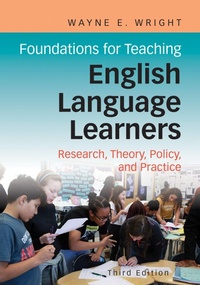
Foundations for Teaching English Language Learners
Research, Theory, Policy, and Practice
3rd Edition
Will be published approx. on 30. May 2019
Book
Paperback/Softback
384 pages
978-1-934000-36-6 (ISBN)
Description
All teachers and administrators must know how to educate multilingual students, particularly English language learners!
Foundations for Teaching English Language Learners: Research, Theory, Policy, and Practice by Wayne E. Wright is a comprehensive course text on ELL education for pre-service elementary and secondary teachers as well as literacy, special education, English as a second language (ESL), and bilingual specialists. This foundational text also targets educational leaders, including coaches, counselors, directors, and administrators working toward equity and excellence in multilingual schools and communities. This text prepares educators to meet state competency requirements in ELL education.
Foundations for Teaching ELLs includes an interactive companion website with extensive resources for students and professors. Professors appreciate the Professor Control Panel on the site, which includes slide presentations that Dr. Wright has made to accompany each chapter, a sample course syllabus, and much more.
Students Learn To
- Make research-based decisions on ELL policies, programs, practices, and assessment
- Relate language and literacy teaching and learning theories and practice
- Differentiate core content-area instruction for multilingual learners, including ELLs
- Teach oral language, reading, and writing in all content areas
- Use students' home languages and technology as resources for learning
Special Features
- Guiding questions and key terms
- Tables, boxes, figures, glossary
- Vignettes, teaching strategies, samples of student work
- Chapter review activities, discussion questions, research activities, recommended readings
- Companion website
- Professor Control Panel on companion website
New to the Third Edition
- A stronger multilingual perspective on ELL education, with attention to new research, theory, and practice on dynamic bilingualism and translanguaging
- New regulations, accountability requirements, and flexibility regarding ELLs since the reauthorization of The Every Student Succeeds ACT(ESSA) in 2018
- Greater focus on the complex language and literacy demands of the Next Generation Science Standards as well as other content-area standards-not just for ELLs, but for all students
- New research on ELLs in content-area classes from the National Academies of Sciences, Engineering, and Medicine in their 2017 report Promoting the Educational Success of Children and Youth Learning English: Promising Futures.
- The integration of new principles by Teachers of English to Speakers of Other Languages (TESOL, 2018) for the exemplary teaching of ELLs.
Foundations for Teaching English Language Learners: Research, Theory, Policy, and Practice by Wayne E. Wright is a comprehensive course text on ELL education for pre-service elementary and secondary teachers as well as literacy, special education, English as a second language (ESL), and bilingual specialists. This foundational text also targets educational leaders, including coaches, counselors, directors, and administrators working toward equity and excellence in multilingual schools and communities. This text prepares educators to meet state competency requirements in ELL education.
Foundations for Teaching ELLs includes an interactive companion website with extensive resources for students and professors. Professors appreciate the Professor Control Panel on the site, which includes slide presentations that Dr. Wright has made to accompany each chapter, a sample course syllabus, and much more.
Students Learn To
- Make research-based decisions on ELL policies, programs, practices, and assessment
- Relate language and literacy teaching and learning theories and practice
- Differentiate core content-area instruction for multilingual learners, including ELLs
- Teach oral language, reading, and writing in all content areas
- Use students' home languages and technology as resources for learning
Special Features
- Guiding questions and key terms
- Tables, boxes, figures, glossary
- Vignettes, teaching strategies, samples of student work
- Chapter review activities, discussion questions, research activities, recommended readings
- Companion website
- Professor Control Panel on companion website
New to the Third Edition
- A stronger multilingual perspective on ELL education, with attention to new research, theory, and practice on dynamic bilingualism and translanguaging
- New regulations, accountability requirements, and flexibility regarding ELLs since the reauthorization of The Every Student Succeeds ACT(ESSA) in 2018
- Greater focus on the complex language and literacy demands of the Next Generation Science Standards as well as other content-area standards-not just for ELLs, but for all students
- New research on ELLs in content-area classes from the National Academies of Sciences, Engineering, and Medicine in their 2017 report Promoting the Educational Success of Children and Youth Learning English: Promising Futures.
- The integration of new principles by Teachers of English to Speakers of Other Languages (TESOL, 2018) for the exemplary teaching of ELLs.
More details
Edition
Third Edition
Language
English
Place of publication
Baltimore
United States
Target group
Professional and scholarly
Edition type
New edition
Dimensions
Height: 254 mm
Width: 178 mm
Thickness: 25 mm
Weight
6600 gr
ISBN-13
978-1-934000-36-6 (9781934000366)
Copyright in bibliographic data and cover images is held by Nielsen Book Services Limited or by the publishers or by their respective licensors: all rights reserved.
Schweitzer Classification
Content
- Chapter One: Who are English Language Learners
- Chapter Two: Language
- Chapter Three: Language Learning and Teaching
- Chapter Four: Language and Education Policy
- Chapter Five: Instructional Models and Programs
- Chapter Six: Assessment
- Chapter Seven: Listening and Speaking
- Chapter Eight: Reading
- Chapter Nine: Writing
- Chapter Ten: Content-Area Instruction
- Chapter Eleven: Translanguaging, Effective Instruction, and Advocay for English Language Learners
- Glossary
- Youth and Childrens Literature
- Index
- Chapter Two: Language
- Chapter Three: Language Learning and Teaching
- Chapter Four: Language and Education Policy
- Chapter Five: Instructional Models and Programs
- Chapter Six: Assessment
- Chapter Seven: Listening and Speaking
- Chapter Eight: Reading
- Chapter Nine: Writing
- Chapter Ten: Content-Area Instruction
- Chapter Eleven: Translanguaging, Effective Instruction, and Advocay for English Language Learners
- Glossary
- Youth and Childrens Literature
- Index