

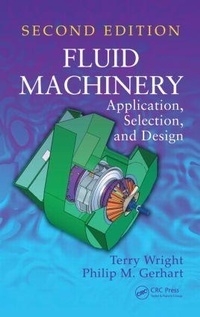
Fluid Machinery
Application, Selection, and Design, Second Edition
2nd Edition
Published on 16. December 2009
Book
Hardback
454 pages
978-1-4200-8294-4 (ISBN)
Description
Published nearly a decade ago, Fluid Machinery: Performance, Analysis, and Design quickly became popular with students, professors, and professionals because of its comprehensive and comprehensible introduction to the fluid mechanics of turbomachinery. Renamed to reflect its wider scope and reorganized content, this second edition provides a more logical flow of information that will enhance understanding. In particular, it presents a consistent notation within and across chapters, updating material when appropriate. Although the authors do account for the astounding growth in the field of computational fluid dynamics that has occurred since publication of the first edition, this text emphasizes traditional "one-dimensional" layout and points the way toward using CFD for turbomachinery design and analysis.
Presents Extensive Examples and Design Exercises to Illustrate Performance Parameters and Machine Geometry
By focusing on the preliminary design and selection of equipment to meet performance specifications, the authors promote a basic yet thorough understanding of the subject. They cover topics including gas and hydraulic turbines and equipment that is widely used in the industry, such as compressors, blowers, fans, and pumps.
This book promotes a pragmatic approach to turbomachinery application and design, examining a realistic array of difficulties and conflicting requirements. The authors use examples from a broad range of industrial applications to illustrate the generality of the basic design approach and the common ground of seemingly diverse areas of application.
With a variety of illustrations, examples, and exercises that emphasize real-world industrial applications, this book not only prepares students to face industrial applications with confidence, but also supplies professionals with a compact and easy-to-use reference.
Presents Extensive Examples and Design Exercises to Illustrate Performance Parameters and Machine Geometry
By focusing on the preliminary design and selection of equipment to meet performance specifications, the authors promote a basic yet thorough understanding of the subject. They cover topics including gas and hydraulic turbines and equipment that is widely used in the industry, such as compressors, blowers, fans, and pumps.
This book promotes a pragmatic approach to turbomachinery application and design, examining a realistic array of difficulties and conflicting requirements. The authors use examples from a broad range of industrial applications to illustrate the generality of the basic design approach and the common ground of seemingly diverse areas of application.
With a variety of illustrations, examples, and exercises that emphasize real-world industrial applications, this book not only prepares students to face industrial applications with confidence, but also supplies professionals with a compact and easy-to-use reference.
More details
Edition
2nd edition
Language
English
Place of publication
Bosa Roca
United States
Publishing group
Taylor & Francis Inc
Target group
College/higher education
Professional
Product notice
Paper over boards
Illustrations
28 s/w Tabellen, 242 s/w Abbildungen
28 Tables, black and white; 242 Illustrations, black and white
Dimensions
Height: 241 mm
Width: 164 mm
Thickness: 27 mm
Weight
780 gr
ISBN-13
978-1-4200-8294-4 (9781420082944)
Copyright in bibliographic data and cover images is held by Nielsen Book Services Limited or by the publishers or by their respective licensors: all rights reserved.
Schweitzer Classification
Other editions
Additional editions
E-Book
12/2009
2nd Edition
CRC Press
€198.99
Available for download
E-Book
12/2009
2nd Edition
CRC Press
€198.99
Available for download
Previous edition
Book
02/1999
1st Edition
CRC Press
€113.89
Article exhausted; check for reprint
Persons
Philip M. Gerhart (1946-2017) held a BSME degree from Rose-Hulman Institute of Technology and MS and PhD degrees from the University of Illinois at Urbana-Champaign. He was a registered professional engineer in Indiana and Ohio. He was a professor of mechanical engineering at the University of Akron from 1971 to 1984, Chair of the Department of Mechanical and Civil Engineering at the University of Evansville from 1985 to 1995, and Dean of the College of Engineering and Computer Science beginning in 1995. Dr. Gerhart wrote two books and more than 35 scholarly papers and reports. He was the principal investigator on grants from the United States Army, NASA, the National Science Foundation, and the Electric Power Research Institute. He served as a consultant to several firms in the power and process industries. He served as an Associate Director of the Indiana Space Grant Consortium. Dr. Gerhart was a member of the American Society for Engineering Education and a fellow member of the American Society of Mechanical Engineers. He served as ASME's vice-president for Performance Test Codes from 1998 to 2001. He served many years on the Performance Test Codes Standards Committee and the technical committees on fans and fired steam generators.
He was awarded the ASME's Performance Test Codes Gold Medal in 1993 and the Silver Beaver award from the Boy Scouts of America in 2001.
Terry Wright holds BS, MS, and PhD degrees from aerospace engineering at the Georgia Institute of Technology and is a registered professional engineer (retired) from Alabama. He initially joined the Westinghouse Research Laboratories and served there for many years as a research scientist and fellow engineer. Much of his effort in this period was in working with the Sturtevant Division of the Westinghouse Corporation, involved with their design and manufacture of turbomachinery. Dr. Wright became a professor of mechanical engineering at the University of Alabama at Birmingham in the mid-1980s, and was active in teaching and mentoring in fluid mechanics and applications in turbomachinery and minimization of turbomachinery-generated noise. While at the university, he consulted with industrial manufacturers and end users of turbomachinery equipment. In addition to his academic and research activities, he also served as chairman of the department of mechanical engineering through most of the 1990s.
He was awarded the ASME's Performance Test Codes Gold Medal in 1993 and the Silver Beaver award from the Boy Scouts of America in 2001.
Terry Wright holds BS, MS, and PhD degrees from aerospace engineering at the Georgia Institute of Technology and is a registered professional engineer (retired) from Alabama. He initially joined the Westinghouse Research Laboratories and served there for many years as a research scientist and fellow engineer. Much of his effort in this period was in working with the Sturtevant Division of the Westinghouse Corporation, involved with their design and manufacture of turbomachinery. Dr. Wright became a professor of mechanical engineering at the University of Alabama at Birmingham in the mid-1980s, and was active in teaching and mentoring in fluid mechanics and applications in turbomachinery and minimization of turbomachinery-generated noise. While at the university, he consulted with industrial manufacturers and end users of turbomachinery equipment. In addition to his academic and research activities, he also served as chairman of the department of mechanical engineering through most of the 1990s.
Content
Introduction. Similitude and Scaling. Scaling Laws, Limitations, and Cavitation. Turbomachinery Noise. Selection and Preliminary Design. Energy Transfer and Diffusion in Turbomachines. Velocity Diagrams and Flowpath Layout. Cascade Analysis. Quasi-Three-Dimensional Flow. Advanced Topics in Performance and Design.