

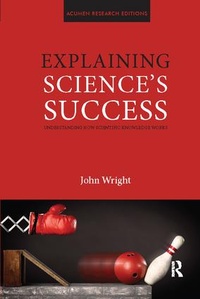
Explaining Science's Success
Understanding How Scientific Knowledge Works
1st Edition
Published on 13. July 2017
Book
Paperback/Softback
208 pages
978-1-138-10820-2 (ISBN)
Description
Paul Feyeraband famously asked, what's so great about science? One answer is that it has been surprisingly successful in getting things right about the natural world, more successful than non-scientific or pre-scientific systems, religion or philosophy. Science has been able to formulate theories that have successfully predicted novel observations. It has produced theories about parts of reality that were not observable or accessible at the time those theories were first advanced, but the claims about those inaccessible areas have since turned out to be true. And science has, on occasion, advanced on more or less a priori grounds theories that subsequently turned out to be highly empirically successful. In this book the philosopher of science, John Wright delves deep into science's methodology to offer an explanation for this remarkable success story.
More details
Language
English
Place of publication
London
United Kingdom
Publishing group
Taylor & Francis Ltd
Target group
College/higher education
Dimensions
Height: 234 mm
Width: 156 mm
Weight
453 gr
ISBN-13
978-1-138-10820-2 (9781138108202)
Copyright in bibliographic data and cover images is held by Nielsen Book Services Limited or by the publishers or by their respective licensors: all rights reserved.
Schweitzer Classification
Other editions
Additional editions
E-Book
09/2014
1st Edition
Routledge
€65.99
Available for download
E-Book
09/2014
1st Edition
Routledge
€65.99
Available for download
Book
11/2012
1st Edition
Acumen Publishing Ltd
€184.50
Shipment within 3-4 weeks
Person
Wright, John
Content
Introduction 1. Some surprising phenomena 2. Some unsatisfactory explanations of the phenomena 3. A defeasible a priori justification of induction 4. The independence of theory from data 5. Some more success-conducive properties of theories 6. Newton's law of motion and law of gravitation 7. Special relativity 8. Mendelian genetics 9. Conclusion