

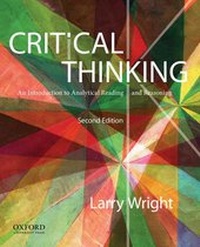
Critical Thinking
An Introduction to Analytical Reading and Reasoning
2nd Edition
Published on 23. June 2016
Book
Paperback/Softback
416 pages
978-0-19-979622-9 (ISBN)
Description
Critical Thinking: An Introduction to Analytical Reading and Reasoning, Second Edition, provides a nontechnical vocabulary and analytic apparatus that guide students in identifying and articulating the central patterns found in reasoning and in expository writing more generally. Understanding these patterns of reasoning helps students to better analyze, evaluate, and construct arguments and to more easily comprehend the full range of everyday arguments found in ordinary journalism.
Critical Thinking, Second Edition, distinguishes itself from other texts in the field by emphasizing analytical reading as an essential skill. It also provides detailed coverage of argument analysis, diagnostic arguments, diagnostic patterns, and fallacies.
Opening with two chapters on analytical reading that help students recognize what makes reasoning explicitly different from other expository activities, the text then presents an interrogative model of argument to guide them in the analysis and evaluation of reasoning. This model allows a detailed articulation of "inference to the best explanation" and gives students a view of the pervasiveness of this form of reasoning. The author demonstrates how many common argument types--from correlations to sampling--can be analyzed using this articulated form. He then extends the model to deal with several predictive and normative arguments and to display the value of the fallacy vocabulary.
Ideal for introductory courses in critical thinking, critical reasoning, informal logic, and inductive reasoning, Critical Thinking, Second Edition, features hundreds of exercises throughout and includes worked-out solutions and additional exercises (without solutions) at the end of each chapter. An Instructor's Manual--offering solutions to the text's unanswered exercises and featuring other pedagogical aids--is available on the book's Companion Website at www.oup.com/us/wright.
Critical Thinking, Second Edition, distinguishes itself from other texts in the field by emphasizing analytical reading as an essential skill. It also provides detailed coverage of argument analysis, diagnostic arguments, diagnostic patterns, and fallacies.
Opening with two chapters on analytical reading that help students recognize what makes reasoning explicitly different from other expository activities, the text then presents an interrogative model of argument to guide them in the analysis and evaluation of reasoning. This model allows a detailed articulation of "inference to the best explanation" and gives students a view of the pervasiveness of this form of reasoning. The author demonstrates how many common argument types--from correlations to sampling--can be analyzed using this articulated form. He then extends the model to deal with several predictive and normative arguments and to display the value of the fallacy vocabulary.
Ideal for introductory courses in critical thinking, critical reasoning, informal logic, and inductive reasoning, Critical Thinking, Second Edition, features hundreds of exercises throughout and includes worked-out solutions and additional exercises (without solutions) at the end of each chapter. An Instructor's Manual--offering solutions to the text's unanswered exercises and featuring other pedagogical aids--is available on the book's Companion Website at www.oup.com/us/wright.
Reviews / Votes
This is the best critical-thinking book on the market. Its strengths are its originality, thoughtfulness, attention to scholarship in informal logic/critical thinking, focus on the importance of critical-reading skills, and practical application to the kinds of reasoning we do every day through a remarkably careful discussion of inference to the best explanation. * Dale Turner, Cal Poly Pomona * I have seen students understand what they are reading and evaluate arguments in a meaningful way in classes where this text is being used. This in itself motivates me to use it. * Sharon Crasnow, Norco College, Riverside Community College District * Critical Thinking constitutes a unified approach to a whole trajectory of intellectual development; that is, it can take someone from 'able to read' all the way to 'able to think analytically and creatively about reasoning.' * Chris Campolo, Hendrix College *More details
Edition
2nd Revised edition
Language
English
Place of publication
New York
United States
Target group
College/higher education
Edition type
Revised edition
Dimensions
Height: 188 mm
Width: 231 mm
Thickness: 20 mm
Weight
635 gr
ISBN-13
978-0-19-979622-9 (9780199796229)
Copyright in bibliographic data and cover images is held by Nielsen Book Services Limited or by the publishers or by their respective licensors: all rights reserved.
Schweitzer Classification
Person
Larry Wright is Professor of Philosophy at the University of California, Riverside, where he has taught since 1970. He is the author of Practical Reasoning (1989), Better Reasoning: Techniques for Handling Argument, Evidence & Abstraction (1982), and Teleological Explanations: An Etiological Analysis of Goals and Functions (1976).
Content
CHAPTERS 1 AND 4-8 OPEN WITH AN INTRODUCTION; EACH CHAPTER ENDS WITH SUPPLEMENTAL EXERCISES AND ANSWERS; PART ONE. PARAPHRASING; 1. THE BARE-BONES PARAPHRASE; 2. READING FOR STRUCTURE: DEPENDENCY AND SUBORDINATION; 3. READING FOR REASONING: PARAPHRASING ARGUMENTS; PART TWO. ANALYZING REASONING; 4. ARGUMENT ANALYSIS: ANSWERING QUESTIONS; 5. DIAGNOSTIC ARGUMENTS: REASONING BY EXPLAINING; 6. DIAGNOSTIC PATTERNS; 7. FURTHER APPLICATIONS: PREDICTION AND RECOMMENDATION; 8. FALLACIES; APPENDIX. DEDUCTION