

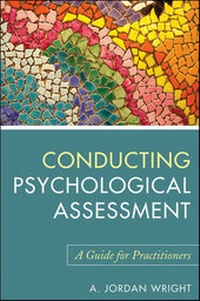
Conducting Psychological Assessment
A Guide for Practitioners
Published on 11. January 2011
Book
Paperback/Softback
528 pages
978-0-470-53675-9 (ISBN)
Description
A Valuable Guide to the Entire Process of Psychological Assessment
Carefully working through all the phases of assessment, including integrating, conceptualizing, test selection, administering, scoring, and report writing, Conducting Psychological Assessment provides clinicians with a step-by-step methodology for conducting skilled individual assessments, from beginning to end.
Unlike most guides to assessment, this book addresses the critical steps that follow administration, scoring, and interpretation--namely the integration of the data into a fully conceptualized report. Rich with case studies that illustrate every major point, this text provides a coherent structure for the entire process, taking into account the imperfection of both clinical intuition and specific psychological tests.
Conducting Psychological Assessment presents practitioners with an accessible framework to help make the process of psychological assessment quicker, easier, and more efficient. It offers a model designed to ensure that assessors provide ethical and competent services and make useful contributions to the lives of the individuals they assess.
Carefully working through all the phases of assessment, including integrating, conceptualizing, test selection, administering, scoring, and report writing, Conducting Psychological Assessment provides clinicians with a step-by-step methodology for conducting skilled individual assessments, from beginning to end.
Unlike most guides to assessment, this book addresses the critical steps that follow administration, scoring, and interpretation--namely the integration of the data into a fully conceptualized report. Rich with case studies that illustrate every major point, this text provides a coherent structure for the entire process, taking into account the imperfection of both clinical intuition and specific psychological tests.
Conducting Psychological Assessment presents practitioners with an accessible framework to help make the process of psychological assessment quicker, easier, and more efficient. It offers a model designed to ensure that assessors provide ethical and competent services and make useful contributions to the lives of the individuals they assess.
More details
Product info
Paperback
Edition
1. Auflage
Language
English
Place of publication
Chichester
United Kingdom
Publishing group
John Wiley and Sons Ltd
Target group
Professional and scholarly
Dimensions
Height: 23.4 cm
Width: 16.2 cm
Thickness: 3.5 cm
Weight
723 gr
ISBN-13
978-0-470-53675-9 (9780470536759)
Schweitzer Classification
Other editions
New editions
Book
11/2020
2nd Edition
Wiley
€68.00
Shipment within 15-20 days
Person
A. JORDAN WRIGHT, PHD, is a full-time faculty member in the Clinical Psychology PhD Program at Teachers College, Columbia University, and is the Director of Mental Health Services at The HOPE Program, a nonprofit organization serving individuals in poverty. Dr. Wright's primary areas of interest are the process of psychological assessment and the eradication of poverty. He is the Co-Director of Psychological Assessment Services of New York (PASNY).
Content
Preface.
Acknowledgments.
Part I Conducting Psychological Assessment.
Introduction: The Hypothesis Testing Model.
Chapter 1 Clinical Interviewing and Hypothesis Building.
Chapter 2 Selecting Tests.
Chapter 3 Testing.
Chapter 4 Integrating Data.
Chapter 5 Writing Reports.
Chapter 6 Providing Feedback.
Part II Case Studies in Psychological Assessment.
Introduction: Case Studies in Psychological Assessment.
Chapter 7 An Underachieving Woman.
Chapter 8 A Recovering Alcoholic.
Chapter 9 A Young Man Who Steals.
Chapter 10 A Boy in Foster Care.
Chapter 11 An Anxious Girl.
Chapter 12 An Aggressive Boy.
References.
Name Index.
Subject Index.
Acknowledgments.
Part I Conducting Psychological Assessment.
Introduction: The Hypothesis Testing Model.
Chapter 1 Clinical Interviewing and Hypothesis Building.
Chapter 2 Selecting Tests.
Chapter 3 Testing.
Chapter 4 Integrating Data.
Chapter 5 Writing Reports.
Chapter 6 Providing Feedback.
Part II Case Studies in Psychological Assessment.
Introduction: Case Studies in Psychological Assessment.
Chapter 7 An Underachieving Woman.
Chapter 8 A Recovering Alcoholic.
Chapter 9 A Young Man Who Steals.
Chapter 10 A Boy in Foster Care.
Chapter 11 An Anxious Girl.
Chapter 12 An Aggressive Boy.
References.
Name Index.
Subject Index.