

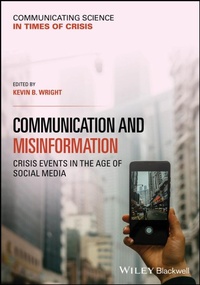
Communication and Misinformation
Crisis Events in the Age of Social Media
1st Edition
Published on 20. January 2025
Book
Paperback/Softback
240 pages
978-1-394-18494-1 (ISBN)
Description
Exploring the influence misinformation has on public perceptions of the risk and severity of crisis events
To what extent can social media networks reduce risks to the public during times of crisis?
How do theoretical frameworks help researchers understand the spread of misinformation?
Which research tools can identify and track misinformation about crisis events on social media?
What approaches may persuade those resistant to changing their perceptions of crisis events?
Communication and Misinformation presents cutting-edge research on the development, spread, and impact of online misinformation during crisis events. Edited by a leading scholar in the field, this timely and authoritative volume brings together a team of expert contributors to explore the both the practical aspects and research implications of the public's reliance on social media to obtain information in times of crisis.
Throughout the book, detailed chapters examine the increasingly critical role of risk and health communication, underscore the importance of identifying and analyzing the dissemination and impact of misinformation, provide strategies for correcting misinformation with science-based explanations for causes of crisis events, and more.
Addressing multiple contexts and perspectives, including political communication, reputational management, and social network theory, Communication and Misinformation: Crisis Events in the Age of Social Media is an essential resource for advanced undergraduate and graduate students, instructors, scholars, and public- and private-sector professionals in risk and crisis communication, strategic communication, public relations, and media studies.
To what extent can social media networks reduce risks to the public during times of crisis?
How do theoretical frameworks help researchers understand the spread of misinformation?
Which research tools can identify and track misinformation about crisis events on social media?
What approaches may persuade those resistant to changing their perceptions of crisis events?
Communication and Misinformation presents cutting-edge research on the development, spread, and impact of online misinformation during crisis events. Edited by a leading scholar in the field, this timely and authoritative volume brings together a team of expert contributors to explore the both the practical aspects and research implications of the public's reliance on social media to obtain information in times of crisis.
Throughout the book, detailed chapters examine the increasingly critical role of risk and health communication, underscore the importance of identifying and analyzing the dissemination and impact of misinformation, provide strategies for correcting misinformation with science-based explanations for causes of crisis events, and more.
Addressing multiple contexts and perspectives, including political communication, reputational management, and social network theory, Communication and Misinformation: Crisis Events in the Age of Social Media is an essential resource for advanced undergraduate and graduate students, instructors, scholars, and public- and private-sector professionals in risk and crisis communication, strategic communication, public relations, and media studies.
More details
Series
Language
English
Place of publication
United States
Publishing group
John Wiley & Sons Inc
Target group
Professional and scholarly
College/higher education
Product notice
Paperback (trade)
Unsewn / adhesive bound
Dimensions
Height: 249 mm
Width: 175 mm
Thickness: 13 mm
Weight
318 gr
ISBN-13
978-1-394-18494-1 (9781394184941)
Copyright in bibliographic data and cover images is held by Nielsen Book Services Limited or by the publishers or by their respective licensors: all rights reserved.
Schweitzer Classification
Other editions
Additional editions
E-Book
12/2024
1st Edition
Wiley
€56.99
Available for download
E-Book
12/2024
1st Edition
Wiley
€56.99
Available for download
Person
KEVIN B. WRIGHT is a Professor of Communication at George Mason University, where he teaches classes on health communication, crisis communication, and social media. With more than 20 years of experience as a communication scholar, Dr. Wright is the author of 8 books, 115 scholarly journal articles and book chapters, and 120 papers presented at national and international conferences.
Content
About the Editor ix
List of Contributors x
Preface xii
1 Characteristics of Crisis Misinformation Messages on Social Media 1
Christopher M. Dobmeier, Jessica A. Zier, and Nathan Walter
2 Social Media Networks, Social Support, and Misinformation During Crisis Situations 16
Kevin B. Wright
3 Emerging Media, Emotions, and Misperceptions in Health Crisis 31
Jiyoung Lee, Sai Datta Mikkilineni, and Eunsung Lee
4 Persuasion, Resistance, and Online Misinformation During Crisis 47
Sarah A. Geegan, Bobi Ivanov, and Kimberly A. Parker
5 Emergent Conceptual Frameworks of Disruption, Character Assassination, and Visual Disinformation in Crisis Communication Research 63
Sergei A. Samoilenko
6 Politicization of Health Issues: Misinformation and Social Media 77
Porismita Borah Copyrighted Material
7 Understanding and Mitigating Vaccine Misinformation on Social Media 90
Tong Lin, Yuan Wang, Kathryn Thier, and Xiaoli Nan
8 The Scope and Effects of Vaccine Misinformation on Social Media 106
Juliana L. Barbati, Kaylin L. Duncan, Kun Yan, Cindy Turner, Ida Tovar, Stephen A. Rains, and Echo L. Warner
9 Misinformation Identification and Correction 122
Rongwei Tang, Caitlin B. Neal, and Emily K. Vraga
10 Message Strategies for Misinformation Correction: Current Research, Challenges, and Opportunities 145
Yan Huang and Weirui Wang
11 Understanding the Role of Attention to Misinformation and Correction Mechanisms on Social Media with Eye- Tracking Technology: Implications for Climate Change Crisis Communication 163
Sojung Claire Kim, Emily K. Vraga, John Cook, and Sydney Carver
12 Inoculation Approaches to Science Misinformation Correction 180
Josh Compton
13 Big Data Approaches to Identifying Crisis Misinformation 196
Haoning Xue and Cuihua (Cindy) Shen
Index 215
List of Contributors x
Preface xii
1 Characteristics of Crisis Misinformation Messages on Social Media 1
Christopher M. Dobmeier, Jessica A. Zier, and Nathan Walter
2 Social Media Networks, Social Support, and Misinformation During Crisis Situations 16
Kevin B. Wright
3 Emerging Media, Emotions, and Misperceptions in Health Crisis 31
Jiyoung Lee, Sai Datta Mikkilineni, and Eunsung Lee
4 Persuasion, Resistance, and Online Misinformation During Crisis 47
Sarah A. Geegan, Bobi Ivanov, and Kimberly A. Parker
5 Emergent Conceptual Frameworks of Disruption, Character Assassination, and Visual Disinformation in Crisis Communication Research 63
Sergei A. Samoilenko
6 Politicization of Health Issues: Misinformation and Social Media 77
Porismita Borah Copyrighted Material
7 Understanding and Mitigating Vaccine Misinformation on Social Media 90
Tong Lin, Yuan Wang, Kathryn Thier, and Xiaoli Nan
8 The Scope and Effects of Vaccine Misinformation on Social Media 106
Juliana L. Barbati, Kaylin L. Duncan, Kun Yan, Cindy Turner, Ida Tovar, Stephen A. Rains, and Echo L. Warner
9 Misinformation Identification and Correction 122
Rongwei Tang, Caitlin B. Neal, and Emily K. Vraga
10 Message Strategies for Misinformation Correction: Current Research, Challenges, and Opportunities 145
Yan Huang and Weirui Wang
11 Understanding the Role of Attention to Misinformation and Correction Mechanisms on Social Media with Eye- Tracking Technology: Implications for Climate Change Crisis Communication 163
Sojung Claire Kim, Emily K. Vraga, John Cook, and Sydney Carver
12 Inoculation Approaches to Science Misinformation Correction 180
Josh Compton
13 Big Data Approaches to Identifying Crisis Misinformation 196
Haoning Xue and Cuihua (Cindy) Shen
Index 215