

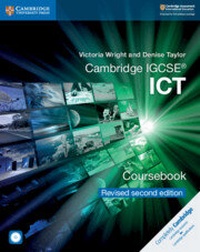
Cambridge IGCSE (R) ICT Coursebook with CD-ROM Revised Edition
2nd Edition
Published on 11. April 2019
Book
Mixed media product
312 pages
978-1-108-69806-1 (ISBN)
Description
This comprehensive resource is written to cover the Cambridge IGCSE ICT syllabus (0417). Cambridge IGCSE (R) ICT Second edition provides a complete course for developing and practising the skills required for students of Cambridge IGCSE ICT. The coursebook contains detailed explanations of concepts, worked examples and exercises to consolidate knowledge. The accompanying CD-ROM contains the source files required to complete the practical tasks set in the chapters. This Revised edition incorporates changes made to the syllabus for examination from 2020. Answers to the coursebook questions are in the teacher's resource.
More details
Series
Edition
2nd Revised edition
Language
English
Place of publication
Cambridge
United Kingdom
Target group
Primary & secondary/elementary & high school
Edition type
Revised edition
Illustrations
Worked examples or Exercises
Dimensions
Height: 276 mm
Width: 219 mm
Thickness: 13 mm
Weight
810 gr
ISBN-13
978-1-108-69806-1 (9781108698061)
Copyright in bibliographic data and cover images is held by Nielsen Book Services Limited or by the publishers or by their respective licensors: all rights reserved.
Schweitzer Classification
Other editions
New editions
David Waller | Victoria Wright | Denise Taylor
Cambridge IGCSE (TM) ICT Coursebook with Digital Access (2 Years)
Book
09/2021
3rd Edition
Cambridge University Press
€56.50
Shipment within 15-20 days
Previous edition
Victoria Wright | Denise Taylor
Cambridge IGCSE (R) ICT Coursebook with CD-ROM
Book
07/2016
2nd Edition
Cambridge University Press
€55.69
Article exhausted; check for reprint
Content
Introduction; 1. Types and components of computer systems; 2. Input and output devices; 3. Storage devices and media; 4. Networks and the effects of using them; 5. The effects of using IT; 6. ICT applications; 7. The systems life cycle; 8. Safety and security; 9. Audience; 10. Communication; 11. File management; 12. Images; 13. Layout; 14. Styles; 15. Proofing; 16. Graphs and charts; 17. Document production; 18. Data manipulation; 19. Presentation; 20. Data analysis; 21. Website authoring; Index.