

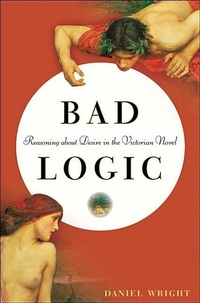
Bad Logic
Reasoning about Desire in the Victorian Novel
Published on 11. June 2018
Book
Hardback
232 pages
978-1-4214-2517-7 (ISBN)
Description
How did the Victorians think about love and desire?
"Reader, I married him," Jane Eyre famously says of her beloved Mr. Rochester near the end of Charlotte Bronte's novel. But why does she do it, we might logically ask, after all he's put her through? The Victorian realist novel privileges the marriage plot, in which love and desire are represented as formative social experiences. Yet how novelists depict their characters reasoning about that erotic desire-making something intelligible and ethically meaningful out of the aspect of interior life that would seem most essentially embodied, singular, and nonlinguistic-remains a difficult question.
In Bad Logic, Daniel Wright addresses this paradox, investigating how the Victorian novel represented reasoning about desire without diluting its intensity or making it mechanical. Connecting problems of sexuality to questions of logic and language, Wright posits that forms of reasoning that seem fuzzy, opaque, difficult, or simply "bad" can function as surprisingly rich mechanisms for speaking and thinking about erotic desire. These forms of "bad logic" surrounding sexuality ought not be read as mistakes, fallacies, or symptoms of sexual repression, Wright asserts, but rather as useful forms through which novelists illustrate the complexities of erotic desire.
Offering close readings of canonical writers Charlotte Bronte, Anthony Trollope, George Eliot, and Henry James, Bad Logic contextualizes their work within the historical development of the philosophy of language and the theory of sexuality. This book will interest a range of scholars working in Victorian literature, gender and sexuality studies, and interdisciplinary approaches to literature and philosophy.
"Reader, I married him," Jane Eyre famously says of her beloved Mr. Rochester near the end of Charlotte Bronte's novel. But why does she do it, we might logically ask, after all he's put her through? The Victorian realist novel privileges the marriage plot, in which love and desire are represented as formative social experiences. Yet how novelists depict their characters reasoning about that erotic desire-making something intelligible and ethically meaningful out of the aspect of interior life that would seem most essentially embodied, singular, and nonlinguistic-remains a difficult question.
In Bad Logic, Daniel Wright addresses this paradox, investigating how the Victorian novel represented reasoning about desire without diluting its intensity or making it mechanical. Connecting problems of sexuality to questions of logic and language, Wright posits that forms of reasoning that seem fuzzy, opaque, difficult, or simply "bad" can function as surprisingly rich mechanisms for speaking and thinking about erotic desire. These forms of "bad logic" surrounding sexuality ought not be read as mistakes, fallacies, or symptoms of sexual repression, Wright asserts, but rather as useful forms through which novelists illustrate the complexities of erotic desire.
Offering close readings of canonical writers Charlotte Bronte, Anthony Trollope, George Eliot, and Henry James, Bad Logic contextualizes their work within the historical development of the philosophy of language and the theory of sexuality. This book will interest a range of scholars working in Victorian literature, gender and sexuality studies, and interdisciplinary approaches to literature and philosophy.
Reviews / Votes
It is this attention to erotic energies and their struggle for articulacy that makes Bad Logic such a compelling intervention into a number of current debates in Victorian studies, and a striking declaration of fiction's wider philosophical exigency.-Times Higher Education Deploying a confident command of philosophical logic alongside an ear well attuned to moments of textual vulnerability, Wright offers a compelling account of the ways we twist the language of reason when "we're called up to make our erotic impulses intelligible to others or to ourselves" . . . Bad Logic is, at its core, a book of deep generosity. Where I had often seen stammer and bluster, or overly pat aphorism, Wright hears searching, and sacred, attempts to communicate. Beyond just offering readings, Bad Logic teaches how to listen . . . Bad Logic has given me a vocabulary for describing the ways in which the language of novels work when they are at their most tenuous and vulnerable.
-Jesse Rosenthal, Johns Hopkins University, Victorian Studies
More details
Language
English
Place of publication
Baltimore, MD
United States
Target group
Professional and scholarly
Product notice
sewn/stitched
Cloth over boards
Dimensions
Height: 231 mm
Width: 152 mm
Thickness: 23 mm
Weight
499 gr
ISBN-13
978-1-4214-2517-7 (9781421425177)
DOI
10.1353/book.58331
Copyright in bibliographic data and cover images is held by Nielsen Book Services Limited or by the publishers or by their respective licensors: all rights reserved.
Schweitzer Classification
Other editions
Additional editions
E-Book
06/2018
Johns Hopkins University Press
€41.49
Available for download
Person
Daniel Wright is an assistant professor of English at the University of Toronto.
Content
Acknolwedgements
To Give a Form to Formless Things
1. Charlotte Bronte's Contradictions
2. Anthony Trollope's Tautologies
3. George Eliot's Vagueness
4. Henry James's Generality
Queer Fiction and The Law
Notes
Bibliography
Index
To Give a Form to Formless Things
1. Charlotte Bronte's Contradictions
2. Anthony Trollope's Tautologies
3. George Eliot's Vagueness
4. Henry James's Generality
Queer Fiction and The Law
Notes
Bibliography
Index