

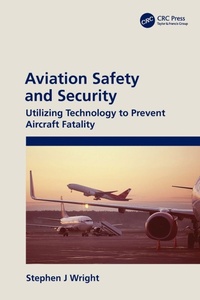
Aviation Safety and Security
Utilizing Technology to Prevent Aircraft Fatality
1st Edition
Published on 12. March 2025
Book
Paperback/Softback
186 pages
978-1-032-01344-2 (ISBN)
Description
This book focuses on ways to better manage and prevent aircraft-based homicide events while in flight using alternate technology to replace the Cockpit Voice Recorder (CVR) and/or Digital Flight Data Recorder (DFDR) functions. While these events are infrequent, the implementation of real-time predictive maintenance allows aircraft operators to better manage both scheduled and unscheduled maintenance events. Aviation Safety and Security: Utilizing Technology to Prevent Aircraft Fatality explores historical events of in-flight homicide and includes relevant accident case study excerpts from the National Transportation Safety Board (NTSB) and Air Accidents Investigation Branch (AAIB).
FEATURES
Explores historical events of in-flight homicide and offers solutions for ways to mitigate risk
Explains how alternate technologies can be implemented to address in-flight safety issues
Demonstrates that metrics for change are not solely for safety but also for financial savings for aircraft operation
Includes relevant accident case study excerpts from the NTSB and AAIB
Expresses the need for real-time predictive maintenance
Stephen J Wright is an academic Professor at the faculty of Engineering and Natural Sciences at Tampere University, Finland, specializing in aviation, aeronautical engineering, and aircraft systems.
FEATURES
Explores historical events of in-flight homicide and offers solutions for ways to mitigate risk
Explains how alternate technologies can be implemented to address in-flight safety issues
Demonstrates that metrics for change are not solely for safety but also for financial savings for aircraft operation
Includes relevant accident case study excerpts from the NTSB and AAIB
Expresses the need for real-time predictive maintenance
Stephen J Wright is an academic Professor at the faculty of Engineering and Natural Sciences at Tampere University, Finland, specializing in aviation, aeronautical engineering, and aircraft systems.
Reviews / Votes
"...This text is particularly well organized and presents a useful historical perspective on in-flight security, supported by a selection of case study information. Detailed chapters on aircraft technologies, including recording and usage of flight data and flight control information, current processes for minimizing loss of aircraft due to safety issues, and recommended modifications to existing processes and aircraft provide an outline of how technology supports prevention of fatality and aircraft loss...Overall, Wright presents a sweeping overview of a specialized topic in aviation not often discussed in textbook format. A fine introduction to in-flight aircraft security."K. M. Singh, Choice Reviews April 2022, USA
More details
Language
English
Place of publication
London
United Kingdom
Publishing group
Taylor & Francis Ltd
Target group
Professional and scholarly
Professional Practice & Development
Illustrations
99 s/w Abbildungen, 44 s/w Photographien bzw. Rasterbilder, 55 s/w Zeichnungen, 1 s/w Tabelle
1 Tables, black and white; 55 Line drawings, black and white; 44 Halftones, black and white; 99 Illustrations, black and white
Dimensions
Height: 234 mm
Width: 156 mm
Thickness: 11 mm
Weight
319 gr
ISBN-13
978-1-032-01344-2 (9781032013442)
Copyright in bibliographic data and cover images is held by Nielsen Book Services Limited or by the publishers or by their respective licensors: all rights reserved.
Schweitzer Classification
Other editions
Additional editions
Book
06/2021
1st Edition
CRC Press
€171.70
Shipment within 15-20 days
E-Book
06/2021
1st Edition
CRC Press
€52.49
Available for download
E-Book
06/2021
1st Edition
CRC Press
€52.49
Available for download
Person
Prof. Stephen J Wright is a professorial academic member of staff in the Faculty of Engineering and Natural Sciences at Tampere University, Finland, specialising in Aviation, Aeronautical Engineering and Aircraft Systems. In addition to his university activities, Prof. Wright continues (at the time of writing) to hold the esteemed post of President for the Finnish Society of Aeronautical Engineers, is a past Member of the Royal Aeronautical Society, UK, and is a life-long Fellow of the Higher Educational Academy, UK.
He holds a PhD from the University of Leeds, UK, in the fouling and failure of commercial aircraft air conditioning systems. Other academic qualifications include a Post Graduate Certification of teaching and learning in Higher Education, awarded by Kingston University, London. He gained a Bachelor of Science in Chemistry from the University of Sussex, with additional studies at Uppsala Universitiet, Sweden.
Prof. Wright engages formally with numerous elements of the European Commission as a recognised expert in Aviation/ Aeronautical Engineering. He is fully committed to the objectives and aspirations to improve the industry, that will allow for better and more effective air transportation (Flightpath 2050 / Master Plan).
Lastly, Prof. Wright has attended and passed examination for numerous manufacturer 'line and base' maintenance engineering type rating courses (B1.1 discipline) associated with his previous commercial aviation employment, in addition to holding a European Aviation Safety Agency Flight Crew license for single engine piston aircraft.
He holds a PhD from the University of Leeds, UK, in the fouling and failure of commercial aircraft air conditioning systems. Other academic qualifications include a Post Graduate Certification of teaching and learning in Higher Education, awarded by Kingston University, London. He gained a Bachelor of Science in Chemistry from the University of Sussex, with additional studies at Uppsala Universitiet, Sweden.
Prof. Wright engages formally with numerous elements of the European Commission as a recognised expert in Aviation/ Aeronautical Engineering. He is fully committed to the objectives and aspirations to improve the industry, that will allow for better and more effective air transportation (Flightpath 2050 / Master Plan).
Lastly, Prof. Wright has attended and passed examination for numerous manufacturer 'line and base' maintenance engineering type rating courses (B1.1 discipline) associated with his previous commercial aviation employment, in addition to holding a European Aviation Safety Agency Flight Crew license for single engine piston aircraft.
Content
1. Introduction 2. History of Security Events 3. Flight Data Recorders and Cockpit Voice Recorders 4. Flight Controls and Environmental Control Systems 5. Use of Live Aircraft Data in Aircraft Maintenance Management 6. Human Factors and Safety Management Systems 7. Aircraft Security 8. Unusual Losses of Aircraft 9. Minimizing Loss: Modifying Current Aircraft and Processes