

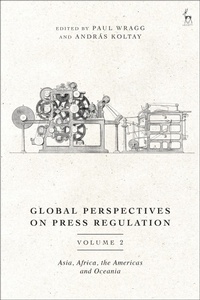
Global Perspectives on Press Regulation, Volume 2
Asia, Africa, the Americas and Oceania
Published on 28. August 2025
Book
Paperback/Softback
368 pages
978-1-5099-5043-0 (ISBN)
Description
In this ground-breaking two-volume set, world-leading experts produce a rich, authoritative depiction of the world's press, its freedom, and its limits.
We want press freedom but we also want freedom from the press. A powerful press may expose corrupt government or aid it. It may champion citizens or unfairly attack them. A vulnerable press may lack supporters and succumb to conformity. It may resist, and overcome tyranny. According to common belief, press freedom involves social responsibilities to equip public debate and render government transparent. Is this attitude valid given that the press is usually a private, commercial actor?
Globally, the health, authority, and viability of the press varies dramatically. These patterns do not conform to traditional divisions between North and South, East and West. Instead, they are much more complex. How do we measure successful press regulation? What concessions can the state and/or society demand of the press? What constitutes the irreducible core of press freedom?
The contributions in Volume 1 look at key jurisdictions in Europe; whereas Volume 2 goes beyond Europe to analyse the situation in key jurisdictions in Asia, Africa, the Americas and Oceania. Each volume can be used independently or as part of the complete set.
This work will be incredibly valuable to policy makers and academics who seek to capture the global picture for the purposes of effecting change.
We want press freedom but we also want freedom from the press. A powerful press may expose corrupt government or aid it. It may champion citizens or unfairly attack them. A vulnerable press may lack supporters and succumb to conformity. It may resist, and overcome tyranny. According to common belief, press freedom involves social responsibilities to equip public debate and render government transparent. Is this attitude valid given that the press is usually a private, commercial actor?
Globally, the health, authority, and viability of the press varies dramatically. These patterns do not conform to traditional divisions between North and South, East and West. Instead, they are much more complex. How do we measure successful press regulation? What concessions can the state and/or society demand of the press? What constitutes the irreducible core of press freedom?
The contributions in Volume 1 look at key jurisdictions in Europe; whereas Volume 2 goes beyond Europe to analyse the situation in key jurisdictions in Asia, Africa, the Americas and Oceania. Each volume can be used independently or as part of the complete set.
This work will be incredibly valuable to policy makers and academics who seek to capture the global picture for the purposes of effecting change.
More details
Language
English
Place of publication
Oxford
United Kingdom
Publishing group
Bloomsbury Publishing PLC
Target group
College/higher education
Professional and scholarly
Dimensions
Height: 234 mm
Width: 156 mm
Thickness: 20 mm
Weight
550 gr
ISBN-13
978-1-5099-5043-0 (9781509950430)
Copyright in bibliographic data and cover images is held by Nielsen Book Services Limited or by the publishers or by their respective licensors: all rights reserved.
Schweitzer Classification
Other editions
Additional editions
Paul Wragg | Andras Koltay
Global Perspectives on Press Regulation, Volume 2
Asia, Africa, the Americas and Oceania
E-Book
02/2024
1st Edition
Hart Publishing
€49.99
Available for download
Paul Wragg | Andras Koltay
Global Perspectives on Press Regulation, Volume 2
Asia, Africa, the Americas and Oceania
E-Book
02/2024
1st Edition
Hart Publishing
€49.99
Available for download
Persons
Paul Wragg is Professor of Media Law at the University of Leeds, UK.
Andras Koltay is Professor of Law at the University of Public Service, Budapest, Hungary and at the Pazmany Peter Catholic University, Budapest, Hungary.
Andras Koltay is Professor of Law at the University of Public Service, Budapest, Hungary and at the Pazmany Peter Catholic University, Budapest, Hungary.
Content
The Scope of the Regulatory Ideal: Vertical Freedom, Horizontal Restrictions, Paul Wragg (University of Leeds, UK)
ASIA
1. Between Politics and Commerce: Media Governance in China, Hualing Fu (University of Hong Kong, Hong Kong)
2. The Uncommon Law in the Hong Kong SAR: The Shifting Norms of Press Freedom under the National Security Law, Anne SY Cheung (University of Hong Kong, Hong Kong)
3. Regulation of Press in India - An Overview of the Legal Framework and Related Concerns, Annappa Nagarathna (National Law School of India University, India)
4. Israeli Perspectives on Press Freedom and Regulation, Tehilla Shwartz Altshuler (Israel Democracy Institute, Israel)
5. Freedom Versus Regulation: An Evolving Free Press in South Korea, Ahran Park (Korea University, South Korea) and Kyu Ho Youm (University of Oregon, USA)
AFRICA
6. Transforming Information and Communication Technologies from Infrastructures of Freedom to Architectures of Political Repression: The Case of Internet Shutdowns in Egypt and Cameroon, Lyombe Eko (Texas Tech University, USA)
7. Free Expression of the Traditional Media in South Africa and the Constraints Imposed by Law, John Campbell (36 Group, UK) and Suhail Mohammed (Group One Advocates, South Africa)
THE AMERICAS
8. Why is Freedom of the Press Adjunct to Freedom of Expression in Canada? David Mangan (Maynooth University, Ireland)
9. Media Regulation in Chile: Authority and Liberty Compounded, John Charney (Pontificia Universidad Catolica de Valparaiso, Chile)
10. The US Press: A Legal Framework of Complexity, Contradiction and Uncertainty, Lili Levi (University of Miami, USA)
OCEANIA
11. Media Regulation and Press Freedom in Australia: Problems Without Resolution, David Rolph (University of Sydney, Australia)
12. One Body to Rule Them All: Press Regulation in New Zealand, Ursula Cheer (University of Canterbury, New Zealand)
Conclusions, Andras Koltay (University of Public Service, Budapest)
ASIA
1. Between Politics and Commerce: Media Governance in China, Hualing Fu (University of Hong Kong, Hong Kong)
2. The Uncommon Law in the Hong Kong SAR: The Shifting Norms of Press Freedom under the National Security Law, Anne SY Cheung (University of Hong Kong, Hong Kong)
3. Regulation of Press in India - An Overview of the Legal Framework and Related Concerns, Annappa Nagarathna (National Law School of India University, India)
4. Israeli Perspectives on Press Freedom and Regulation, Tehilla Shwartz Altshuler (Israel Democracy Institute, Israel)
5. Freedom Versus Regulation: An Evolving Free Press in South Korea, Ahran Park (Korea University, South Korea) and Kyu Ho Youm (University of Oregon, USA)
AFRICA
6. Transforming Information and Communication Technologies from Infrastructures of Freedom to Architectures of Political Repression: The Case of Internet Shutdowns in Egypt and Cameroon, Lyombe Eko (Texas Tech University, USA)
7. Free Expression of the Traditional Media in South Africa and the Constraints Imposed by Law, John Campbell (36 Group, UK) and Suhail Mohammed (Group One Advocates, South Africa)
THE AMERICAS
8. Why is Freedom of the Press Adjunct to Freedom of Expression in Canada? David Mangan (Maynooth University, Ireland)
9. Media Regulation in Chile: Authority and Liberty Compounded, John Charney (Pontificia Universidad Catolica de Valparaiso, Chile)
10. The US Press: A Legal Framework of Complexity, Contradiction and Uncertainty, Lili Levi (University of Miami, USA)
OCEANIA
11. Media Regulation and Press Freedom in Australia: Problems Without Resolution, David Rolph (University of Sydney, Australia)
12. One Body to Rule Them All: Press Regulation in New Zealand, Ursula Cheer (University of Canterbury, New Zealand)
Conclusions, Andras Koltay (University of Public Service, Budapest)