

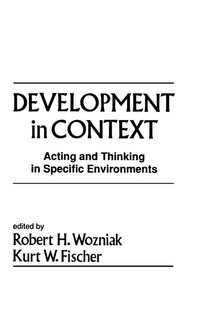
Development in Context
Acting and Thinking in Specific Environments
Published on 1. May 1993
Book
Hardback
308 pages
978-0-8058-0769-1 (ISBN)
Description
In this volume leading developmentalists address the question of how children's thinking develops in context by drawing on the theories of Vygotsky, Gibson, and Piaget.
Analyses of the ecology and the dynamics of behavior have become popular, emphasizing the particulars of people acting in specific environments and the many complex factors of human body and mind that contribute to action and thought. This volume brings together many of the current efforts to deal with development in this richly ecological, dynamic way.
The research reported demonstrates that recent years have produced major shifts in approach. Activities are studied as they naturally occur in everyday contexts. Children's active construction of the world around them is treated as fundamentally social in nature, occurring in families, with peers, and in cultures. Behavior is studied not as something disembodied but within a rich matrix of body, emotion, belief, value, and physical world. Behavior is analyzed as changing dynamically, not only over seconds and minutes, but over hours, days, and years.
Analyses of the ecology and the dynamics of behavior have become popular, emphasizing the particulars of people acting in specific environments and the many complex factors of human body and mind that contribute to action and thought. This volume brings together many of the current efforts to deal with development in this richly ecological, dynamic way.
The research reported demonstrates that recent years have produced major shifts in approach. Activities are studied as they naturally occur in everyday contexts. Children's active construction of the world around them is treated as fundamentally social in nature, occurring in families, with peers, and in cultures. Behavior is studied not as something disembodied but within a rich matrix of body, emotion, belief, value, and physical world. Behavior is analyzed as changing dynamically, not only over seconds and minutes, but over hours, days, and years.
Reviews / Votes
"The content of this volume has broad-based appeal both within psychology and across disciplines."-Child Development Abstracts & Bibliography
More details
Series
Language
English
Place of publication
Philadelphia
United States
Publishing group
Taylor & Francis Inc
Target group
College/higher education
Professional and scholarly
Dimensions
Height: 235 mm
Width: 157 mm
Thickness: 21 mm
Weight
599 gr
ISBN-13
978-0-8058-0769-1 (9780805807691)
Copyright in bibliographic data and cover images is held by Nielsen Book Services Limited or by the publishers or by their respective licensors: all rights reserved.
Schweitzer Classification
Other editions
Additional editions
Robert H. Wozniak | Kurt W. Fischer
Development in Context
Acting and Thinking in Specific Environments
Book
07/2015
1st Edition
Psychology Press Ltd
€86.00
Shipment within 10-20 days
Robert H. Wozniak | Kurt W. Fischer
Development in Context
Acting and Thinking in Specific Environments
E-Book
02/2014
1st Edition
Psychology Press Ltd
€78.99
Available for download
Robert H. Wozniak | Kurt W. Fischer
Development in Context
Acting and Thinking in Specific Environments
E-Book
02/2014
1st Edition
Psychology Press Ltd
€78.99
Available for download
Persons
Kurt W. Fischer, Robert H. Wozniak
Content
Contents: R.H. Wozniak, K.W. Fischer, Development in Context: An Introduction. Part I:Ecosystems, Affordances, Transactions, and Skills: Theories of Person/Situation Interaction.U. Bronfenbrenner, The Ecology of Cognitive Development: Research Models and Fugitive Findings. E.S. Reed, The Intention to Use a Specific Affordance: A Conceptual Framework for Psychology. R.H. Wozniak, Co-Constructive Metatheory for Psychology: Implications for an Analysis of Families as Specific Social Contexts for Development. K.W. Fischer, D.H. Bullock, E.J. Rotenberg, P. Raya, The Dynamics of Competence: How Context Contributes Directly to Skill. Part II:Context and the Acquisition of Sociocultural Knowledge.B. Rogoff, Children's Guided Participation and Participatory Appropriation in Sociocultural Activity. R.M. Downs, L.S. Liben, Mediating the Environment: Communicating, Appropriating, and Developing Graphic Representations of Place. N. Granott, Patterns of Interaction in the Co-Construction of Knowledge: Separate Minds, Joint Effort, and Weird Creatures. Part III:Social Systems as Specific Contexts for Development.I.E. Sigel, E.T. Stinson, M-I. Kim, Socialization of Cognition: The Distancing Model. D.H. Feldman, Cultural Organisms in the Development of Great Potential: Referees, Termites, and the Aspen Music Festival. Part IV:Commentaries.J.A. Meacham, Where Is the Social Environment? A Commentary on Reed. W. Kessen, Rumble or Revolution: A Commentary.