

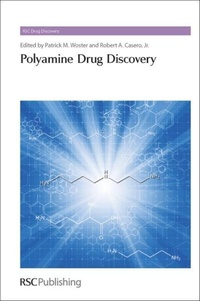
Polyamine Drug Discovery
Published on 30. November 2011
Book
Hardback
302 pages
978-1-84973-190-4 (ISBN)
Description
Polyamines are ubiquitous molecules that are involved in a number of important cellular processes. Aberrations in their function or metabolism play a role in diseases such as cancer and parasitic infection. A number of validated drug targets have been identified, including enzymes in the polyamine biosynthetic and catabolic pathways and the S-adenosylmethionine synthetic and salvage pathways. Polyamine Drug Discovery is the first comprehensive volume to cover all aspects of the design and development of potential therapeutics targeting polyamine metabolism. The book details research progress from 1975 to the present date and discusses the design and use of polyamine metabolism inhibitors as therapeutic agents. Various polyamine-containing drugs are described that can be used in chemotherapy, and as treatments for infections including trypanosomiasis, leishmaniasis and malaria. Finally, the roles of polyamine analogues in chemoprevention, polyamine-containing vectors for gene delivery, and the design of polyamine-based epigenetic modulators are detailed. Each chapter addresses a different aspect of polyamine drug discovery and all are written by medicinal and biological chemists with particular expertise in developing agents that modulate polyamine metabolism or function. The book will increase the visibility of polyamine drug discovery among pharmaceutical researchers and provide a valuable reference for everyone working in the field.
Reviews / Votes
The link between the chapters is well achieved and gives an overall clear story of polyamine drug discovery, from starting compound synthesis to remarkable pharmaceutical investigations. -- Prof. Raphael Tripier * ChemMedChem 2012, 7, 1858 - 1862 * The book covers a very important aspect of linear polyamine research at the interface of chemistry and human health. -- Prof. Raphael Tripier * ChemMedChem 2012, 7, 1858 - 1862 * it will be a valuable resource for those seeking an overview of polyamine research and access to the primary literature. -- Prof. Raphael Tripier * ChemMedChem 2012, 7, 1858 - 1862 * Throughout the book, the authors and editors have successfully attempted to introduce some elements of constructive reviewing, highlighting limitations and further developments that are required in the field. This gives the book an important impact that many researchers will undoubtedly appreciate. -- Prof. Raphael Tripier * ChemMedChem 2012, 7, 1858 - 1862 *More details
Series
Language
English
Place of publication
Cambridge
United Kingdom
Target group
Professional and scholarly
Product notice
Unsewn / adhesive bound
Dimensions
Height: 241 mm
Width: 162 mm
Thickness: 24 mm
Weight
594 gr
ISBN-13
978-1-84973-190-4 (9781849731904)
Copyright in bibliographic data and cover images is held by Nielsen Book Services Limited or by the publishers or by their respective licensors: all rights reserved.
Schweitzer Classification
Other editions
Additional editions
Patrick Woster | Robert Casero
Polyamine Drug Discovery
E-Book
11/2011
1st Edition
Royal Society of Chemistry
€184.99
Available for download
Complete work / Part of the work
Drug Discovery Series Set
2010-2014
Other
06/2015
Royal Society of Chemistry
€7,798.50
Article not available at the moment
Persons
Patrick M. Woster, Ph.D. is Professor and Center for Economic Excellence Endowed Chair in the Department of Pharmaceutical and Biomedical Sciences at the Medical University of South Carolina. He is a medicinal chemist with an interest in the synthesis of molecules that modulate polyamine metabolism or chromatin remodeling as potential antitumor agents. Dr. Woster also maintains a program in antiparasitic drug discovery with a particular emphasis on malaria and trypanosomiasis. He has produced a number of inhibitors that target enzymes in the polyamine biosynthetic pathway, and synthesized the first unsymmetrically substituted alkylpolyamine analogues. Molecules developed in the Woster laboratory have been shown to produce dramatic effects on a variety of tumor cells by initiating apoptosis, binding to DNA and by producing epigenetic changes in gene expression. Robert A. Casero, Jr., Ph.D. is a Professor of Oncology in the Johns Hopkins University School of Medicine. Dr. Casero is a molecular pharmacologist who has spent most of the last 30 years studying the role of polyamines in normal and tumour cell growth, and devising strategies to target polyamine function and metabolism for therapeutic benefit. His laboratory was responsible for cloning several genes involved in human polyamine catabolism; genes whose expression are thought to play a role in determining cellular responses to specific polyamine analogues.
Content
Polyamine Drug Discovery: Synthetic Approaches to Therapeutic Modulators of Polyamine Metabolism;
Structural Biology in Polyamine Drug Discovery;
Antiparasitic Drug Discovery for the Polyamine Pathway;
Inhibitors of Polyamine Biosynthetic Enzymes;
Symmetrical- and Unsymmetrical Terminally Alkylated Polyamines;
Targeting the Polyamine Catabolic Enzymes Spermine Oxidase, N1-Acetylpolyamine Oxidase and Spermidine/Spermine-N1-Acetyltransferase;
Design of Polyamine Transport Inhibitors as Therapeutics;
Non-Covalent Polynuclear Platinum Compounds as Polyamine Analogs;
Polyamine-Based Agents for Gene and siRNA Transfer;
The Design and Development of Polyamine-Based Analogs with Epigenetic Targets;
Clinical Applications of Polyamine-Based Therapeutics;
Subject Index
Structural Biology in Polyamine Drug Discovery;
Antiparasitic Drug Discovery for the Polyamine Pathway;
Inhibitors of Polyamine Biosynthetic Enzymes;
Symmetrical- and Unsymmetrical Terminally Alkylated Polyamines;
Targeting the Polyamine Catabolic Enzymes Spermine Oxidase, N1-Acetylpolyamine Oxidase and Spermidine/Spermine-N1-Acetyltransferase;
Design of Polyamine Transport Inhibitors as Therapeutics;
Non-Covalent Polynuclear Platinum Compounds as Polyamine Analogs;
Polyamine-Based Agents for Gene and siRNA Transfer;
The Design and Development of Polyamine-Based Analogs with Epigenetic Targets;
Clinical Applications of Polyamine-Based Therapeutics;
Subject Index