

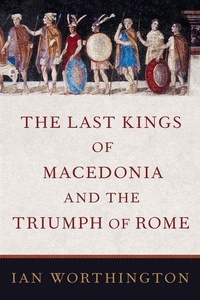
The Last Kings of Macedonia and the Triumph of Rome
Published on 8. June 2023
Book
Hardback
320 pages
978-0-19-752005-5 (ISBN)
Description
In the history of ancient Macedonia, the last three Antigonid kings--Philip V (r. 221-179), his son Perseus (r. 179-168), and the pretender Andriscus or Philip VI (r. 149-148)--are commonly overlooked in favor of their predecessors Philip II (r. 359-336) and his son Alexander the Great (r. 336-323), who established a Macedonian empire. By the time Philip V became king, Macedonia was no longer an imperial power and Rome was fast spreading its dominance over the Mediterranean. Viewed as postscripts to the kingdom's heyday, the last Macedonian kings are often denounced for self-serving ambitions, flawed policies, and questionable personal qualities by hostile ancient writers. They are condemned for defeats by Rome that saw both the end of the monarchy and the fall of the formidable Macedonian phalanx before the Roman legion.
In The Last Kings of Macedonia and the Triumph of Rome, Ian Worthington reassesses these three kings and demonstrates how such denunciations are inaccurate. Producing the first full-scale treatment of Philip V in eighty years and the first in English of Perseus and Andriscus in more than fifty, Worthington argues that this period was far from a postscript to Macedonia's Classical greatness and disagrees that the last Antigonid kings were merely collateral damage in Rome's ascendancy in the east. Despite superior Roman manpower and resources, Philip and Perseus often had the upper hand in their wars against Rome. As Worthington asserts, these kings deserve to be remembered for striving to preserve their kingdom's independence against staggering odds.
In The Last Kings of Macedonia and the Triumph of Rome, Ian Worthington reassesses these three kings and demonstrates how such denunciations are inaccurate. Producing the first full-scale treatment of Philip V in eighty years and the first in English of Perseus and Andriscus in more than fifty, Worthington argues that this period was far from a postscript to Macedonia's Classical greatness and disagrees that the last Antigonid kings were merely collateral damage in Rome's ascendancy in the east. Despite superior Roman manpower and resources, Philip and Perseus often had the upper hand in their wars against Rome. As Worthington asserts, these kings deserve to be remembered for striving to preserve their kingdom's independence against staggering odds.
Reviews / Votes
The Macedonian king Philip V is usually remembered as the man whose alliance with Hannibal triggered the Roman expansion in the East. Drawing upon epigraphic discoveries of the last decades that document Philip's military and administrative reforms and responses to crises and correct the hostile account of the historian Polybius, Ian Worthington has composed a nuanced and up-to-date narrative of a life that started with ambitions and triumphs, and ended with defeats and tragedies. Philip's actions generated a process that Polybius calls symploke: the entanglement of political developments in Europe, Africa, and Asia. With this book, he now takes the place that he deserves among the greatest protagonists of the Hellenistic Age. * Angelos Chaniotis, Institute for Advanced Study, Princeton * A brilliant and much-needed volume on the last kings of ancient Macedonia. Worthington duly gives Philip V, Perseus, and Andriscus (Philip VI) the attention they deserve, challenging the view that they are mere 'postscripts' to Macedonia's Classical past and losers in the fight for supremacy in the second century BC Mediterranean. This updated history will undoubtedly foster interest in the last Antigonid kings and revise our understanding of the conflict between Macedonia and Rome. * Emma Nicholson, University of Exeter * [The book] may be enjoyed by a general audience, but also profitably read by undergraduates as a scholarly introduction and graduate students as a brisk refresher to one of the most important, if doomed, dynasties of the Hellenistic world. * Bryn Mawr Classical Review * W.'s book is a valuable and indispensable narrative of the last Antigonids that offers a lens through which we are better able to understand that turbulent period of the Hellenistic era. It also sheds light on some of the political dynamics that shaped Rome's fateful entrance and continuing presence in Greek affairs, by delving into all the subtleties and intricacies of the conflicts involving the last eight decades or so of the Macedonian kingdom. * Elizabeth Kosmetatou, Classical Review * Perfectly accessible, this relevant and welcome synthesis for researchers and students alike will find, as such, and for a long time to come, a deserved place in the bibliography of Macedonian studies. * Pierre Bourrieau, Kentron *More details
Language
English
Place of publication
New York
United States
Target group
College/higher education
Illustrations
23 black & white halftones, 7 maps
Dimensions
Height: 238 mm
Width: 161 mm
Thickness: 32 mm
Weight
578 gr
ISBN-13
978-0-19-752005-5 (9780197520055)
Copyright in bibliographic data and cover images is held by Nielsen Book Services Limited or by the publishers or by their respective licensors: all rights reserved.
Schweitzer Classification
Other editions
Additional editions
Ian Worthington
The Last Kings of Macedonia and the Triumph of Rome
E-Book
03/2023
OUP eBook
€9.99
Available for download
Ian Worthington
The Last Kings of Macedonia and the Triumph of Rome
E-Book
03/2023
OUP eBook
€9.99
Available for download
Person
Ian Worthington is Professor of Ancient History at Macquarie University. His many publications include Athens after Empire, Ptolemy I, By the Spear, and Demosthenes of Athens and the Fall of Classical Greece. He has served as Editor-in-Chief of Brill's New Jacoby since 2003, and in 2019 and 2020 was elected a Fellow of the Royal Historical Society (London) and the Society of Antiquaries (London), respectively.
Content
Preface Figures Abbreviations Maps Introduction: We Three Kings 1. The Kingdom of Macedonia
2. Introducing Philip V
3. The Social War
4. Taking on Rome
5. From the First to the Second Macedonian Wars
6. The Second Macedonian War
7. Fall of the Phalanx
8. Macedonia Renascent
9. Perseus: Last of the Antigonids
10. The Third Macedonian War
11. Dismembering Macedonia
12. Provincia Macedonia Appendix: "Fake News:" The Sources on Philip V and Perseus
Bibliography, Index
2. Introducing Philip V
3. The Social War
4. Taking on Rome
5. From the First to the Second Macedonian Wars
6. The Second Macedonian War
7. Fall of the Phalanx
8. Macedonia Renascent
9. Perseus: Last of the Antigonids
10. The Third Macedonian War
11. Dismembering Macedonia
12. Provincia Macedonia Appendix: "Fake News:" The Sources on Philip V and Perseus
Bibliography, Index