

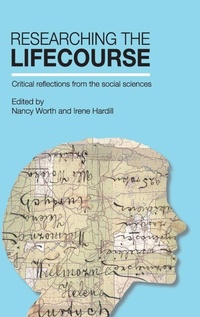
Researching the Lifecourse
Critical Reflections from the Social Sciences
1st Edition
Published on 30. June 2015
Book
Hardback
240 pages
978-1-4473-1752-4 (ISBN)
Description
The lifecourse perspective continues to be an important subject in the social sciences. Researching the Lifecourse offers a distinctive approach in that it truly covers the lifecourse (childhood, adulthood and older age), focusing on innovative methods and case study examples from a variety of European and North American contexts. This original approach connects theory and practice from across the social sciences by situating methodology and research design within relevant conceptual frameworks. This diverse collection features methods that are linked to questions of time, space and mobilities while providing practitioners with practical detail in each chapter.
Reviews / Votes
"This edited volume clearly contributes to the debate on the role of time, space and mobility at different stages of the life course and promises to be of great interest for social science researchers across the various disciplines such as sociology, anthropology, geography and demography." Journal of Population Ageing "A highly provocative and engaging work, raising questions about the epistemology of life course research across themes of time, space, and mobilities." Jeylan Mortimer, University of Minnesota "Clearly and engagingly written, this collection illustrates and reflects on diverse methodologies for enriching life course studies . It is a major resource for researchers across the social sciences." Janice Monk, University of ArizonaMore details
Edition
First Edition
Language
English
Place of publication
Bristol
United Kingdom
Publishing group
Bristol University Press
Target group
College/higher education
Illustrations
Not illustrated
Dimensions
Height: 240 mm
Width: 161 mm
Thickness: 19 mm
Weight
570 gr
ISBN-13
978-1-4473-1752-4 (9781447317524)
Copyright in bibliographic data and cover images is held by Nielsen Book Services Limited or by the publishers or by their respective licensors: all rights reserved.
Schweitzer Classification
Other editions
Additional editions
E-Book
06/2016
1st Edition
Policy Press
€47.99
Available for download
E-Book
06/2015
1st Edition
Policy Press
€231.99
Available for download
Persons
Nancy Worth is a Banting Fellow in the School of Geography and Earth Sciences at McMaster University, Canada. Co-editor of Intergenerational Space (Routledge, 2014), her work focuses on the geographies of youth and young adulthood.
Irene Hardill is Professor of Public Policy and Director of the Centre for Civil Society and Citizenship, Northumbria University, UK. Co-author of Enterprising Care (Policy Press, 2011), her work focuses on theorising work (paid and unpaid).
Irene Hardill is Professor of Public Policy and Director of the Centre for Civil Society and Citizenship, Northumbria University, UK. Co-author of Enterprising Care (Policy Press, 2011), her work focuses on theorising work (paid and unpaid).
Content
Introduction ~ Nancy Worth & Irene Hardill;
Part I: Time;
Time and the lifecourse: perspectives from qualitative longitudinal research ~ Bren Neale;
Time in mixed methods longitudinal research: working across written narratives and large-scale panel survey data to investigate attitudes to volunteering ~ Rose Lindsey, Elizabeth Metcalfe & Rosalind Edwards;
A restudy of young workers from the 1960s: researching intersections of work and lifecourse in one locality over 50 years ~ John Goodwin & Henrietta O'Connor;
A method for collecting lifecourse data: assessing the utility of the lifegrid ~ Ann Del Bianco;
Part II: Space & place;
Life geohistories: examining formative experiences and geographies ~ Bisola Falola;
Using mapmaking to research the geographies of young children affected by political violence ~ Bree Akesson;
Keeping in touch: studying the personal communities of women in their fifties ~ Sophie Bowlby;
Triangulation with softGIS in lifecourse research: situated action possibilities and embodied knowledge ~ Kaisa Schmidt-Thome;
Part III: Mobilities;
Using a life history approach within transnational ethnography: a case study of Korean New Zealander returnees ~ Jane Yeonjae Lee;
Sensing sense and mobility at the end of the lifecourse: a methodology of embodied interaction ~ Anne Leonora Blaakilde;
Event history approach to life spaces in French-speaking research ~ Francoise Dureau, Matthieu Giroud & Christophe Imbert;
Using an intersectional lifecourse approach to understand the migration of the highly skilled ~ Melissa Kelly.
Part I: Time;
Time and the lifecourse: perspectives from qualitative longitudinal research ~ Bren Neale;
Time in mixed methods longitudinal research: working across written narratives and large-scale panel survey data to investigate attitudes to volunteering ~ Rose Lindsey, Elizabeth Metcalfe & Rosalind Edwards;
A restudy of young workers from the 1960s: researching intersections of work and lifecourse in one locality over 50 years ~ John Goodwin & Henrietta O'Connor;
A method for collecting lifecourse data: assessing the utility of the lifegrid ~ Ann Del Bianco;
Part II: Space & place;
Life geohistories: examining formative experiences and geographies ~ Bisola Falola;
Using mapmaking to research the geographies of young children affected by political violence ~ Bree Akesson;
Keeping in touch: studying the personal communities of women in their fifties ~ Sophie Bowlby;
Triangulation with softGIS in lifecourse research: situated action possibilities and embodied knowledge ~ Kaisa Schmidt-Thome;
Part III: Mobilities;
Using a life history approach within transnational ethnography: a case study of Korean New Zealander returnees ~ Jane Yeonjae Lee;
Sensing sense and mobility at the end of the lifecourse: a methodology of embodied interaction ~ Anne Leonora Blaakilde;
Event history approach to life spaces in French-speaking research ~ Francoise Dureau, Matthieu Giroud & Christophe Imbert;
Using an intersectional lifecourse approach to understand the migration of the highly skilled ~ Melissa Kelly.