

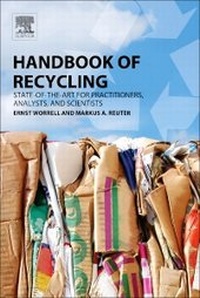
Handbook of Recycling
State-of-the-art for Practitioners, Analysts, and Scientists
Published on 26. June 2014
Book
Hardback
600 pages
978-0-12-396459-5 (ISBN)
Description
Winner of the International Solid Waste Association's 2014 Publication Award, Handbook of Recycling is an authoritative review of the current state-of-the-art of recycling, reuse and reclamation processes commonly implemented today and how they interact with one another. The book addresses several material flows, including iron, steel, aluminum and other metals, pulp and paper, plastics, glass, construction materials, industrial by-products, and more. It also details various recycling technologies as well as recovery and collection techniques. To completely round out the picture of recycling, the book considers policy and economic implications, including the impact of recycling on energy use, sustainable development, and the environment.
With contemporary recycling literature scattered across disparate, unconnected articles, this book is a crucial aid to students and researchers in a range of disciplines, from materials and environmental science to public policy studies.
With contemporary recycling literature scattered across disparate, unconnected articles, this book is a crucial aid to students and researchers in a range of disciplines, from materials and environmental science to public policy studies.
More details
Language
English
Place of publication
United States
Target group
College/higher education
Professional and scholarly
Graduate through active materials scientists and materials engineers in industry involved in the recycling, reuse and reclamation of metals, plastics, other materials and industrial byproducts, and some more general environmental scientists and engineers.
Illustrations
Approx. 150 illustrations
Dimensions
Height: 229 mm
Width: 152 mm
Weight
1390 gr
ISBN-13
978-0-12-396459-5 (9780123964595)
Copyright in bibliographic data and cover images is held by Nielsen Book Services Limited or by the publishers or by their respective licensors: all rights reserved.
Schweitzer Classification
Other editions
New editions
Christina Meskers | Ernst Worrell | Markus A. Reuter
Handbook of Recycling
State-of-the-art for Practitioners, Analysts, and Scientists
Book
10/2023
2nd Edition
Elsevier
€167.50
Available immediately
Additional editions
Ernst Worrell | Markus A. Reuter
Handbook of Recycling
State-of-the-art for Practitioners, Analysts, and Scientists
Book
10/2018
Elsevier
€117.61
The article will not be published
Ernst Worrell | Markus A. Reuter
Handbook of Recycling
State-of-the-art for Practitioners, Analysts, and Scientists
E-Book
04/2014
Elsevier
€113.00
Available for download
Persons
Ernst Worrell (Ph.D.) is professor of 'Energy, Resources & Technological Change' at Utrecht University in the Copernicus Institute. His research focuses on the technical, economic and policy aspects of the energy-resource nexus, including energy, material, and resource efficiency improvement, as well as waste management and processing. The research includes the transition to a circular economy working on recycling and material efficiency. He has led the industrial energy assessment work at Lawrence Berkeley National Laboratory until 2008 and was Director Energy Use & Efficiency at the sustainable energy consulting company Ecofys between 2004 and 2010. He is (co-) author of over 300 publications, of which over 200 peer-reviewed articles. He was until 2013, for 12 years Editor-in-Chief of the peer-reviewed journal Resources, Conservation and Recycling, and also serves as associate editor of Energy, the International Journal and of Energy Efficiency. Markus A. Reuter is with SMS Group in Duesseldorf, Germany. Prior to holding this position, Reuter was director at Helmholtz Institute Freiberg for Resource Technology; chief technologist, Ausmelt Australia; and director of technology management, Outotec (now Metso) Australia and Finland. He also worked at Mintek & Anglo American Corporation both in South Africa. In addition, he has served as a full professor at TU Delft in the Netherlands and the University of Melbourne in Australia, and has held honorary and adjunct professorships at Aalto University in Finland, at Central South University in China, and presently ongoing positions at TU Bergakademie Freiberg in Germany, as well as Curtin University Perth in Australia. He holds honorary doctorates from the University of Liege in Belgium and the University of Stellenbosch in South Africa; D.Eng. & Ph.D. degrees from Stellenbosch University; and a Dr. habil. from RWTH Aachen in Germany. Recent honors include receiving The Minerals, Metals & Materials Society (TMS) TMS Extraction & Processing Division Distinguished Lecture Award in 2016, delivering the TMS Extraction & Processing Division (EPD) and Light Metals Luncheon Lectures in 2020 & 2022 respectively, receiving 3 TMS Science Awards in 2022 & 2014 and as well as receiving an Outotec Technology award in 2014.
Content
I RECYCLING IN CONTEXT1 Recycling: A Key Factor for Resource Efficiency2 Definitions and Terminology3 Recycling in Context4 Recycling Rare Metals5 Theory and Tools of Physical Separation/Recycling
II RECYCLING - APPLICATION & TECHNOLOGY6 Recycling of Steel7 Copper Recycling8 Lead Recycling9 Zinc and Residue Recycling10 Recycling of Rare Metals11 Recycling of Lumber12 Paper Recycling13 Plastic Recycling14 Glass Recycling15 Textile Recycling16 Cementitious Binders17 Industrial By-products18 Recovery of Metals from Different Secondary Resources (Waste)19 Recycling of Carbon Fibers20 Recycling of Construction and Demolition Wastes21 Recycling of Packaging22 Material-Centric (Aluminum and Copper) and Product-Centric (Cars, WEEE, TV, Lamps, Batteries, Catalysts) Recycling and DfR Rules23 Separation of Large Municipal Solid Waste24 Recovery of Construction and Demolition Wastes25 Waste Electrical and Electronic Equipment Management26 Developments in Collection of Municipal Solid Waste
III STRATEGY AND POLICY27 From Recycling to Eco-design28 Recycling and Labeling29 Informal Waste Recycling in Developing Countries30 Squaring the Circular Economy31 The Economics of Recycling32 Geopolitics of Resources and Recycling33 Recycling in Waste Management Policy34 Voluntary and Negotiated Agreements35 Economic Instruments36 Information Instruments37 Regulatory Instruments: Sustainable Materials Management, Recycling, and the Law
Appendix 1: Physical Separation 101Appendix 2: Thermodynamics 101Appendix 3: Life-Cycle Assessment
II RECYCLING - APPLICATION & TECHNOLOGY6 Recycling of Steel7 Copper Recycling8 Lead Recycling9 Zinc and Residue Recycling10 Recycling of Rare Metals11 Recycling of Lumber12 Paper Recycling13 Plastic Recycling14 Glass Recycling15 Textile Recycling16 Cementitious Binders17 Industrial By-products18 Recovery of Metals from Different Secondary Resources (Waste)19 Recycling of Carbon Fibers20 Recycling of Construction and Demolition Wastes21 Recycling of Packaging22 Material-Centric (Aluminum and Copper) and Product-Centric (Cars, WEEE, TV, Lamps, Batteries, Catalysts) Recycling and DfR Rules23 Separation of Large Municipal Solid Waste24 Recovery of Construction and Demolition Wastes25 Waste Electrical and Electronic Equipment Management26 Developments in Collection of Municipal Solid Waste
III STRATEGY AND POLICY27 From Recycling to Eco-design28 Recycling and Labeling29 Informal Waste Recycling in Developing Countries30 Squaring the Circular Economy31 The Economics of Recycling32 Geopolitics of Resources and Recycling33 Recycling in Waste Management Policy34 Voluntary and Negotiated Agreements35 Economic Instruments36 Information Instruments37 Regulatory Instruments: Sustainable Materials Management, Recycling, and the Law
Appendix 1: Physical Separation 101Appendix 2: Thermodynamics 101Appendix 3: Life-Cycle Assessment