

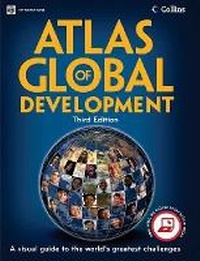
Atlas of Global Development
A Visual Guide to the World's Greatest Challenges
3rd Edition
Will be published approx. on 30. April 2011
Book
Paperback/Softback
250 pages
978-0-8213-8583-8 (ISBN)
Description
The Atlas of Global Development is a comprehensive guide to the most critical issues facing our changing world. Co-published with Harper Collins, the new edition has been completely revised and updated, presenting a comprehensive overview of the world and its people at the start of the 21st century.
Every topic is presented through easy-to-read graphical presentations including colourful world maps, charts, tables, graphs, photographs and web addresses of additional data sources.
A visual guide to global issues - easy-to-read graphical presentation with every topic presented by colourful world maps, tables, graphs, and photographs.
Topics that are shaping our world - key development indicators, from poverty, population growth, and food production to climate change, foreign direct investment, and international trade.
The latest, authoritative statistics - from the World Bank's World Development Indicators database.
New! Interactive Companion Online Atlas. For the first time, the Atlas comes with the new World Bank e-Atlas of Global Development. Map and graph 179 indicators from the World Bank's development database. Features include worldwide mapping, timeline graphing, ranking tables, easy navigation, comparative mode, and exporting and sharing of graphics. Visit data.worldbank.org/atlas-global.
Every topic is presented through easy-to-read graphical presentations including colourful world maps, charts, tables, graphs, photographs and web addresses of additional data sources.
A visual guide to global issues - easy-to-read graphical presentation with every topic presented by colourful world maps, tables, graphs, and photographs.
Topics that are shaping our world - key development indicators, from poverty, population growth, and food production to climate change, foreign direct investment, and international trade.
The latest, authoritative statistics - from the World Bank's World Development Indicators database.
New! Interactive Companion Online Atlas. For the first time, the Atlas comes with the new World Bank e-Atlas of Global Development. Map and graph 179 indicators from the World Bank's development database. Features include worldwide mapping, timeline graphing, ranking tables, easy navigation, comparative mode, and exporting and sharing of graphics. Visit data.worldbank.org/atlas-global.
Reviews / Votes
This is an excellent, up-to-date source book which will be invaluable for students of, and staff teaching, higher levels of geography .... a clear, concise, easily-accessible and well-illustrated volume.""- Geographical Association, United KingdomMore details
Series
Edition
Third Edition
Language
English
Place of publication
Washington
United States
Target group
Professional and scholarly
Edition type
New edition
Dimensions
Height: 245 mm
Width: 188 mm
Thickness: 8 mm
Weight
411 gr
ISBN-13
978-0-8213-8583-8 (9780821385838)
Copyright in bibliographic data and cover images is held by Nielsen Book Services Limited or by the publishers or by their respective licensors: all rights reserved.
Schweitzer Classification
Person
The World Bank came into formal existence in 1945 following the international ratification of the Bretton Woods agreements. It is a vital source of financial and technical assistance to developing countries around the world. The organization's activities are focused on education, health, agriculture and rural development, environmental protection, establishing and enforcing regulations, infrastructure development, governance and legal institutions development. The World Bank is made up of two unique development institutions owned by its 185 Member Countries. The International Bank for Reconstruction and Development (IBRD) focuses on middle income and creditworthy poor countries and the International Development Association (IDA), which focuses on the poorest countries in the world.