

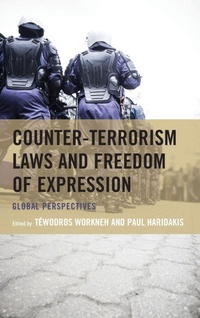
Counter-Terrorism Laws and Freedom of Expression
Global Perspectives
Published on 22. June 2021
Book
Hardback
408 pages
978-1-7936-2216-7 (ISBN)
Description
As nations have aggressively implemented a wide range of mechanisms to proactively curb potential threats terrorism, Counter-Terrorism Laws and Freedom of Expression: Global Perspectives offers critical insight into how counter-terrorism laws have adversely affected journalism practice, digital citizenship, privacy, online activism, and other forms of expression. While governments assert the need for such laws to protect national security, critics argue counter-terrorism laws are prone to be misappropriated by state actors who use such laws to quash political dissent, target journalists, and restrict other forms of citizen expression.
The book is divided into three parts. Part I deals with the politics and discourse of counter-terrorism laws. Part II focuses on the ways counter-terrorism laws have impacted journalistic practice in different countries, with effects ranging from imprisonment of reporters to self-censorship. Part III addresses how counter-terrorism laws have been used to target everyday citizens, social media activists, whistleblowers, and human rights advocates around the world. Together, the chapters address how counter-terrorism laws have undermined democratic values in both authoritarian and liberal political contexts. Scholars of political science, communication, and legal studies will find this book particularly interesting.
The book is divided into three parts. Part I deals with the politics and discourse of counter-terrorism laws. Part II focuses on the ways counter-terrorism laws have impacted journalistic practice in different countries, with effects ranging from imprisonment of reporters to self-censorship. Part III addresses how counter-terrorism laws have been used to target everyday citizens, social media activists, whistleblowers, and human rights advocates around the world. Together, the chapters address how counter-terrorism laws have undermined democratic values in both authoritarian and liberal political contexts. Scholars of political science, communication, and legal studies will find this book particularly interesting.
Reviews / Votes
An impressive contribution to the comparative and multi-disciplinary study of counter-terrorism and its effects. This book examines a broad range of jurisdictions from throughout the globe and drills down on how growing counter-terrorism laws too often shrink the space available for free expression. -- Kent Roach, University of Toronto The global reach of the critiques and analyses in Counter-Terrorism Laws and Freedom of Expression make this book a crucial new tool for the interrogation of dangerous threats to free speech worldwide. Tewodros Workneh and Paul Haridakis seamlessly weave representative studies from a diverse array of experts and locales to show that, no matter the system, all governments seek the cover of terrorism to rationalize self-interested censorship. A primary - and sobering - text across disciplines, from political science to international studies to journalism and beyond. -- Peter Laufer, University of Oregon The main contribution of this book is the reflection on the ways democratic and non-democratic states deals with the threat of external and internal terrorism using counter-terrorism as their legal machinery. The book sheds light on a wide spectrum of the risks counter-terrorism poses to democratic values such as freedom of expression by showing the difficulties to maintain this right in times of combating terrorism. The book indicates strongly what happens when states are using anti-terrorism acts without strong judicial review by the courts. Without due balances between the needs of security and preservation of freedom of expression we are depriving our citizens from having a fair report about security operations and the risks involved in the lives of media personnel. -- Emanuel Gross, University of HaifaMore details
Language
English
Place of publication
United States
Publishing group
Bloomsbury Publishing Plc
Target group
Professional and scholarly
Illustrations
2 tables;
Dimensions
Height: 235 mm
Width: 157 mm
Thickness: 26 mm
Weight
739 gr
ISBN-13
978-1-7936-2216-7 (9781793622167)
Copyright in bibliographic data and cover images is held by Nielsen Book Services Limited or by the publishers or by their respective licensors: all rights reserved.
Schweitzer Classification
Other editions
Additional editions
Counter-Terrorism Laws and Freedom of Expression
Global Perspectives
E-Book
06/2021
1st Edition
Lexington Books
€39.49
Available for download
Persons
Tewodros Worknehis assistant professor of global communication at the School of Communication Studies, Kent State University.
Paul Haridakis is professor of communication studies at Kent State University.
Paul Haridakis is professor of communication studies at Kent State University.
Content
Table of Contents
PART I: Introduction
1.Counter-terrorism Laws in the International frame: Uncertain Times for Freedom of Expression
Tewodros Workneh & Paul Haridakis
PART II: The Politics and Discourse of Counterterrorism Laws
2. Schizorevolutions versus Microfascisms: The Fear of Anarchy in State Securitization
Athina Karatzogianni & Andrew Robinson
3. Parliamentary Discussion of Counter-terrorism in Portugal: Discourses on the Right and on the Left
Eunice Castro Seixas
4. Anti-terrorism Regulations and Freedom of Speech in Spain
Isabel Serrano Maillo
5. Counter-terrorism Gone Digital: Framing Cybercrime in Turkey
Nazli Bu?lay Dogan
6. Chinese-Speaking Netizens' Comments on VOA's Coverage of China's Counter-Terrorism Laws and Freedom of Speech
Wei Sun
7. Terrorism and Counter-terrorism legislation in Brazil
Daniel Oppermann
8. How 9/11 Changed America and How We (can) Talk about It: Torture and the Guantanamo Military Commissions
Rita Radostitz
PART III: Counter-Terrorism Laws
PART I: Introduction
1.Counter-terrorism Laws in the International frame: Uncertain Times for Freedom of Expression
Tewodros Workneh & Paul Haridakis
PART II: The Politics and Discourse of Counterterrorism Laws
2. Schizorevolutions versus Microfascisms: The Fear of Anarchy in State Securitization
Athina Karatzogianni & Andrew Robinson
3. Parliamentary Discussion of Counter-terrorism in Portugal: Discourses on the Right and on the Left
Eunice Castro Seixas
4. Anti-terrorism Regulations and Freedom of Speech in Spain
Isabel Serrano Maillo
5. Counter-terrorism Gone Digital: Framing Cybercrime in Turkey
Nazli Bu?lay Dogan
6. Chinese-Speaking Netizens' Comments on VOA's Coverage of China's Counter-Terrorism Laws and Freedom of Speech
Wei Sun
7. Terrorism and Counter-terrorism legislation in Brazil
Daniel Oppermann
8. How 9/11 Changed America and How We (can) Talk about It: Torture and the Guantanamo Military Commissions
Rita Radostitz
PART III: Counter-Terrorism Laws