

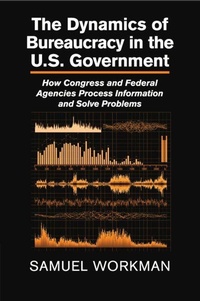
The Dynamics of Bureaucracy in the US Government
How Congress and Federal Agencies Process Information and Solve Problems
Published on 13. June 2019
Book
Paperback/Softback
208 pages
978-1-107-67955-9 (ISBN)
Description
This book develops a new theoretical perspective on bureaucratic influence and congressional agenda setting based on limited attention and government information processing. Using a comprehensive new data set on regulatory policymaking across the entire federal bureaucracy, Samuel Workman develops the theory of the dual dynamics of congressional agenda setting and bureaucratic problem solving as a way to understand how the US government generates information about, and addresses, important policy problems. Key to the perspective is a communications framework for understanding the nature of information and signaling between the bureaucracy and Congress concerning the nature of policy problems. Workman finds that congressional influence is innate to the process of issue shuffling, issue bundling, and the fostering of bureaucratic competition. In turn, bureaucracy influences the congressional agenda through problem monitoring, problem definition, and providing information that serves as important feedback in the development of an agenda.
Reviews / Votes
'Workman proposes an important and completely novel perspective on the relations between Congress and the bureaucracy. Based on a newly collected database of every federal regulation since the 1980s, he shows that Congressional committees and federal agencies are engaged in a mutual dance in which new information coming from agencies signals to Congress that developments require more attention or activity, and that the diversity or range in sources of the regulatory activity signal which parts of the issue require congressional intervention. The book is a model of methodology, theory building, and addressing an important issue of great substantive value: how does government set its agenda, and what is the role of the regulatory apparatus of the state in doing so? It will be seen as a major contribution to the literatures on agenda setting, bureaucratic politics, and congressional policy making for years to come.' Frank R. Baumgartner, University of North Carolina, Chapel Hill 'This is a book that forces us to think about the policy-making process in new ways. It puts bureaucracy at center stage. Rather than characterize the administrative state as the passive implementer of political decisions by elected officials, Workman argues that federal agencies are strategic actors competing for Congress's attention. Congress, in turn, is trying to learn from the administrative state and shape its information-providing activities. This is a book that utilizes amazing new data to illuminate how agencies influence the policy agenda and policy process as attention-seeking and attention-directing institutions.' David E. Lewis, Vanderbilt University, TennesseeMore details
Language
English
Place of publication
Cambridge
United Kingdom
Target group
Professional and scholarly
Product notice
Paperback (trade)
Illustrations
16 Tables, unspecified; 16 Plates, unspecified
Dimensions
Height: 229 mm
Width: 152 mm
Thickness: 12 mm
Weight
313 gr
ISBN-13
978-1-107-67955-9 (9781107679559)
Copyright in bibliographic data and cover images is held by Nielsen Book Services Limited or by the publishers or by their respective licensors: all rights reserved.
Schweitzer Classification
Other editions
Additional editions
Samuel Workman
The Dynamics of Bureaucracy in the US Government
How Congress and Federal Agencies Process Information and Solve Problems
Book
04/2015
Cambridge University Press
€130.60
Shipment within 15-20 days
Person
Samuel Workman is an Assistant Professor of Political Science at the University of Oklahoma. He has held the position of J. J. 'Jake' Pickle Research Fellow at the University of Texas, Austin, and the position of Assistant Professor at the University of Texas, Austin. He is one of the principals within the Center for Applied Social Research and the Center for Risk and Crisis Management, both at the University of Oklahoma. His work has appeared in the Policy Studies Journal and the Journal of Public Administration Research and Theory.
Content
1. Bureaucracy and problem-solving; 2. The dual dynamics of the administrative state; 3. The regulatory process as an attention mechanism; 4. Problem monitoring in the administrative state; 5. Problem prioritization and demand for information; 6. Problem-solving and the supply of information; 7. Information, bureaucracy, and government problem solving; Appendix A. Conceptualization and measurement; Appendix B. Statistical models.