

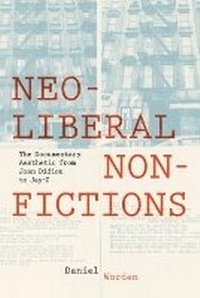
Neoliberal Nonfictions
The Documentary Aesthetic from Joan Didion to Jay-Z
Will be published approx. on 31. March 2020
Book
Paperback/Softback
200 pages
978-0-8139-4416-6 (ISBN)
Description
With the ascendancy of neoliberalism in American culture beginning in the 1960s, the political structures governing private lives became more opaque and obscure. Neoliberal Nonfictions argues that a new style of documentary art emerged to articulate the fissures between individual experience and reality in the era of finance capitalism.
In this wide-ranging study, Daniel Worden touches on issues ranging from urban poverty and criminal justice to environmental collapse and international politics. He examines the impact of local struggles and global markets on music, from D. A. Pennebaker's infamous Dylan documentary Dont Look Back to Kendrick Lamar's breakthrough album Good Kid, M.A.A.D. City. He details the emergence of the hustler as an icon of neoliberal individualism in Jay-Z's autobiography Decoded, Alex Haley's Autobiography of Malcom X, and Hunter S. Thompson's "gonzo" journalism. He looks at how contemporary works such as Maggie Nelson's memoir The Red Parts and Taryn Simon's photography series The Innocents challenge the moral simplifications of traditional true crime writing. In his conclusion, he explores the dominance of memoir as a literary mode in the neoliberal era, particularly focusing on works by Joan Didion and Dave Eggers.
Documentary has become the aesthetic of our age, harnessing the irreconcilable distance between individual and society as a site for aesthetic experimentation across media, from journalism and photography to memoir, music, and film. Both a symptom of and a response to the emergence of economic neoliberalism, the documentary aesthetic is central to how we understand ourselves and our world today.
In this wide-ranging study, Daniel Worden touches on issues ranging from urban poverty and criminal justice to environmental collapse and international politics. He examines the impact of local struggles and global markets on music, from D. A. Pennebaker's infamous Dylan documentary Dont Look Back to Kendrick Lamar's breakthrough album Good Kid, M.A.A.D. City. He details the emergence of the hustler as an icon of neoliberal individualism in Jay-Z's autobiography Decoded, Alex Haley's Autobiography of Malcom X, and Hunter S. Thompson's "gonzo" journalism. He looks at how contemporary works such as Maggie Nelson's memoir The Red Parts and Taryn Simon's photography series The Innocents challenge the moral simplifications of traditional true crime writing. In his conclusion, he explores the dominance of memoir as a literary mode in the neoliberal era, particularly focusing on works by Joan Didion and Dave Eggers.
Documentary has become the aesthetic of our age, harnessing the irreconcilable distance between individual and society as a site for aesthetic experimentation across media, from journalism and photography to memoir, music, and film. Both a symptom of and a response to the emergence of economic neoliberalism, the documentary aesthetic is central to how we understand ourselves and our world today.
More details
Series
Language
English
Place of publication
Charlottesville
United States
Target group
Professional and scholarly
Product notice
Paperback (trade)
Illustrations
19 colour illustrations, 3 black & a white illustrations
Dimensions
Height: 226 mm
Width: 182 mm
Thickness: 10 mm
Weight
265 gr
ISBN-13
978-0-8139-4416-6 (9780813944166)
Copyright in bibliographic data and cover images is held by Nielsen Book Services Limited or by the publishers or by their respective licensors: all rights reserved.
Schweitzer Classification
Person
Daniel Worden is Associate Professor of English at Rochester Institute of Technology and author of Masculine Style: The American West and Literary Modernism.