

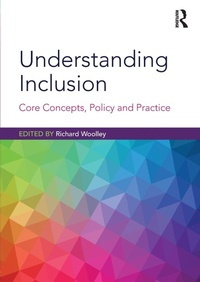
Understanding Inclusion
Core Concepts, Policy and Practice
1st Edition
Published on 9. November 2017
Book
Paperback/Softback
206 pages
978-1-138-24168-8 (ISBN)
Description
Understanding Inclusion is a rich, comprehensive exploration of inclusion in education, challenging us to think about being 'inclusive' in its broadest sense. It unpicks a wide range of complex themes and issues that impact on educational practice, supporting educational professionals in helping teachers and learners understand difference as the norm, and not the exception.
Underpinned by the latest research, discussion is brought to life through vignettes of real experiences and examples of practice from a range of settings and across continents. Chapters consider crucial aspects of inclusion:
Social inclusion and social class
Global perspectives on culture and identity
Aspirations and social mobility
Relationships and sexual behaviours
Gender equality and diversity
Perceptions of ability and disability
Barriers to learning
Multilingualism in schools
Religion and belief
Restorative justice for inclusion
Inclusion and the arts
Teaching Assistants and inclusion
The central role of leadership.
Written by experts with extensive experience in a range of educational contexts, Understanding Inclusion is designed for all those engaged in understanding the complexities of teaching and learning. With reflective questions and selected reading designed to support further study, it will be essential reading for students on Education Studies and related course, and pre- and in-service teachers.
Underpinned by the latest research, discussion is brought to life through vignettes of real experiences and examples of practice from a range of settings and across continents. Chapters consider crucial aspects of inclusion:
Social inclusion and social class
Global perspectives on culture and identity
Aspirations and social mobility
Relationships and sexual behaviours
Gender equality and diversity
Perceptions of ability and disability
Barriers to learning
Multilingualism in schools
Religion and belief
Restorative justice for inclusion
Inclusion and the arts
Teaching Assistants and inclusion
The central role of leadership.
Written by experts with extensive experience in a range of educational contexts, Understanding Inclusion is designed for all those engaged in understanding the complexities of teaching and learning. With reflective questions and selected reading designed to support further study, it will be essential reading for students on Education Studies and related course, and pre- and in-service teachers.
Reviews / Votes
"It's a book to realy make the reader think about their own practice, with reflective questions (pause for thought) and selected reading designed to support further study. Valuable reading for students on Education Studies and related course, and pre- and in-service teachers."-Parents in TouchMore details
Language
English
Place of publication
London
United Kingdom
Publishing group
Taylor & Francis Ltd
Target group
College/higher education
Illustrations
5 s/w Abbildungen, 5 s/w Zeichnungen, 2 s/w Tabellen
2 Tables, black and white; 5 Line drawings, black and white; 5 Illustrations, black and white
Dimensions
Height: 246 mm
Width: 174 mm
Thickness: 12 mm
Weight
394 gr
ISBN-13
978-1-138-24168-8 (9781138241688)
Copyright in bibliographic data and cover images is held by Nielsen Book Services Limited or by the publishers or by their respective licensors: all rights reserved.
Schweitzer Classification
Other editions
Additional editions
Book
11/2017
1st Edition
Routledge
€215.41
Shipment within 10-20 days
E-Book
10/2017
Routledge
€45.99
Available for download
E-Book
10/2017
Routledge
€45.99
Available for download
Person
Richard Woolley is Deputy Head of the Institute of Education at the University of Worcester, UK, and was Head of the Centre for Education and Inclusion from 2011 to 2017. He is a Principal Fellow of the Higher Education Academy, UK.
Content
Acknowledgements
Introduction
1. Social Inclusion
2. Global Dimension
3. Learners and Learning
4. Identity
5. Religion and Belief
6. Disability
7. Gender
8. Nurturing and Mentoring
9. Lifelong Learning
10. Leadership for Inclusion
11. Sexual Behaviours and Development
12. Inclusion and Teaching Assistants (tbc)
Conclusion
Introduction
1. Social Inclusion
2. Global Dimension
3. Learners and Learning
4. Identity
5. Religion and Belief
6. Disability
7. Gender
8. Nurturing and Mentoring
9. Lifelong Learning
10. Leadership for Inclusion
11. Sexual Behaviours and Development
12. Inclusion and Teaching Assistants (tbc)
Conclusion