

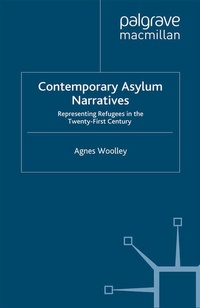
Contemporary Asylum Narratives
Representing Refugees in the Twenty-First Century
Published on 1. January 2014
Book
Paperback/Softback
X, 239 pages
978-1-349-45258-3 (ISBN)
Description
Contemporary Asylum Narratives marks a transition from traditional modes of diasporic belonging to the need for identifications that encompass the statelessness of refugees and asylum seekers. This book explores representations of asylum seekers and refugees in twenty-first century literature, film and theatre.
Reviews / Votes
"Contemporary Asylum Narratives is a fluent, insightful, and theoretically astute work with much to say about the politics of representing refugee experience. Agnes Woolley has made a timely addition to debates around the place of asylum in postcolonial studies." - David Farrier, University of Edinburgh, UK
More details
Edition
1st ed. 2014
Language
English
Place of publication
London
United Kingdom
Target group
Professional and scholarly
Illustrations
X, 239 p.
Dimensions
Height: 216 mm
Width: 140 mm
Thickness: 14 mm
Weight
322 gr
ISBN-13
978-1-349-45258-3 (9781349452583)
DOI
10.1057/9781137299062
Schweitzer Classification
Other editions
Additional editions
Book
01/2014
Palgrave Macmillan
€53.49
Shipment within 10-20 days
Person
Agnes Wooley is Lecturer in English at the University of Lincoln, UK
Content
Introduction PART I: HOSPITABLE REPRESENTATIONS 1. Narrator as Host in Graham Swift's The Light of Day 2. 'Communicable Empathy': Reading A Distant Shore Conclusion to Part I PART II: REFUGEES ON FILM 3. Screening asylum: Pawel Pawlikowski's Last Resort 4. States of Belonging in Alfonso Cuarón's Children of Men Conclusion to Part II PART III: STAGING ASYLUM 5. Authenticating asylum: Kay Adshead's The Bogus Woman 6. Europe, history and myth in Timberlake Wertenbaker's Credible Witness Conclusion to Part III PART IV: ASYLUM IN A GLOBAL ERA 7. Globalisation: crisis and celebration in Chris Cleave's The Other Hand 8. Cosmopolitan representation: Kate Clanchy's Antigona and Me Conclusion to Part IV CONCLUSION: AN UNCERTAIN BELONGING