

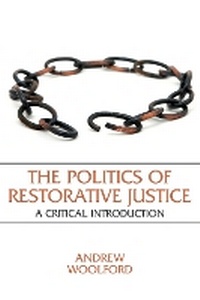
The Politics of Restorative Justice
A Critical Introduction
Published on 1. August 2009
Book
Paperback/Softback
176 pages
978-1-55266-316-5 (ISBN)
Description
This book invites the reader to reconsider restorative justice and its politics. Through an examination of restorative themes, theories and practices, three distinct ways in which politics affect restorative justice are explored. First, restorative justice is situated in a context in which political actors, as well as structural forces, either enable or obstruct its practice. Second, restorative justice is understood as a contributor to political power in that its practice helps govern individual and collective behaviour. Finally, restorative justice is described as a social movement requiring an enabling politics that will allow it to promote a justice that does more than affirm the status quo - it must aspire toward a transformative politics concerned with class-based, gendered, racialized and other injustices.
More details
Language
English
Place of publication
Black Point, Nova Scotia
Canada
Target group
College/higher education
Dimensions
Height: 23 mm
Width: 15 mm
Thickness: 2 mm
Weight
255 gr
ISBN-13
978-1-55266-316-5 (9781552663165)
Copyright in bibliographic data and cover images is held by Nielsen Book Services Limited or by the publishers or by their respective licensors: all rights reserved.
Schweitzer Classification
Other editions
New editions
Book
11/2019
2nd Edition
Fernwood Publishing Co Ltd
€50.99
Shipment within 10-20 days
Person
Andrew Woolford is professor of sociology and criminology at the University of Manitoba, an emeritus member of the Royal Society of Canada College, and former president of the International Association of Genocide Scholars. He is author of 'This Benevolent Experiment': Indigenous Boarding Schools, Genocide and Redress in the United States and Canada (2015) and Between Justice and Certainty: Treaty-Making in British Columbia (2005), and co-author of The Politics of Restorative Justice (2019) and Informal Reckonings: Conflict Resolution in Mediation, Restorative Justice, and Reparations (2005). He is co-editor of Did You See Us? Reunion, Remembrance, and Reclamation at an Urban Indian Residential School (2021); Canada and Colonial Genocide (2017); The Idea of a Human Rights Museum (2015); and Colonial Genocide in Indigenous North America (2014). He has worked on two community-based research projects with residential school Survivors: 1) Embodying Empathy, which designed, built, and tested a virtual Indian Residential School that serves as a site of knowledge mobilization and empathy formation; and 2) Remembering Assiniboia, which focuses on commemoration of the Assiniboia Residential School. He is completing a project on human and more-than-human relations within genocidal processes under the title "Genocide with Nature."
Content
: Introduction to the Politics of Restorative Justice
: What Events Trigger a Restorative Response?
: Delineat-ing the Restorative Justice Ethos: History, Theory and Restorative Justice
: Restorative Justice Styles
: Constructing Restorative Justice Identities
: Restorative Justice Contexts
: Restorative Justice Criticisms
: Transformation and the Politics of Restorative Justice
: What Events Trigger a Restorative Response?
: Delineat-ing the Restorative Justice Ethos: History, Theory and Restorative Justice
: Restorative Justice Styles
: Constructing Restorative Justice Identities
: Restorative Justice Contexts
: Restorative Justice Criticisms
: Transformation and the Politics of Restorative Justice