

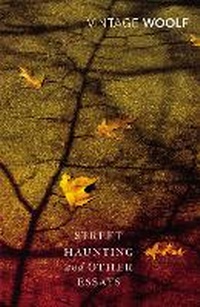
Street Haunting and Other Essays
Published on 2. October 2014
Book
Paperback/Softback
272 pages
978-0-09-958977-8 (ISBN)
Description
Virginia Woolf began writing reviews for the Guardian 'to make a few pence' from her father's death in 1904, and continued until the last decade of her life. The result is a phenomenal collection of articles, of which this selection offers a fascinating glimpse, which display the gifts of a dazzling social and literary critic as well as the development of a brilliant and influential novelist. From reflections on class and education, to slyly ironic reviews, musings on the lives of great men and 'Street Haunting', a superlative tour of her London neighbourhood, this is Woolf at her most thoughtful and entertaining.
Reviews / Votes
Brilliant and subtle essays * Independent on Sunday * It is all pure Woolf, so distinctive is her voice - ironic, cool, conversational and playful, shrewd and fantastical by turns * Literary Review * Woolf was easily the greatest literary journalist of her age -- James Wood * Guardian * More like novels than ordinary criticism * New Statesman * Filled with comic spirit...there are some beautiful essays here...and many memorable ones -- Peter Ackroyd * New York Times * Her essays are delightful in the way that serious play is delightful. She is enjoying herself, and reading her gives me that leaping sense of being in excellent company -- Jeanette Winterson * The Times *More details
Language
English
Place of publication
London
United Kingdom
Publishing group
Vintage Publishing
Product notice
Paperback (UK-B)
Dimensions
Height: 198 mm
Width: 128 mm
Thickness: 20 mm
Weight
224 gr
ISBN-13
978-0-09-958977-8 (9780099589778)
Copyright in bibliographic data and cover images is held by Nielsen Book Services Limited or by the publishers or by their respective licensors: all rights reserved.
Schweitzer Classification
Other editions
Additional editions
Virginia Woolf | Stuart N. Clarke
Street Haunting and Other Essays
E-Book
10/2014
1st Edition
Vintage Digital
€10.99
Available for download
Persons
Virginia Woolf was born in London in 1882, the daughter of Sir Leslie Stephen, first editor of The Dictionary of National Biography. After his death in 1904 Virginia and her sister, the painter Vanessa Bell, moved to Bloomsbury and became the centre of 'The Bloomsbury Group'. This informal collective of artists and writers which included Lytton Strachey and Roger Fry, exerted a powerful influence over early twentieth-century British culture.
In 1912 Virginia married Leonard Woolf, a writer and social reformer. Three years later, her first novel The Voyage Out was published, followed by Night and Day (1919) and Jacob's Room (1922). These first novels show the development of Virginia Woolf's distinctive and innovative narrative style. It was during this time that she and Leonard Woolf founded The Hogarth Press with the publication of the co-authored Two Stories in 1917, hand-printed in the dining room of their house in Surrey. Between 1925 and 1931 Virginia Woolf produced what are now regarded as her finest masterpieces, from Mrs Dalloway (1925) to the poetic and highly experimental novel The Waves (1931). She also maintained an astonishing output of literary criticism, short fiction, journalism and biography, including the playfully subversive Orlando (1928) and A Room of One's Own (1929) a passionate feminist essay. This intense creative productivity was often matched by periods of mental illness, from which she had suffered since her mother's death in 1895. On 28 March 1941, a few months before the publication of her final novel, Between the Acts, Virginia Woolf committed suicide.
In 1912 Virginia married Leonard Woolf, a writer and social reformer. Three years later, her first novel The Voyage Out was published, followed by Night and Day (1919) and Jacob's Room (1922). These first novels show the development of Virginia Woolf's distinctive and innovative narrative style. It was during this time that she and Leonard Woolf founded The Hogarth Press with the publication of the co-authored Two Stories in 1917, hand-printed in the dining room of their house in Surrey. Between 1925 and 1931 Virginia Woolf produced what are now regarded as her finest masterpieces, from Mrs Dalloway (1925) to the poetic and highly experimental novel The Waves (1931). She also maintained an astonishing output of literary criticism, short fiction, journalism and biography, including the playfully subversive Orlando (1928) and A Room of One's Own (1929) a passionate feminist essay. This intense creative productivity was often matched by periods of mental illness, from which she had suffered since her mother's death in 1895. On 28 March 1941, a few months before the publication of her final novel, Between the Acts, Virginia Woolf committed suicide.