

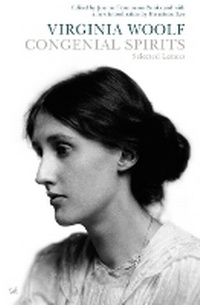
Congenial Spirits
Selected Letters of Virginia Woolf
Published on 18. May 2015
Book
Paperback/Softback
496 pages
978-1-84595-224-2 (ISBN)
Description
EDITED BY JOANNE TRAUTMANN BANKS, WITH A PREFACE BY HERMIONE LEE
The finest and most enjoyable of Virginia Woolf's letters are brought together in a single volume. It is a marvelous collection - spontaneous, witty, often flirtatious and powerfully moving. Whether bemoaning some domestic travail, commenting publicly on the state of the nation, or discussing cultural, artistic or personal concerns, Virginia Woolf is one of the great correspondents. This volume displays not only Woolf's courage and brilliance, her generosity and love of gossip, but also her genius for close and enduring friendship.
The finest and most enjoyable of Virginia Woolf's letters are brought together in a single volume. It is a marvelous collection - spontaneous, witty, often flirtatious and powerfully moving. Whether bemoaning some domestic travail, commenting publicly on the state of the nation, or discussing cultural, artistic or personal concerns, Virginia Woolf is one of the great correspondents. This volume displays not only Woolf's courage and brilliance, her generosity and love of gossip, but also her genius for close and enduring friendship.
More details
Language
English
Place of publication
London
United Kingdom
Publishing group
Vintage Publishing
Product notice
Paperback (UK-trade)
Dimensions
Height: 234 mm
Width: 153 mm
Thickness: 28 mm
Weight
514 gr
ISBN-13
978-1-84595-224-2 (9781845952242)
Copyright in bibliographic data and cover images is held by Nielsen Book Services Limited or by the publishers or by their respective licensors: all rights reserved.
Schweitzer Classification
Persons
Virginia Woolf (Author)
Virginia Woolf was born in London in 1882, the daughter of Sir Leslie Stephen, first editor of The Dictionary of National Biography. After his death in 1904 Virginia and her sister, the painter Vanessa Bell, moved to Bloomsbury and became the centre of 'The Bloomsbury Group'. This informal collective of artists and writers which included Lytton Strachey and Roger Fry, exerted a powerful influence over early twentieth-century British culture.
In 1912 Virginia married Leonard Woolf, a writer and social reformer. Three years later, her first novel The Voyage Out was published, followed by Night and Day (1919) and Jacob's Room (1922). These first novels show the development of Virginia Woolf's distinctive and innovative narrative style. It was during this time that she and Leonard Woolf founded The Hogarth Press with the publication of the co-authored Two Stories in 1917, hand-printed in the dining room of their house in Surrey. Between 1925 and 1931 Virginia Woolf produced what are now regarded as her finest masterpieces, from Mrs Dalloway (1925) to the poetic and highly experimental novel The Waves (1931). She also maintained an astonishing output of literary criticism, short fiction, journalism and biography, including the playfully subversive Orlando (1928) and A Room of One's Own (1929) a passionate feminist essay. This intense creative productivity was often matched by periods of mental illness, from which she had suffered since her mother's death in 1895. On 28 March 1941, a few months before the publication of her final novel, Between the Acts, Virginia Woolf committed suicide.
Joanne Trautmann Banks (Author)
Virginia Woolf was born in London in 1882. In 1904 Virginia and her sister, the painter Vanessa Bell, moved to Bloomsbury and became the centre of 'The Bloomsbury Group'. This informal collective of artists and writers which included Lytton Strachey and Roger Fry, exerted a powerful influence over early twentieth-century British culture. In 1912 Virginia married Leonard Woolf. Her first novel The Voyage Out was published in 1915, followed by Night and Day (1919) and Jacob's Room (1922). It was during this time that she and Leonard Woolf founded The Hogarth Press. The majority of Virginia Woolf's work was first published by The Hogarth Press, and these original texts are now available, together with her selected letters and diaries, from Vintage Classics, which belongs to the publishing group that Hogarth became part of in 1987. Between 1925 and 1931 Virginia Woolf produced what are now regarded as her finest masterpieces, from Mrs Dalloway (1925) and To the Lighthouse (1927) to the poetic and highly experimental novel The Waves (1931). She also maintained an astonishing output of literary criticism, short fiction, journalism and biography, including the playfully subversive Orlando (1928) and A Room of One's Own (1929) a passionate feminist essay. On 28 March 1941, a few months before the publication of her final novel, Between the Acts, Virginia Woolf committed suicide.
Virginia Woolf was born in London in 1882, the daughter of Sir Leslie Stephen, first editor of The Dictionary of National Biography. After his death in 1904 Virginia and her sister, the painter Vanessa Bell, moved to Bloomsbury and became the centre of 'The Bloomsbury Group'. This informal collective of artists and writers which included Lytton Strachey and Roger Fry, exerted a powerful influence over early twentieth-century British culture.
In 1912 Virginia married Leonard Woolf, a writer and social reformer. Three years later, her first novel The Voyage Out was published, followed by Night and Day (1919) and Jacob's Room (1922). These first novels show the development of Virginia Woolf's distinctive and innovative narrative style. It was during this time that she and Leonard Woolf founded The Hogarth Press with the publication of the co-authored Two Stories in 1917, hand-printed in the dining room of their house in Surrey. Between 1925 and 1931 Virginia Woolf produced what are now regarded as her finest masterpieces, from Mrs Dalloway (1925) to the poetic and highly experimental novel The Waves (1931). She also maintained an astonishing output of literary criticism, short fiction, journalism and biography, including the playfully subversive Orlando (1928) and A Room of One's Own (1929) a passionate feminist essay. This intense creative productivity was often matched by periods of mental illness, from which she had suffered since her mother's death in 1895. On 28 March 1941, a few months before the publication of her final novel, Between the Acts, Virginia Woolf committed suicide.
Joanne Trautmann Banks (Author)
Virginia Woolf was born in London in 1882. In 1904 Virginia and her sister, the painter Vanessa Bell, moved to Bloomsbury and became the centre of 'The Bloomsbury Group'. This informal collective of artists and writers which included Lytton Strachey and Roger Fry, exerted a powerful influence over early twentieth-century British culture. In 1912 Virginia married Leonard Woolf. Her first novel The Voyage Out was published in 1915, followed by Night and Day (1919) and Jacob's Room (1922). It was during this time that she and Leonard Woolf founded The Hogarth Press. The majority of Virginia Woolf's work was first published by The Hogarth Press, and these original texts are now available, together with her selected letters and diaries, from Vintage Classics, which belongs to the publishing group that Hogarth became part of in 1987. Between 1925 and 1931 Virginia Woolf produced what are now regarded as her finest masterpieces, from Mrs Dalloway (1925) and To the Lighthouse (1927) to the poetic and highly experimental novel The Waves (1931). She also maintained an astonishing output of literary criticism, short fiction, journalism and biography, including the playfully subversive Orlando (1928) and A Room of One's Own (1929) a passionate feminist essay. On 28 March 1941, a few months before the publication of her final novel, Between the Acts, Virginia Woolf committed suicide.