

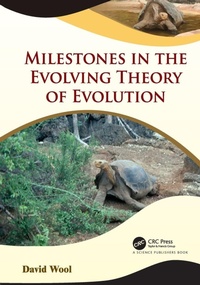
Milestones in the Evolving Theory of Evolution
1st Edition
Published on 17. June 2022
Book
Paperback/Softback
344 pages
978-0-367-53807-1 (ISBN)
Description
The book illustrates how Darwin's theory has evolved, about the development of the biological world before Darwin, and great changes that took place with the incorporation of statistics, and after Darwin's death of genetics and mathematics. The formation of 'Modern Synthesis', protein electrophoresis, Discovery of DNA opened new avenues for the study of evolution.
More details
Language
English
Place of publication
London
United Kingdom
Publishing group
Taylor & Francis Ltd
Target group
College/higher education
Illustrations
15 s/w Abbildungen, 15 s/w Zeichnungen, 1 s/w Tabelle
1 Tables, black and white; 15 Line drawings, black and white; 15 Illustrations, black and white
Dimensions
Height: 254 mm
Width: 178 mm
Thickness: 19 mm
Weight
648 gr
ISBN-13
978-0-367-53807-1 (9780367538071)
Copyright in bibliographic data and cover images is held by Nielsen Book Services Limited or by the publishers or by their respective licensors: all rights reserved.
Schweitzer Classification
Other editions
Additional editions
David Wool | Leonid Friedman | Naomi Paz
Milestones in the Evolving Theory of Evolution
Book
11/2020
1st Edition
CRC Press
€262.40
Shipment within 15-20 days
David Wool | Leonid Friedman | Naomi Paz
Milestones in the Evolving Theory of Evolution
E-Book
11/2020
1st Edition
CRC Press
€104.99
Available for download
David Wool | Leonid Friedman | Naomi Paz
Milestones in the Evolving Theory of Evolution
E-Book
11/2020
1st Edition
CRC Press
€104.99
Available for download
Persons
Dr Wool is a retired professor (emeritus). M.Sc in Tel Aviv (1965), PhD in the University of Kansas, Lawrence, Kansas 1969 - Supervisor prof. Robert Sokal. Thesis in population Genetics (Published 1970 in the journal Genetics). Since 1970, professor of zoology at Tel Aviv University - taught mainly Biometry and Population Genetics, the former a required course for graduate students and retired in 2001.
Content
Introduction. The starting point: Evolution versus Creation? The Origin of Life. THE FIRST CIRCLE. Early theories: Creation, Pre-formation and Order in the Biological World. More Theories. THE SECOND CIRCLE. Georges Cuvier and the Theory of Catastrophes. Etienne Geoffroy Saint-Hilaire: The Theory of Comparative Anatomy. Jean Baptiste Lamarck: The Theory of Descent. Charles Lyell: "The Father of Geology". THE THIRD CIRCLE: CHARLES DARWIN, HIS THEORY, HIS SUPPORTERS AND ADVERSARIES. Charles Darwin: The Formative Years. Evolution of the Theory of Natural Selection. On the Same Track: Ideas about the History of Life before 1859. Alfred Russell Wallace. Thomas Henry Huxley. Louis Agassiz: Classification and the Plan of Nature. The Struggle for Existence of the Theory of Evolution. Charles Darwin: "The Descent of Man" (1871). Charles Darwin, "Sexual Selection". Charles Darwin in the Vegetable Kingdom. Heredity in the 19th Century: What did Darwin know? Ernst Haeckel: Embryology and Phylogeny in Evolution. August Weismann: The Theory of the Germ Plasm and the (Non)-Inheritance of Acquired Characters. Francis Galton: Quantitative Measurements of Heredity. The Biometricians: Karl Pearson. THE FOURTH CIRCLE: THE THEORY OF EVOLUTION IN THE 20th CENTURY. Gregor Mendel and the Origin of Genetics. Hugo de Vries and the Theory of Mutations. T. H. Morgan: Drosophila, Genetics and Evolution. The Resurrection of the Inheritance of Acquired Characters: from Weismann to Lysenko. Genetics in Populations: An Introductory Overview. R.A. Fisher: The Fundamental Theorem of Natural Selection. J.B.S. Haldane: Science in Everyday Life and Genetics in Populations. Sewall Wright: Chance and Evolution in Small Populations. Theodosius Dobzhansky. Ernst Mayr: The Biological Species and Speciation. Julian Sorrel Huxley. Richard Goldschmidt (1878 -1958): Genetics, Evolution, and Hopeful Monsters. E.B. Ford and H.B.D. Kettlewell: Ecological Genetics. Motoo Kimura and the Neutrality Hypothesis. Closing comments.