

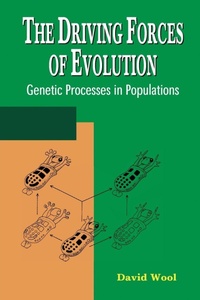
The Driving Forces of Evolution
Genetic Processes in Populations
1st Edition
Published on 2. December 2019
Book
Paperback/Softback
362 pages
978-0-367-45392-3 (ISBN)
Description
To cope with the abiotic stress-induced osmotic problems, plants adapt by either increasing uptake of inorganic ions from the external solution, or by de novo synthesis of organic compatible solutes acting as osmolytes. Of the osmoregulants and protectants discussed in this volume, trehalose, fructans, ectoine and citrulline, which are generated in different species, in osmotically ineffective amounts, mitigate the stress effects on cells/plants and improve productivity. There are several pieces of encouraging research discussed in this volume showing significant improvement in stress tolerance and in turn productivity by involving genetic engineering techniques.
More details
Language
English
Place of publication
London
United Kingdom
Publishing group
Taylor & Francis Ltd
Target group
Professional and scholarly
Professional Practice & Development
Dimensions
Height: 234 mm
Width: 156 mm
Weight
670 gr
ISBN-13
978-0-367-45392-3 (9780367453923)
Copyright in bibliographic data and cover images is held by Nielsen Book Services Limited or by the publishers or by their respective licensors: all rights reserved.
Schweitzer Classification
Other editions
Additional editions
E-Book
01/2006
1st Edition
CRC Press
€86.99
Available for download
E-Book
01/2006
1st Edition
CRC Press
€86.99
Available for download
Book
01/2006
1st Edition
Science Publishers,U.S.
€282.53
Shipment within 3-4 weeks
Person
David Wool was born in Tel Aviv, Israel. He received his B.Sc. and M.Sc. at Tel Aviv University, followed by Ph.D. at the University of Kansas, USA in 1969. For his doctorate he studied genetic processes in populations, using flour beetles as an experimental model. Dr. Wool joined the Department of Zoology, Tel Aviv University, as a lecturer in 1970, and advanced to full professorship in 1984, teaching population genetics, ecological genetics and biometry. His research interests shifted from the laboratory population models to the biology and ecology of gall-inducing aphids in nature and to the historical development of the theory of evolution. His research yielded 150 papers in scientific journals. He spent sabbatical years doing research at the universities of Reading, UK, Michigan State, USA and Macquarie, Australia, and participated in numerous international scientific conferences.
Content
MAINLY THEORY: The Beginning; Evolution as an On-going Process; Populations at Equilibrium: The Hardy-Weinberg Law; Deviation from Equilibrium: Genetic Drift?Random Changes in Small Populations; Deviations from Equilibrium: Mutations; Deviations from Equilibrium: Migration; Deviations from Equilibrium: Non-random Mating; Deviation from Equilibrium: Selection; SELECTION IN NATURE: The Theory of Natural Selection: A Historical Outline; Genetic Variation in Natural Populations; Genetic Variation in Natural Populations (continued); Evolutionary Processes in Natural Populations; Natural Selection and Adaptation; Natural Selection and Polymorphism; Classification of Selection Processes; Evolution in Asexually-reproducing Populations; Laboratory Populations as Models for Natural Selection; The Neutralist-Selectionist Controversy: ?Non-Darwinian? Evolution?; The Neutrality Hypothesis: Molecular Support?and Evidence to the Contrary; Molecular Evolution; MACRO-EVOLUTION: The Concepts of ?Species in Evolution;