

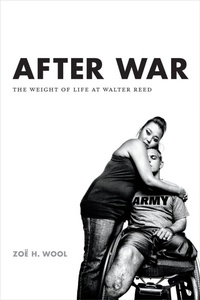
After War
The Weight of Life at Walter Reed
Published on 27. November 2015
Book
Hardback
264 pages
978-0-8223-5971-5 (ISBN)
Description
In After War ZoE H. Wool explores how the American soldiers most severely injured in the Iraq and Afghanistan wars struggle to build some kind of ordinary life while recovering at Walter Reed Army Medical Center from grievous injuries like lost limbs and traumatic brain injury. Between 2007 and 2008, Wool spent time with many of these mostly male soldiers and their families and loved ones in an effort to understand what it's like to be blown up and then pulled toward an ideal and ordinary civilian life in a place where the possibilities of such a life are called into question. Contextualizing these soldiers within a broader political and moral framework, Wool considers the soldier body as a historically, politically, and morally laden national icon of normative masculinity. She shows how injury, disability, and the reality of soldiers' experiences and lives unsettle this icon and disrupt the all-too-common narrative of the heroic wounded veteran as the embodiment of patriotic self-sacrifice. For these soldiers, the uncanny ordinariness of seemingly extraordinary everyday circumstances and practices at Walter Reed create a reality that will never be normal.
Reviews / Votes
"For anyone looking for an intimate depiction of military trauma or scholars looking for a strong example of how the rising generation of anthropologists are writing about violence, After War is a must read." - Christopher Webb (Somatosphere) "After War demands that we reckon with the ways violence lives on in even the most civilian and intimate of spaces. ... After War focuses narrowly on veterans, but in asking how we make the world inhabitable after world-altering violence, it points to the limits of medicalized understandings of trauma. If only some ways of being 'count' as posttraumatic, we miss the ways in which posttraumatic movement is a sensible reaction to violence." - Emma Shaw Crane (Public Books) "...provocative and instructive. . . . Wool's writing is relentless, and she has an evocative way of explicating contradiction such that vivid and unexpected intimacies snap into place. . . . In After War, Wool succeeds in significantly reworking notions of suffering as they are rendered in ethnographic accounts." - Lauren Cubellis (Savage Minds) "ZoE Wool's After War offers an ethnographically rich, theoretically nuanced, and compulsively readable analysis of the experiences of injured soldiers at one of the nation's most iconic medical centers.... After War is an important addition to current anthropological studies of the body, health, disability, mental illness, conflict, and trauma, and would be an excellent addition for courses at the graduate or undergraduate level. It will also be of interest to scholars of contemporary military history, American Studies, and Disability Studies." - Elizabeth Lewis (Medical Anthropology Quarterly) "What sets this book apart are the detailed and interesting stories of wounded soldiers and their families attempting to return to the ordinary." - R. I. Hooper (Choice) "After War is indispensable to the anthropological literature on the United States military and the country's post-9/11 wars. . . . [A] compelling model for any scholar thinking about the politics and poetics of ethnographic representation of people whose bodies and identities are overdetermined in one way or another."- Anna Zogas (Medicine Anthropology Theory) "This is an ethnography enriched by the kind of experiential detail only available from immersion. Wool captures the serendipitous moments-the arguments and indiscretions, the rants, confusion, frustration, and ever-present boredom-that are lost with quicker methodologies.... After War is not...an antiwar ethnography but a necessarily limited truth of war narrative that I highly recommend." - Steven Gardiner (American Anthropologist) "[U]nlike earlier ethnographic studies, which focus on the 'symbolic, social, and institutional politics' of war injury, After War offers a uniquely intimate look at soldiers' embodied experiences and ordinary lives (4). For this reason alone, the book is a must-read for any serious scholar of disabled vets. . . . After War is an important contribution to the growing literature on the embodied legacies of war injury." - John Matthew Kinder (Disability Studies Quarterly) "ZoE Wool's ethnography of severely injured American soldiers recuperating at Walter Reed Army Medical Hospital is, in a word, amazing." - Pamela Moss (Journal of the Royal Anthropological Institute)
More details
Series
Language
English
Place of publication
North Carolina
United States
Target group
Professional and scholarly
Product notice
Cloth over boards
Illustrations
17 illustrations
Dimensions
Height: 236 mm
Width: 157 mm
Thickness: 20 mm
Weight
499 gr
ISBN-13
978-0-8223-5971-5 (9780822359715)
Copyright in bibliographic data and cover images is held by Nielsen Book Services Limited or by the publishers or by their respective licensors: all rights reserved.
Schweitzer Classification
Other editions
Additional editions
E-Book
11/2015
1st Edition
De Gruyter
€198.99
Available for download
Person
ZoE H. Wool is Assistant Professor of Anthropology at Rice University.
Content
List of Abbreviations vii
Preface xiii
Acknowledgments xvii
Introduction 1
1. The Extra/ordinary Atmosphere of Walter Reed 25
2. A Present History of Fragments 63
3. The Economy of Patriotism 97
4. On Movement 131
5. Intimate Attachments and the Securing of Life 157
Conclusion 189
Notes 195
References 217
Index 233
Preface xiii
Acknowledgments xvii
Introduction 1
1. The Extra/ordinary Atmosphere of Walter Reed 25
2. A Present History of Fragments 63
3. The Economy of Patriotism 97
4. On Movement 131
5. Intimate Attachments and the Securing of Life 157
Conclusion 189
Notes 195
References 217
Index 233